Saturday, October 9, 2010

#Readathon: Shel's Third Update

Coffee:  2 cups drunk!

Books Finished: Monkey and Me by Emily Gravett (picturebook), The Cow Loves Cookies by Karma Wilson (picturebook), The Village Garage by G. Brian Karas (picturebook) The Trucker by Barbara Samuels (picturebook, and my favorite among the ones I've read so far today.  And even though it has a cat in it, my cat still wandered away as I attempted to read it aloud for him.) and Anything But Typical by Nora Raleigh Baskin (I loved the ending!).

Book I'm Currently Reading:  The Twilight Prisoner by Katherine Marsh.  (It's for school.  Boo!  And I probably won't finish it today.)

Snacks Consumed Since Last Update:  Strawberries and pancakes!  (Mmm, sugar!  Should we start the countdown for when I crash?)

#Readathon Challenge Response: Show Me the Books

As you can see, I have a lot of work ahead of me:

#Readathon: Shel's Second Update

So far so good:

Coffee:  One cup drunk.  (Plus more poured!)

Books Read:  Monkey and Me by Emily Gravett (picturebook), The Cow Loves Cookies by Karma Wilson (picturebook) and The Village Garage by G. Brian Karas (picturebook).


Book Currently Reading:  Anything But Typical by Nora Raleigh Baskin (50 pages to go!)


Snacks Consumed Since Last Update:  None!  I'm becoming a hungry bear.  (And after reading The Cow Loves Cookies, I want COOKIES!  That would clearly be the breakfast of readathon champions.)

#Readathon Challenge Response: Six Word Celebration Challenge


Sleepless Book Peeps United in Sleepiness!

#Readathon: Shel's First Update: Where I'm Reading From

Good morning, fellow Readathoners!

I woke up this morning refreshed and ready to read!  (Plus, the coffee is brewing.  That'll keep me excited!)

It's dangerous, but I think I am going to start out the morning reading in bed.  Mostly because one of my cats is sleeping on my foot.  If I move she may scratch.  And I'm not opposed to warm feet.

So, before I dare to move to actually pour the coffee, here are my answers to the meme-challenge on the readathon website:

1.  My To Be Read pile technically consists of hundreds of books stacked around my bedroom in out of the way places.  But I really want to finish reading Anything But Typical by Nora Raleigh Baskin and Black Hole Sun by David Macinnis Gill.  After those are done?  Who knows.


2.  I don't have any specific goals aside from having some devoted reading time.  (Which is a huge deal for me!  My past several weeks have been dominated by various projects, so I haven't gotten much reading done.)

3.  This is my third-ish(?) readathon.  The first time I ignored some advice to start out reading some short books or picturebooks to begin on a high "look at me finish books!  YAY!" note, and that readathon draaaaaagged.  The second time, I made sure to include some short books, and that readathon went much more smoothly.  So take breaks from longer books with wee-little-baby short ones!  That is all the wisdom I have.

Thursday, October 7, 2010

REVIEW: Tiny Tyrant (Volume Two: The lucky winner)

Trondheim, L. & Parme, F.  Tiny Tyrant:  The Lucky Winner.  New York:  First Second.

62 pages.


Appetizer:  Oh, Tiny Tyrant.  I love you.  You entertain me greatly, King Ethelbert.  But having said that, I am so thankful you are a character in a graphic novel series and that I will never have to parent you or babysit for you.  Ever!

(Side note--Have I ever mentioned that I once had a child I babysat for pull a knife on me.  True story.  I'm no naive newby myself.)

This wee-little king could crush a person's soul, be a bit of a handful and drive people who survived torture without a single tear to weep uncontrollably.

For those of you who didn't see my last post about this graphic novel import, Tiny Tyrant is a collection of ten-page comics about the antics of a tiny little despot in an imaginary country.

In this volume, King Ethelbert is visited by a princess with an annoyingly large vocabulary and needs an interpreter to tell him what she is saying.  In the next story, he is jealous of a game show winner who is going to India and decides to go on the trip instead.  But the king, who is used to opulence, is less than excited about the hotel amenities when he arrives.  The king also has to track down some pirates who are selling his image throughout the country and abroad, battle his cousin for their great aunt's inheritance, "rightsize" the world so that the world fits him and find the right biographer to write about his life (and create enough excitement for the biographer to write about).

While I have to admit, I laughed out loud less often with this volume than with the first one, I did really like the second to last story, "Rightsizing," in which a scientist finds a way to shrink objects and people to be to the size that King Ethelbert thinks is appropriate.  I thought it really dealt with one of the key tensions of childhood and having to navigate the adult world.  (But unlike other kiddies, King Ethelbert has the power to change the usual adult-favoring power dynamics in his country.)

As, with the first Tiny Tyrant book, I'd recommend this book to third or fourth graders and up.  These books are an age appropriateness nightmare, since the protagonist is six, but include some vocabulary words that adults will have trouble with.

But, since the order that the reader looks at the panels is pretty straight forward, the books can also ease in readers who are still getting used to reading graphic novels.  Some of the vocabulary will still be very advanced, but I remember reading a lot of comics myself and just ignoring the big words.  (Of course, kids who were less lazy and smarter than me, probably looked them up in the dictionary.  Good for those kids.)

I actually just used the first volume of Tiny Tyrant with some of my undergraduate students.  They enjoyed it.  Mostly they seemed confused about what age of student seemed appropriate.  It was kinda cool that such a very practical teacher question was the first to come to their minds.  Makes me a proud teacher.

Also,  I hope they actually start making some of these political-angst-reducing King Ethelbert merchandise:


I would totally by the archery target.


Dinner Conversation:


Tasty Rating:  !!!


On a completely unrelated note.  Tomorrow is the fall readathon.  I've been going a wee-bit crazy with all of the different projects I'm supposed to be working on (thus the general decrease in the number of posts), so I am VERY excited to have a whole day to devote to reading.  I wanted to warn you few but dear readers, because it means that I'll probably be posting every couple of hours tomorrow.  I'll also be hosting a mini-challenge for the participants starting at 11 PM.  So be sure to check back then.


Monday, October 4, 2010

REVIEW: The Birthday Ball

Lowry, L.  (2010).  The Birthday Ball.  New York:  Houghton Mifflin Books for Children.

186 pages.

I first heard about this book through some positive reviews from some teachers that I knew.  But the thing was, all the teachers would say was, "The Birthday Ball is fun!" or "The Birthday Ball is cute!"  And that's it.  All of them.  Only those words.  They wouldn't even describe the plot of the book.  Just say that it was cute.

I started to think it was some kind of conspiracy.  Why wouldn't anyone say more?

Having entertained ideas of being an investigative journalist for about three weeks when I was in high school, and then again for another two weeks while in college, I decided the job fell to me to try to understand the silence surrounding the cult of The Birthday Ball.

While I do agree that The Birthday Ball is fun AND cute, I will say more!


Appetizer:  As Princess Patricia Priscilla's sixteenth birthday approaches the castle is preparing for her birthday ball and when she will meet suiters.  The princess isn't nearly as excited about her birthday.  She is bored.  But with the help of a chambermaid, she soon finds a cure for her boredom:  disguising herself as a peasant girl and attending school under the eye of a handsome young teacher.

As her birthday ball approaches, the princesses suitors prepare themselves and gifts for their potential wife.  The Princess is going to have a veeeeeeery difficult decision over who to marry (not that she really wants to get married at all.  Here are her choices:


Who would you choose?
Duke Desmond
Prince Percival
Count Colin AND Count Cuthbert
How about that young, handsome--but stern-looking--schoolmaster in the corner?
Frak them all. Run away!


This book has a vague Shakespearian Twelfth Night feel.  It's kind of a comedy of misuderstandings, with separated siblings, assumptions about people being of noble birth and secret identities.

As I was reading, I was reminded of one of Lowry's other books, The Willoughbys.  Both are kind of set in a time outside our own (but still with references to some modern things).  Both make references to classic children's books and emphasize some excellent vocabulary words.  Also in both books, Lowry did the illustrations herself.

There's a lot to love about this book:  The fact that the princess gets so much joy out of attending school and the fact that those characters who are literate are very excited about their skill.  I like that the story plays with class and that the princess comes to appreciate the peasants.

I think this book would be a great read aloud to do with a young girl.  The humor and alliteration would go over well.  Plus, since the book has a very modern sensibility, this is one princess I wouldn't mind early elementary school girls parading around, pretending to be (she feels driven to help others and learn, but isn't focused on having a prince in her life).  But having said that, this book does put a lot of emphasis on appearances.  While it is done for humor and some of the negatively characterized suitors do find acceptance, the beautiful people do end up with other beautiful people.  Of course.

So, overall, it would seem the cult of the Birthday Ball are right:  "A cute and fun book."


Dinner Conversation:

"When Princess Patricia Priscilla woke on the morning of the day that was five days before her birthday, her first thoughts were not Oh, I am almost another year older, hardly a child anymore! or I wonder what fabulous gifts will be presented to me at the Birthday Ball six nights from now! 
No.  Her thoughts were Bored, bored, bored." (p. 1).

"Below in the village, the new young schoolmaster was preparing his classroom.  He set the little desks in straight rows, looked at the alignment, thought, then shook his head and moved the desks again until they formed a semicircle facing his own larger desk.  He decided that he liked it better that way.
His name was Rafe" (p. 10).

"I'm a poor peasant girl only recently come to live in the village because my mother was killed by a wild boar and my pa has to take in washing."
The princess stood nervously in the doorway of the schoolhouse.  She looked down at her own dirty bare toes, then, because of the silence, back up at the face of the schoolmaster.  His mouth was set in a line and his forehead was furrowed.  He looked very stern, just as Tess, the chambermaid, had described.
The children, each one seated at a small desk, giggled.
I said it wrong, she thought.  "I mean my pa was killed, that's what, and it's my mother that has to take in washing.  I mean my ma."
"And you would like to become a pupil?"
"Yes" (pp. 45, 47).

"My first day as a peasant was the loveliest day I've ever had.  I was not bored for a minute" (p. 55).


Tasty Rating:  !!!

Thursday, September 30, 2010

REVIEW: The Night Tourist

The Night TouristMarsh, K.  (2007).  The Night Tourist.  New York:  Hyperion Books for Children.

232 pages.


Appetizer: While walking on the Yale campus, Jack Perdu was hit by a car.  While his injuries weren't too serious, he can now see the ghosts that haunt the world at night.  When his dad sends him to New York City to see a doctor friend, Jack is led by a strange girl deeper and deeper down into Grand Central Station and into the land of the dead.

After receiving this unexpected opportunity, Jack seeks out his dead mom, who his father refused to speak about.  But Jack's situation grows complicated when he grows attached to his New York City ghost guide, Euri, and learns that he can only stay in the realm of the dead for three nights and that the three headed dog, Cerberus hunts him.

I actually had a lot of trouble getting into this book.  A LOT.  Jack was just a bit too smart for my tastes.  He doesn't come across that way in the narration, exactly.  But as I was reading, I imagined what I would think of him if I sat down next to this guy in a class or at a train station:

JACK:  I'm helping a Yale professor translate Ovid's Metamorphoses from Latin.
JACK:  Because I understand Latin.
JACK:  And I'm a high school freshman.
SHEL:  ....
JACK:  And I can randomly quote from other works of poetry and literature, classic and modern.
SHEL:  ....
JACK:  Would you like to hear a quote now?
SHEL:  ....
JACK:  My jacket is tweedy.  Would you like to touch it?
SHEL STANDS AND MOVES TO ANOTHER SEAT AS FAR AWAY FROM THIS JACKASS AS POSSIBLE.

Basically, I'd find Jack annoying while also being secretly jealous that he was so much smarter than me.  The jackass!

My other problem was that he was clearly going through some very tense and emotional situations, but I didn't feel any real emotion coming from him until the veeeeeeeeery ending.


Following along this line, I also had some trouble with the plot.  I wanted to feel a sense of urgency.  I wanted to care.  Really I did.  Knowing Jack can only stay in the ghosty New York City for three nights should have instantly caused tensions.  But the fact that Euri and Jack spend most of their nights touring the city, sledding and attending plays (granted, the play attending is meant to lead them to some people who could help them or to provide some intertextuality), I felt almost no urgency.  That left me feeling "meh" about the whole book.

Perhaps it's me.  I do know of a middle grade teacher who strongly recommended this book.  In comparison to the Percy Jackson series, which is also incorporates Greek mythology, this book emphasizes characters' emotions rather than a fast-paced plot, which will appeal to a more YA audience.  Maybe.  Plus, it is worth noting that this book really focuses on death, letting go and suicide.

The Twilight PrisonerPerhaps I'm just grouchy.  I read this book as part of my research for Dudley the Dissertation.  (And because of that, I will also be going on to read the sequel, The Twilight Prisoner.)  Right now, Dudley and I are fighting, so I could be taking that out on The Night Tourist.

Could be.  But not likely.


Dinner Conversation:


"It was just after dusk when the accident happened.  As usual, Jack Perdu was walking through the Yale University campus with his nose buried in Ovid's Metamorphoses.  Although he was only in the ninth grade, he had an after-school job helping the head of the university's Classics department on her new English translation.  It was the day after Christmas so there were no professors around, which meant there was no reason for Jack to look up out of his book" (p. 3).

"The next thing he knew, there was a loud, heavy metal music, and he was knocked off his feet and into the air.
Jack barely had time to register what had happened.  He caught a glimpse of the car that hit him, heard panicked shouts, and closed his eyes as his body hit the ground.  A loud rushing sound filled his ears.  Then he blacked out" (p. 6).

"Jack thought about his accident, how it had led him to New York, and to Euri.  Maybe following her to track 61 hadn't been a mistake.  Maybe it was meant to happen, so he could find his mother.  For the first time in years he allowed himself to imagine seeing her again, and his chest tightened.  He took a deep breath.  "Do you think I could find her?" (p. 51).


Tasty Rating:  !!

Tuesday, September 28, 2010

REVIEW: One Crazy Summer

Williams-Garcia, R.  (2010).  One Crazy Summer.  New York:  Amistad.

215 pages.


Appetizer:  During the summer of 1968, eleven-year-old Delphine and her two little sisters are on their way to Oakland to spend a month with their mother who left them and their father almost six years ago.

The woman that meets Delphine, Vonetta and Fern at the airport is a bit strange, keeping her face hidden.  Her house is also a bit unusual and their mother, Cecile, won't let the girls go in the kitchen.  It doesn't take long for Delphine to realize that their mother is crazy.  But soon after that, they realize that there may be a reason behind some of Cecile's strange behavior:  she may be involved with the Black Panthers.

This book (currently being talked about as a potential winner for both the Coretta Scott King and Newbery awards) has a lot of social studies tie-ins.  Rather than list them in a boring way, I thought I'd make a word cloud:


It was also easy to relate to Delphine emotionally.  She's responsible for her sisters and takes her job very seriously.  I also felt so awful for these girls after they arrived in Oakland.  Hungry after a long flight, their mother refuses to feed them unless they give her all of the money their father had given them.

It gave me the nervy-creepers.

And I realized that if this woman, if Cecile, were my mother.  I would have died a slow painful death to starvation.

I would not have been able to trust that woman, but I also would not have been able to fend for myself.  Not when I was eleven.  Not now.  During my last visit to my parents house I finally and really-truly, for reals realized that I will forever be a child in my parents house.

This does not mean that they treat me like a child.  They, in fact, do not.

Shel:  Can I go over to Holly's?
The Mother:  I don't care.

Shel:  Is it okay if I go over to Holly's?
The Father:  You don't have to ask permission.
Shel:  So, it's okay if I go?
The Father:  You're not a prisoner.
Shel:  So then I can steal your car?

The childlike behavior is all on me.

When I'm in Columbus, living alone, I am a somewhat-mature adult.  I clean (usually a randomly selected portion of a room) once-ish a month (twice if I'm really mature that month).  I clean my cats' litters every night.  I shop for groceries and cook--even some "fancy" stuff like roasted asparagus.

At my parents house, none of this happens.  

The mother and I engage in passive aggressive battles of who will cave and finally load the dishes in the sink into the dishwasher.  (I always win, since I'm the one who doesn't mind the mess)  I wait for the cat litters to actually become smelly-gross before carrying the entire tray outside and dumping it behind the shed. 


And, worst of all, the source of quite a bit of suffering on my part, I will not eat unless a parent is there to serve me food.  I'm like a baby bird, beak open, chirping for Mommy to return to the nest with a worm.  And if the mommy bird doesn't make it home, the baby DIES.

Somewhere within the several hundred miles between my home and my parents', I lose all ability to forage for myself.

I suffer from head aches, listlessness and drowsiness waiting for my parents to arrive home, god willing with Chinese take-out in hand.

I suppose I could cook.  But a bit of fear sets in at the mere thought.  Since I didn't do the shopping, I don't know that the house is stocked with the foods I prefer.  Plus, my parents remodeled the kitchen after I already left for college.  I don't know where any of those pots and pans thingies are kept.  And The Mother will yel--speak with great authority and conviction if she feels I have misplaced one of her colanders.

Also, since I only figured out how to boil water a couple of years ago, when I do cook, there's always some suspense to it, as far as The Parents are concerned.  Will the baby burn down the kitchen?  Will the baby's meal be edible?  Will the baby spray too much Pam on the baking sheet?  Will the baby drop the oven mit in the marinara sauce again?  None of these questions are actually asked out loud.

My parents do not arrange to bring me dinner.  They long ago got their own lives and play an evening round of golf.  I just expect them to provide food for me.

Now, I'm not saying I'm the weakest little beastie, drawn toward extinction due to my bad genes.  I still find a way to survive.  Mostly, I eat from a giant bag of carrots on one of the refrigerator's drawers:


Notice how the bag is torn open, with bunny-like little claws and how I have never bothered to tie the back closed to prevent the carrots from becoming scaly white.  That would be too mature.

It's far more child-like to nibble on a few disgusting carrots and then call The Father to ask when he'll be home.

Baby carrots, my Few But Dear Readers, that is how I am still alive after six weeks of starving in my parents' house.

Frankly, I'm surprised I didn't turn orange from eating too many carrots before I returned to Ohio.

Mentioning skin color (turning orange!), one of the subplots of the book involves Fern carrying around her beloved doll, Miss Patty Cake.  This causes some trouble for her and her sisters since the doll is white.  Delphine narrates:

"No one could call Fern White Baby Lover even though Miss Patty Cake was a white baby and Fern loved her.  No one could call Fern a Big Baby but Vonetta and me...But I didn't care.  Fern could love Miss Patty Cake all she wanted.  We could call ourselves Vanilla Wafers, Chocolate Chips, or Oreo Cookies for all I cared about black girls and colored girls" (p.67).

I thought this element of the text (as well as some others) would be a great way to begin discussing how race is perceived in this country.  I'd probably pair this portion of the book with this video of a recreation of Clark's Doll study:


So, I have to admit, while there are a lot of awesome uses for this book in a classroom and while Delphine is a relatable and well-constructed character who shares about an important aspect of history well, nothing about this story drove me I-can't-put-this-down-I-love-this-book-crazy.  I read it to get through it.  And I think my childhood-self would have approached the book in the same way.

I think it drove me a little crazy to see exactly how responsible Delphine was for caring for her sisters.  As I was reading, I'd think "What about Delphine?!  Nobody puts Delphine in a corner!" and the like.  The girl was a nanny machine.  I suppose my difficulty connecting with her could be the fact that I'm an only child or the fact that in the presence of my mom I revert to being a baby (metaphorically speaking, of course).  So, despite Delphine's struggles over what to believe and the fact that her superhero ability to care for her siblings was addressed, she just felt like a too perfect character who never really got a chance to breathe.  Ever.

But that's just me.  My personal reaction certainly won't stop me from recommending this book to...oh, everyone.


Dinner Conversation:


"Good thing the plane had seat belts and we'd been strapped in tight before takeoff.  Without them, that last jolt would have been enough to throw Vonetta into orbit and Fern across the aisle.  Still, I anchored myself and my sisters best as I could to brace us for whatever came next" (p. 1).

"Mother is a statement of fact.  Cecile Johnson gave birth to us.  We came out of Cecile Johnson.  In the animal kingdom that makes her our mother.  Every mammal on the planet has a mother, dead or alive.  Ran off or stayed put.  Cecile Johnson--mammal birth giver, alive, an abandoner--is our mother.  A statement of fact.
Even in the song we sing when we miss having a mother--and not her but a mother, period--we sing about a mother.  "Mother's gotta go now, la-la-la-la-la..."  Never Mommy, Mom, Mama, or Ma.
Mommy gets up to give you a glass of water in the middle of the night.  Mom invites your friends inside when it's raining.  Mama burns your ears with the hot comb to make your hair look pretty for class picture day.  Ma is sore and worn out from wringing your wet clothes and hanging them to dry; Ma needs peace and quiet at the end of the day.
We don't have one of those.  We have a statement of fact" (p. 14).

"I was sure they were Black Panthers.  They were on the news a lot lately.  The Panthers on TV said they were in communities to protect poor black people from the powerful; to provide things like food, clothing and medical help; and to fight racism.  Even so, most people were afraid of Black Panthers because they carried rifles and shouted "Black Power."  From what I could see, these three didn't have rifles, and Cecile didn't seem afraid" (p. 45).


Tasty Rating:  !!!

Friday, September 24, 2010

REVIEW: Getting Revenge on Lauren Wood

Cook, E.  (2010).  Getting Revenge on Lauren Wood.  New York:  Simon Pulse.

261 pages.


Appetizer:  Helen and Lauren were best friends.  That is until the end of eighth grade, when Lauren betrayed Helen to launch her own plan to become the most popular girl in their grade.  Left behind and bullied by the entire eighth grade class, Helen is lucky when her family has to move to New York for her ninth grade year.

But not a day goes by that Helen doesn't think about their lost friendship and Lauren's betrayal.  So, when Helen learns that she may have to move back to Terrace, Michigan to live with her grandmother for her senior year, she concocts a plan to finally get the revenge she has been craving.

Helen (who'd lost some weight and had suffered through a broken nose, both altering her appearance) returns to Michigan and begins going by the name Claire, working to become popular so she can better destroy Lauren's perfect life.

The premise has the potential to be a little confusing unless you're reading the book, so here's the book trailer.  I find the music and sound effects strangely hypnotizing:


Like if I ever go to a dance club again, this is the music I want to hear.  And whenever I hear one of the sound effects, I will pause my awkward dancing in some strange new position:

"Wow!"


"What? Umm, I don't know."


"Meeeow."


Also, it's been brought to my attention, that if you just can't get enough of that mean manipulative Lauren Wood, you can now get popularity tips from her on YouTube:


I will obviously be following her advice.

But enough youtube fun for now.

As I was reading Getting Revenge on Lauren Wood, I was strongly reminded of the movie Mean Girls.  The premise is very similar, with an outsider coming in, gaining popularity to destroy a mean girl, using people and potentially losing sight of who they are and why they did what they did.  Blah.  Blah.  Blah.

I'd even say the execution of Mean Girls is better, mostly because of my main problem with Getting Revenge on Lauren Wood:  Helen/Claire's characterization.

So, even after Helen/Claire leaves the state, she can't let go of what Lauren did to her.  She remains an outsider at her new New York school and stalks Lauren through Facebook.  Then, when she moves back to Michigan, with only a bit of research and after spending hours thinking about what makes a person popular and making a popularity scale, she is suddenly an expert on popularity, clothes, designers, hairstyles, etc.  She returns and is suddenly the queen of manipulation, with only the occasional pang of guilt.


But, no.  No, no, no, no.  Her parents couldn't be scientists.  Because that's part of the premise of Mean Girls (zoologists).

Damn, I'm gonna go watch Mean Girls.

(I watched it a record four times while reading through this book)


I had a lot of trouble with Helen/Claire's sudden and complete understandings of the high school and fashion worlds.  I needed a reason to believe that Helen/Claire could somehow gain all this knowledge into how to analyze groups of people and their behavior.  I found myself wishing her parents were anthropologists instead of hippies.  Then I could suspend my disbelief.


Plus, when Helen/Claire's character evolves, I didn't quite understand what was triggering those changes either.  


I also had trouble with this book because of how stalkery Helen/Claire is.  It doesn't end with facebook.  Once she's back in town, Helen/Claire's antics involve sabotaging Lauren's possessions and breaking into her house.

Stalker!  STALKER!  STALKER!


I hadn't planned to have to drag out my stalker scale so often.  But I'm quickly learning the difficult lesson that stalkers are EVERYWHERE in YA literature.

Because of the stalker elements and my trouble believing Helen/Claire's characterization, I was left feeling that Getting Revenge on Lauren Wood was pretty so-so.  Having said that though, I can see how the book provides some happy escapism for teen girls who weren't popular or who were bullied.

Also, Eileen Cook and I have something in common:  We both graduated from Michigan State.

Go green!  Go white!  Or whatever.

I wasn't there because I was a sports fan.  (Although taking pictures of the riots after games was a surprising good time.  And now I can say, "Yes, yes, I have been tear gassed."  Thank you, MSU!)


Dinner Conversation:


"Last night I dreamed I dissected Lauren Wood in Earth Sciences class.  She was wearing her blue and white cheerleader outfit, the pleated skirt fanned out and the sweater cut right down the middle.  She lay there, unmoving, staring straight up at the ceiling tiles.  She was annoyed.  I could tell from the way her jaw thrust forward and her lips pressed together in a thin line.  I opened up her chest, peeling her ribs back like a half-opened Christmas present, and the entire class leaned in to get a good look.
"As I suspected," I declared, "no heart." (p. 1).

"Before the incident there hadn't been a single moment of my life without Lauren in it.  We were born in the same hospital, her the day before me.  They placed us side by side in the nursery, our first sleepover. Helen Worthington right next to Lauren Wood.  Even alphabetically, Lauren came before me.  Lauren was in every one of my birthday photos--from age one, when she has her fist buried in my cake, to fourteen when we are both posing supermodel style for the camera, Lauren's outstretched arm covering part of my face.  Looking back, I can see how she always had to be front and center" (p. 2).

"I want to be invited out.  We were always second string, but now I have a chance to make the A-list."
"And that matters so much?"
"Of course it matters."  Lauren tossed her hands in the air and paced back and forth.  "My mom tells me that the friends you have in high school determine who your friends are in college, and then who your friends are for the rest of your life."
"Well, my mom says you can't buy friendship," I countered" (p 20).

"Nothing is forever, you know.  Once I'm popular, we can be friends again and then you'll be popular too.  It will all be worth it."
"What makes you think I'll want to be your friend?"
"What makes you think you'll have other options?" (p. 20).

"...Maybe the universe wants you to come back here to teach her a lesson.  Lord knows the girl could use it.  You know I'm crazy about your mom and dad, but I'm thinking karma could use a helping hand."
I didn't say anything.  I just thought about what [grandma'd] said.  That was the first time it occurred to me that instead of just thinking about revenge, dreaming about it, I could actually make it happen.  Lauren would never see it coming.  She would never expect it" (p. 35).


Tasty Rating:  !!!

Tuesday, September 21, 2010

Literary Feast Discussion: I Am Number Four (Chapters 29-END)

I am so sorry this is late, Few But Dear Readers.  I know you were all waiting with bated breath to hear our opinions about the ending of I Am Number Four.  You probably passed out a couple of days ago while waiting.  But at least you've regained consciousness and have been discharged from the hospital by now.  


Would you believe that Monica and I just didn't want this literary feast to end?


No, you're clearly too smart of that.


Here are our final thoughts on the book.  Be warned, there are spoilers below.  And we'd love to hear your thoughts in the comments.

CHAPTER 29-THE END!

Shel: Okay, I'm not ashamed to admit that I'm totally half-assing it right now and am only skimming this book. But it's the bad kind of skimming. The kind when I'm mostly thinking about what I want to eat, and how I'll make an avocado cheese sandwich with mustard and Miracle Whip and how I hope we have the fancy deli bread because the Wonderbread kind means the sandwich will be too big, but I'll still feel obligated to eat it and maybe I should just eat a handful of baby carrots instead, when SUDDENLY I zoom in on a random sentence from the book to check what has been happening and "...Six seems to know what the rock is for. She takes her shirt off" (p. 361). What the hell?
Turns out Six was not actually getting naked. She was wearing a "rubber suit" underneath her shirt. But still, why do girls always have to take their shirts off during action scenes? It's like some gender...some non-girl gender seems to think we think better without wearing shirts.

Monica: Let's be fair, Captain Kirk always managed to get his shirt ripped off during the dramatic alien fight scenes... Plus, honestly, it's nice that Six is at least kicking some butt. The girls in this book have left something to be desired in terms of Action and Excitement ("Help, I'm trapped in a burning building with dogs!") so at least at the end the womenfolk get to see some fighting.

Shel: This is true.  I love it when the girls kick ass...but then, I forgot about my planned avocado cheese sandwich and I had to google images for "rubber suit," to see what popped up on the internets (while secretly hoping their might be a cartoon image of a giant condom so I could complain about how sick the internets is.
Alas, no condoms. Apparently I'm the only sick one. Aside from the images of Batman and Robin that popped up, this rubber suit did amuse me:


Monica: Focus, Shel, focus! I know you hate this book, but we must sort of review it! Our honor demands it! (Plus, I'm freaked out by the picture of our author, Pittacus Lore, doing his shady reflection thing on the back flap. I don't want him to come after us if we don't wrap up the Feast.)

Shel:  One more thing!  (This photo actually had the subheading "Never ever fart in a rubber suit" on MySpace. Good advice, I suppose. I hope Six knows that).

Monica: Sigh.

Shel: Throughout this 79-page action sequence, John has to flash his light hands on and off A LOT! I'm surprised nobody suffered from an epileptic fit with all the flashes.  (Notice that WHOLE comment was about the book!  I am a focus machine!)

Monica: ::: LAUGHS ::: It's the problem with having limited superhero powers. You have to use what you got, but it's not all that impressive. I imagine in the movie it will be very dramatic, and each flash will perhaps be accompanied by a loud whooshing noise. Children will be able to buy Number Four Flash Gloves at their local Toys R Us....

Shel: I keep zoning back into this book at the worst moments to misinterpret the text: "Something warm collects at the waistband of my pants" (p. 388). Turns out John had been stabbed. But since I'd interpreted the sentence very differently, I couldn't bring myself to care. Is my mind really that sick?

Monica: Yes. On the other hand, I can't blame you for skimming and zoning. Could this book be any longer? I feel like it's sneaking in extra chapters when my back is turned.

Shel: I can't believe it took 405-ish pages for John to figure out what exactly was going on with his badly named, but beloved dog. Dear John, next time just ask the read. We had it figured out over 300 pages ago.

Monica: He was busy, though! Um... learning how to make his hands flash! And making out with strawberry-chapstick girls!

Shel: Ummm, how exactly can Sam go on the adventure into book two with John and Six. Did I skim over some random explanation of what had happened about his mean mom?

Monica: I couldn't find an explanation either, and I actually went back and looked after you mentioned it. I can only assume that his mother snarked something in French out to him (Seriously, a rude French person? This is the best stereotype we could come up with?) and he took that as tacit permission to run off and seek his fortune.

Shel: P.S. I can't believe Henri is gone. He was the one character who amused me, if solely because Timothy Olyphant is playing him in the movie. You guys all saw my pretty interpretation of how wardrobe will be dressing him, right?


Monica: Don't worry, Shel! Maybe he'll come back in the next book! The next book that we're definitely going to read, right? RIGHT!?

...

No.

Thus endeth this literary feast.  It looks like Monica and I found a book that we would both rather spit out than after gnaw on ever again.


But hey, we're just two people.  We'd love to hear what you thought of I Am Number Four in the comments.


We'll be back with another literary feast...soon-ish.  We might have to wait for the bad taste of this book to leave our mouths first.

Monday, September 20, 2010

REVIEW: Swim the Fly

Calame, D.  (2009).  Swim the Fly.  Somerville, MA:  Candlewick Press.

345 pages.

Despite the fact that I bought this book almost a year ago and it took me until now to finally read it, Swim the Fly has a special place in my heart.  My Few But Dear Readers, I used to swim the fly:


Okay, so that photo actually isn't of me.  Mostly because I was waaay too lazy to go through my parents many drawers of photos (The Father has always considered himself to be a bit of a photographer) and scan in a real photo of myself.  It was much easier to do a google image search for "swim butterfly."

For those of you who cannot properly interpret my-lack-of-art-skills, the above image is a recreation of the time I swam the 100 Fly at Nationals, right after I'd eaten my way through the great white shark that had accidentally been released into the pool through a faulty drainage system.  I won the gold that year.  Mostly because none of the other swimmers were willing to swim through the shark blood and bits that my awesome kicks sent flying all over the Olympic-sized pool.

Make sense now?

Just to reiterate, no, the shark did not eat me.  I am the tough one here.  Not the shark.  The shark is weak.  I am a shark eater (This was a few months before I went vegetarian).  Which brings me to the "Fear Me!" tattoo I've had since I was seven.  The Mother and The Father thought the other second graders (who could already read "big" words) should be warned about my temperament.


Appetizer:  Despite the fact that Matt and his two best friends, Coop and Sean, have been on the summer swim team for years, none of them are really devoted to the sport.  Or to being athletic.  But after the three have promised to see a *real* girl completely naked by the end of the summer and after a new girl, Kelly, who is known for having dated the fastest butterfly swimmer in the division, has joined the team, Matt finds himself volunteering to swim the fly in the hopes of winning Kelly's affection and accomplishing his summer goal.

The problem?  Matt can't even finish one lap of butterfly, let alone compete.  He begins to try different fitness regimens that are both painfully awkward and awkwardly painful (but hilarious for the reader) to get ready for the championship meet at the end of the summer.

To complicate matters, as the three boys make their first attempt at planning to see a particular popular girl naked, they are caught by Sean's sister and her friend.  Now not only do they have their own promise to each other, but they also have to contend with blackmail.

Plus, Matt has to deal with his grandfather's problems along with his own.  Matt's parents are divorced and his Grandpa Arlo lives with him, his mom and brother, Peter.  The grandfather reminded me a lot of Grandma Mazur from the Stephanie Plum series, since he was such a fun and strong personality.  Grandpa Arlo is trying to woo the widow who lives across the street.  And for some reason, Grandpa's plans always seem to involve Matt's help.

This book is freakin' hilarious--laugh out loud multiple time, not just snort or chuckle once FUNNY.  There were so many amusing scenes that stuck with me, I can't even claim one to be my favorite.  (*Slight spoilers for the first-half of the book in the rest of this paragraph*)  Was it the time Grandpa Arlo had Matt roleplay being the widow he wanted to ask out?  Maybe.  Was it the scene when Matt accidentally joined a swimmer survival course and wished for death?  Possibly.  The scene when Matt was dressed in drag and really had to use the bathroom, but wound up running into his crush outside the bathroom stall, and Kelly tried to figure out whether she knew this familiar-looking girl from ballet?  Actually, no.  That scene was so embarrassing for poor Matt I tried to block it out.  And those are just in the first third of the book, so I'm not giving much away.

Swim the Fly is an excellent recommendation as a funny YA boy book.  Calame seems to be one of those super-sadistic authors who excels at making their protagonists suffer in awkward and embarrassing ways.  I mean, all authors have to be mean to their characters, breaking them up with their loves, sending their parents away, not letting them make some team, even orchestrating the occasional murder and causing every other form of suffering the author can imagine.  But Calame tortures Matt.  This, of course, translates to more fun for the readers and more sympathy for Matt.

I really enjoyed how bad, awful, terrible, horrible, no good Matt was at swimming the fly.  This boy would drown if his only way out of a bathtub was to do a couple of strokes of the butterfly.  As someone who suffered through swimming the fly every practice and every meet for about ten years, I like that the book shows respect for those of us who can swim the fly.  But having said that, I also had trouble understanding exactly how awful Matt was.  Why does he not improve?  He is practicing.  Do his arms and legs actually tear from his body when he tries to swim, leaving only his torso and head to slowly sink to the bottom of the pool?  I do not understand.

The friendships among Matt, Coop and Sean are believable.  Although, at moments, they did feel a little immature (but that's probably just my own mature "girl-ness" speaking).  I dated my first boyfriend when we were both fourteen and I like to imagine he'd grown beyond doing some of the weird challenges that this trio torture/amuse one another with.  But I'm guessing The First Ex-Boyfriend had similar ridiculous antics at some point.  He probably just didn't want to tell me about them.  Which was wise.  And I'm not about to call and ask now.  Little awkward.

There's quite a bit of bathroom humor--first there's poop, then there's vomit with fish bits.  And later on there are farts.  Fake farts.  Real farts.  Farts.  Farts.  Farts.  Good icky times.  It kind of reminded me of a somewhat-more-appropriate, PG-13 version of the American Pie movies.  (The original ones.  I don't dare let the straight-to-DVD ones potentially suck out my soul.)  Matt has a way of getting into embarrassing situations that is similar to Jim's tendency to get into sexually awkward horrifying situations in the movie franchise.

As a nerd, it was hard not to read this book in terms of the way gender was presented.  There's a lot of transgressing of those traditional gender line-thingies (usually with the consequence of embarrassment and humor...which it could be argued just reaffirms the traditional norms.  Maybe).  Even Grandpa Arlo notes the blur between modern gender norms when he sees Matt wearing an exfoliating mask:

"It's a mud mask."  I touch the thick hard plaster on my cheeks.  "It's supposed to help your complexion.  I wasn't expecting to see anyone."
"Oh, that's your excuse?  What else are you doing when you aren't expecting to see anyone?  Painting your nails, maybe?  Shaving your legs?
"Mom got it for me."
He frowns.  "There used to be such a clear line between boys and girls.  I don't know what the hell's happening to the world" (p. 217). 
There's also a cross-dressing scene (Sidenote--speaking as a girl who has helped a guy disguise himself as a girl during her teen years, there is nothing quite as much fun.  Yay for putting makeup on guys!).  Most of the girls are described in terms of their physical attributes (and not always the best aspects of their appearances--veins and sideburns are occasionally mentioned).  And while some of the girl characters are sexualized, I never felt that Matt and his friends were complete horn-dogs.  Horny puppies, maybe.

Every now and then their voracious, little, horny puppy drives took over and they learned that they were horny were-puppies who could transform into awkward peeping toms when they thought they had a chance at seeing a real naked girl without her knowledge.  The boys do realize being peeping toms is not ideal....

But they do it anyway, unable to stop their horny were-puppy nature.  (Also, why hasn't anyone written a YA novel including were-puppies?!  They'd be cute!  I want my were-puppies!)

So, on the stalker scale the book must go!


You'll notice that Swim the Fly is waaaaay down there in the "barely creepy" realm of stalkerdom.

It would seem that a sequel to Swim the Fly came out just last week.  Beat the Band follows the exploits of one of Matt's best friends, Coop, as he is paired with a girl on a sex-ed assignment.

And I'm guessing at some point there will be a drum set.  And it will be on fire.  Not metaphorically.  But really on fire.  In a purple room.  Show of hands, who thinks I'm right?

I will, of course, be reading it.  I love drum sets that have been set on fire.  If we're lucky, it'll be before next September (when undoubtably there will be a book released from Sean's perspective  I'm on to you, Don Calame!  Maybe).

*Sigh* I take one book off the giant mountain of books that have to be read, only to add another.  (I suppose I should be thankful, usually the conservation of energy sciency principle isn't quite so fair, since if the mountain of books were ever to topple, it would crush my pour little body and tear me limb from limb one paper cut at a time.  Now there's a fun image.)


Dinner Conversation:


"Movies don't count," Cooper says.  "The internet doesn't count.  Magazines don't count.  A real, live naked girl.  That's the deal.  That's our goal for the summer."
"Been there, done that," Sean says.
"Taking baths with your sister doesn't count, either," Sean."  Cooper snorts" (p. 1).

"Don't you get it?  You have to follow the natural way of things.  It's like that picture in our bio textbook.  First there's the monkey.  Then there's the caveman.  Than there's the human.  It's the same with sex.  First there's Internet porn, then there's seeing your first real naked girl, and finally its the dirty deed.  You do want to have sex someday, don't you, Matt?" (p. 2).

"Without thinking, I look over at Kelly.  She turns and our eyes connect.  She pulls the lollipop from her mouth and smiles.  I smile back.  Her eyes are so clear, so green.  They're the color of the water you see in those travel pictures.  Where the man and woman are snorkeling and they're holding hands, and it's like they're the only two people in the world.
Kelly looks away, like she's shy or something.  Still smiling.  Her neck flushes slightly.
"Come on people," Ms. Luntz says.  "Who is the hero here?  Who is going to challenge themselves?  Who is going to swim the fly?"
And it's like some force outside of me suddenly grabs my right arm and thrusts my hand high into the air, and the words tumble out of my mouth before I know what's going on.
"I'll do it."
The entire team turns and looks at me.  I feel my face get hot.
"Matt Gratton?" Ms. Luntz coughs like she's got a fleck of popcorn stuck in her throat.  "Well.  That's...unexpected.  But I guess...we don't have any other option" (pp. 24-25).

"There's something exciting about taking control of your life.
One breath in, two breaths out.
Setting your mind and then following through.
One breath in, two breaths out.
It makes you feel powerful.  Like you can do anything you want.
On breath in and--
Gack!  Fthew!  Goddamn it!
A bug just flew up my nose.  And it's buzzing like crazy.  I exhale hard and a bee comes shooting out of my left nostril, flying off unsteadily.
I've lost my breathing pattern ow, and the full force of how badly out of shape I am hits me" (p. 49).

"Do you know what the consequences are for trespassing and for impersonating a country club member?"
"No," I say, looking back down, but I have a feeling he's about to tell me.
Ulf stands and smiles.  "You have two choices, Mr. Gratton:  my class.  Or jail.  What will it be?"
I hesitate, because it's a tough choice.  I've never been to jail, but it's hard to imagine it's much worse than this class.  Still, I can't go to prison.  Mom would be pissed.  "Your class, I guess," I say finally" (p. 153).


Tasty Rating:  !!!!
Saturday, September 18, 2010

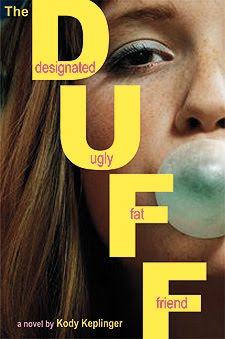
REVIEW: The DUFF (Designated Ugly Fat Friend)

Keplinger, K.  (2010).  The Duff:  Designated Ugly Fat Friend.  New York:  Poppy.

277 pages.


Appetizer:  Seventeen-year-old Bianca was sitting out during all of the dances at the club that her two best friends dragged her to when, Wesley, the hottest and sluttiest guy from school informs her that she is the Duff (AKA the Designated Ugly Fat Friend) out of her trio of best friends.

Bianca vows not to be bothered by Wesley's words, but after she learns that her mother won't be returning home anytime soon, she begins to worry that her father, a recovering alcoholic, might return to his worst habit, she finds herself in need of a distraction.  That distraction comes in the form of using Wesley and by making out with him.  Even though Bianca feels dirty after their encounter, soon enough she is repeatedly sleeping with him in secret.

For Bianca, being a secret is nothing new, the one boy she has ever loved kept her a secret as well.  And now he's coming back into town with his fiancee.  With all the parts of her life that are upsetting her, Bianca may not be able to leave Wesley's bed ever again.

The DUFF is getting a lot of rave reviews around the internets (and also as the occasional blogger acknowledges, some hate from the anal-judgey, pitchfork-wielding crowd on Amazon over the swearing and how far the multiple sex scenes push toward being explicit.  But hey, anal-judges, some teens do have sex (and by "some" I mean most).  For good and for bad reasons.  So, it's nice to see a book that explores some of those motives.  At least throughout the entire book, the characters are having SAFE sex.  There are condoms EVERYWHERE!).

I found the book to be refreshing because it shares an experiences that are only occasionally explored separately and rarely bound together:  Body image, self-esteem, class, name calling, the different ways guys and girls are perceived when they're promiscuous, parents getting divorced and being left with an alcoholic parent.  There's even a brief tangent into discussing arguments in support of gay marriage.  *wipes brow*  It's a lot to take on.

But I absolutely loved Biana as a character.  She felt very real.  I loved how complex she was.  Readers can relate to her because her concerns and worries are often their own.  Then, towards the end of the book, there's even an opportunity for escapism when a love triangle rears its three giant heads.


I have to admit though, the ending did feel a wee bit abrupt.  Very well-written, bringing together the lose ends (if not quite making a pretty bow), but still ABRUPT!  Plus *very small vague spoiler* a female character randomly tripped at the end of the book to have a love interest pick her up.  WHY?!  WHY?!  WHY?!  Why are so many girls being portrayed as suddenly losing their ability to walk when a guy is near.  I don't understand (but I do blame Bella Swan *shakes fist in Twilight's direction).  Can't girls be coordinated AND get the guy?  Internets, I am confused.  Sure in freshman year, a mere week after I started dating my first boyfriend, I did almost walk into an electrical pole while talking to him and my friends.  Okay, so it wasn't almost.  I walked into the stupid electrical pole.  But it was right beside the sidewalk.  And there were too many of us walking together for us all to fit on said sidewalk.  But even with walking into said giant, foot-wide pole, I did not fall!  There was no hero necessary to pick up a would-be damsel in distress.  The boyfriend laughed.  I laughed too!  Balance was maintained by all!  Is it asking too much that girls in books get to stay on their feet too.


Also, whenever I do finish a romantic book or movie, I can't help but think about the couple as eventually becoming parents who must explain to their future-children how mommy and daddy met.  Although Bianca makes it clear in the book that she is not "looking for a husband or whatever" (p. 243), I still couldn't help but worry for her and the tale she'd have to spin if it *did* work out.

Here's how I think her story would have to go as she sat down to tell her seven-year-old daughter how she and Daddy-Dear met:  (MAJOR PLOT SPOILERS BELOW!)


Well Princess, Mommy hated daddy.  He insulted her by saying she was her friends' "designated ugly fat friend."  Then he nicknamed her Duffy for the next month to rub her face in it.  And Mommy's skin crawled like icky bugs were on her whenever daddy got near.  But after learning about grandpappy and grandmommy's divorce, Mommy freaked out and ended up kissing daddy.  (Yay!  *jazz hands*)  And although the experience made Mommy feel icky all over for hours and hours after, Mommy later slept with daddy.  Again and again.  In fact, I'd say Mommy was addicted to having sex with him.  But as our secret affair went on, Mommy slowly started to develop feelings for him and Mommy was jealous when Daddy flirted with other girls.  Then!  After Daddy saved Mommy from being abused by drunk Grandpappy, we truly connected.  So, Mommy freaked out and dumped daddy and started dating the perfect, nerdy, gentlemanly guy that she'd had a crush on for aaaaaaall of high school.  That was fun, but Mommy was still torn.  And Mommy became aware of how she was putting herself at risk.  And how she could have become pregnant.  Because Mommy wasn't ready to have you yet, Babydoll.  And so Mommy decided to be more careful about having sex in the future.  And then Daddy sent her flowers!  And that nice, gentlemanly boy figured out that Daddy and Mommy weren't over each other.  So, he sent Mommy over to daddy.  And then Mommy tripped.  *Oh no!*  But Daddy helped her back up and new what type of soda she preferred so we've been together ever since!  Yay!  Don't get addicted to running away, sex or alcohol.  It runs in the family.  Big kiss for Mommy!  *Mwa*  Sweet dreams, Buttercup.
That poor, traumatized, imaginary, future child.


PLOT SPOILERS HAVE ENDED!  IT IS SAFE TO READ ONCE MORE!


I hope I didn't sound mean in that spoiler-tastic "what if" scenario.  That wasn't my intention.  Because I really enjoyed this book, the conclusions Bianca reaches about the people in her life.  And not only does this book share an experience often overlooked in fiction, but it is well-written by an author who is still a teenager herself (she answers some fun questions about the book here).  At eighteen or nineteen, there is no way I could have written such an enlightened and honest account of high school that was so fair to the secondary-characters as The Duff was.  Major props to Kody Keplinger.

And Honestly, since she did such an amazing job, I had to fight my base instinct to hate her a little for writing such an awesome book at such a young age.

I wish I'd been so certain that I wanted to write YA at that age.  It wasn't until pretty much my last year of undergrad that I paced back and forth in front of the children's section of the East Lansing Barnes & Noble, wanting to go in, but also not wanting to be mistaken for a pedophile.

Because any adult who walks into a children's section alone MUST be there for nefarious purposes.

(NOTE:  I have since gotten over this feeling, mostly because I worked in a bookstore for two years and learned that, despite the shelves dividing adult land from children's world and the sign over the only way into the children's section, adults would not be immediately tagged or given scarlet "Creepy"emblems just for crossing the threshold to buy books.  It never occurred to me that people would just assume I was a nanny/teacher/parent.  No, my mind immediately went to the Bad Place.

What I saw every time I even thought about entering a
children's' section
This is something that I sometimes have to help my undergraduate students get over as well.  They are education majors who plan to work with kids.  But they too feel weird going into the children's section.

Do we all feel secretly creepy when we go in spaces designated for children?

I think maybe my problem was that I'd ever left that section.  Around fourth grade, I didn't want to be thought a little kid anymore, so I hung out in the fiction section (completely ignoring the teen section).  I didn't realize that I had actually been saying goodbye to Never-Never Land and that my ability to return would involve finding magic fairy dust, abandoning my preconceived notions about the type of adults who hang out in kids' sections, flying straight on til morning, and giving up two years of my life to remind people that, "You can save 10% if you have a Barnes & Noble membership."

But it's okay, because I live in the children's section now.

P.S.  In a non-creepy way.  That's clear, right?  How non-creepy I am?


Dinner Conversation:


"This was getting old.
Once again, Casey and Jessica were making complete fools of themselves, shaking their asses like dancers in a rap video.  But I guess guys eat that shit up, don't they?  I could honestly feel my IQ dropping as I wondered, for the hundredth time that night, why I'd let them drag me here again" (p. 1).

"I've got to hand it to you; you're smarter and more stubborn than most girls I talk to.  But I'm here for a little more than witty conversation." He moved his attention to the dance floor.  "I actually need your help.  You see, your friends are hot.  And you, darling, are the Duff."
"Is that even a word?"
"Designated.  Ugly.  Fat.  Friend," he clarified.  "No offense, but that would be you."
"I am not the--!"
"Hey, don't get defensive.  It's not like you're an ogre or anything, but in comparison..." He shrugged his broad shoulders.  "Think about it.  Why do they bring you here if you don't dance?" (pp. 5-6).

"Then I did a really fucked-up thing.  My only excuse is that I was under an unbelievable amount of stress, and I spotted an outlet.  I needed something to distract me--anything far away from my parents' drama--just for a second.  And when I saw my chance I didn't stop to think about how much I'd regret it later.  An opportunity sat on the bar stool beside me, and I lunged at it.  Literally.
I kissed Wesley Rush" (p. 29).

"I looked at Jessica again, remembering how small and weak she'd seemed that day.  Not cute.  Not pretty.  Just kind of pathetic.  The Duff.  Now she was beautiful.  Voluptuous and adorable and...well, sexy.  Any guy--except Harrison, unfortunately--would want her.  But the strange thing was, she didn't look all that different.  Not on the surface, at least.  She'd been curvy and blond even then.  So what had changed?
How could one of the most gorgeous girls I'd ever met have been the Duff?  How did that logic even work?  It was like Wesley calling me sexy and Duffy at the same time.  It just didn't make sense.
Was it possible that you didn't have to be fat or ugly to be the Duff?  I mean, Wesley had said, that night at the Nest, that Duff was a comparison.  Did that mean even somewhat attractive girls could be Duffs?" (pp. 110-111).


Tasty Rating:  !!!!!

LinkWithin

Related Posts with Thumbnails