Sunday, February 24, 2013

REVIEW: Boy 21 (A #Cybils Award Finalist!)


Quick, M.  (2011).  Boy 21.  New York:  Little, Brown and Company.

250 pages.

Appetizer:  Finley doesn't say much.  The two things he's passionate about are basketball and his girlfriend, Erin.  He and Erin live in Bellmont, PA.  Gang wars and the Irish mob impact all aspects of life there.  All Erin and Finley want to do is escape and a basketball scholarship would save them both.

When his coach asks Finley to help convince a new boy to try to join the basketball team, Finley will have to choose between the team and his own future as he finds his starting position in danger of going to Russ, the new boy.  Russ has experienced a trauma recently, one that has left him broken and believing that he is from space, with the name Boy21, and destined to leave the planet to soon.  Despite Russ's break with reality, Finley may have more in common with the new basketball player than he can imagine and their developing friendship may bring up memories he has long refused to speak of.


When I first started reading Boy21, I was a little worried.  I'm not a big sports novel person, but after Russ/Boy21 was introduced, the book appealed more.  I loved the tension that Finley felt about wanting to help Russ and maintain his spot on the team.  I also initially liked the gang tensions and how it impacted the daily lives of characters who wanted nothing to do with that lifestyle.

I liked Finley's voice.  There are a lot of wonderfully rich descriptions throughout the novel that I really liked.

There's also a Harry Potter sub-plot that amused me.

But having said that, about 2/3 or 3/4ths of the way through the story, the plot took a turn that I wasn't crazy about.  And from that point forward, the book pretty much lost me.

I am very excited to have a book recommendation for my students who play basketball.


Dinner Conversation:

"Sometimes I pretend that shooting hoops in my backyard is my earliest memory." (p. 1)

"And then one day a girl appeared in my backyard.  She had blond hair and a smile that seemed to last forever.
"I live down the street," she said.  "I'm in your class."
I kept shooting and hoped she'd go away.  Her name was Erin and she seemed really nice, but I didn't want to make friends with anyone.  I only wanted to shoot hoops alone for the rest of my life."  (pp. 2-3)

"In my memory, she hits dozens of shots before I get the ball back, but she doesn't ever leave my backyard--the two of us keep shooting for years and years." (p. 3)

"'My friend Russell and his wife were murdered last February.'  The word murdered gets stuck in my ear and suddenly it feels like someone is jabbing a finger into my throat.  I begin to cough a little, but Coach keeps talking.  It takes a few minutes for my mind to process the rest of his words.  "The details aren't important right now.  But the event has had a dramatic effect on Russell junior.  He's spent some time in a group home for kids who suffer from post-traumatic stress.  The Allens here in town are his closest relatives and even though they don't feel quite up to taking on a troubled teenage boy, because Russell requested it, they have agreed to care for him until he goes to college next year."
I suddenly realize that Russell will be eligible to play for our basketball team.  And even though Coach is talking about the aftereffects of a murder, I'm ashamed to admit that Immediately begin worrying about my starting position." (p. 27)

"'Russell isn't exactly going by the name Russell at this moment in his life.' Coach glances out the windshield with this vacant look on his face.  "Russell now likes to be called Boy21."  He nods a few times, as if to say he isn't joking.
"Why?" I say, noting that twenty-one is my basketball number.  Could this night possibly get any weirder?
"The people at his group home and his local therapist have both recommended that we all call him Boy21 out of respect for his wishes.  They say he now needs to exert control over his environment in some small way, or something like that.  I don't know anything about therapy, but I think after all that's happened the boy could sure use a kindhearted friend.  That's what this is about. We'll call him Boy21 tonight and work on getting him back to Russ before school starts." (pp. 30-31)

"'You are an Earthling?' Boy21 says to me.
I swallow and nod.
"I am programmed to treat all Earthlings with kindness.  Greetings.  I am Boy21 from the cosmos.  I am stranded here on Earth, but I will be leaving soon.  Enter into my domestic living pod." (p. 37)

"'You don't talk much, do you?' Boy21 asks, looking over his shoulder.
"No."
"Did something happen to you?" he asks.
Truth is, many things have happened to me, both good and bad, stuff that would take a lot of words to explain, too many words for me.
There's part of me that wants to discuss my past, why I don't talk much, outer space even, everything, but it's like my mind is a fist and it's always clenched tight, trying to keep the words in." (p. 41)


Tasty Rating:  !!!

Thursday, February 21, 2013

REVIEW: The Theory of Everything (A #Cybils Award Finalist)


Johnson, J.J.  (2011).  The Theory of Everything.  Atlanta: Peachtree.


334 pages.

Appetizer:  To say sophomore Sarah Smith is going through a rough patch would be a understatement.  Left reeling from the death of her best friend, Jamie, in the school gymnasium, finding a deer in said gymnasium who needs to be put down, brings out many bad memories and emotions.  Sarah can't seem to turn off her snarkbox or openly share with her loved ones what she is going through.  She's worried she's going to love her long distance boyfriend, Sten, forever.  Her parents are running out of ideas of how to help her and all they can think to do now is prevent Sarah from getting her driver's license, take away her beloved wild dog, Rubie, or continue to ground her.  Jamie's twin brother want nothing more than to hear the story of how his sister died from Sarah's lips.  Sarah alone must find a way out of her tailspin.

The main aspects that drew me into this realistic YA novel was Sarah's voice and the various charts and graphs that were featured at the start of each chapter.  (The latter factor means I'm going to be recommending this book to my many mathematically-inclined students...even though Sarah herself never expresses any preference for the subject matter.  It was still interesting to see her represent her life experiences in such varied ways.)

Since the book is serious, and since Sarah spends much of the novel not expressing herself aloud, I was kind of reminded of Melinda from Anderson's Speak.  Although, the books' conflicts are very different.

My one concern with Sarah's voice was the fact that she made a lot of references and allusions to Star Wars, Battlestar Galactica,  and some movies from the 1980s.  As a mmpha-year-old adult, I can appreciate and enjoy all of these references, but I'm not so certain they'll appeal to some of the teenager readers, who will at best maybe be familiar with two of the shows or movies.  (I know, I know, that gives them a reason to try and see the other shows and movies mentioned.)  I just felt it made the book a little dated...it's not the 14 to 16-year-old crowd I hear running around still saying 'frak.'  (Let's be honest it's my group of friends.)

I also wasn't initially crazy about the character Captain Possum/Roy.  Sarah's multiple interactions with him early in the novel seemed a little too convenient to be a coincidence in realistic fiction.  Eventually, his story line won me over.

Aspects of the ending of The Theory of Everything left me unsatisfied, although, one of the scenes (Sarah's prank!) was my favorite in the book and made me laugh out loud.

Overall, I enjoyed The Theory of Everything, but I didn't *love* it.  It was the kind of book I could put down and didn't mind coming back to several days later.


Dinner Conversation:

"Eight years ago, when we were seven, my best friend Jamie gave me a kaleidoscope.  It sounds lame, but I loved that thing.  So did Jamie.  The girl kept stealing it back until I gave her one of her own.  We would just lie there in my backyard, staring up at the sky through them.  Prisms turning, colors changing.  White cloud crystals, blue sky fractals.
Trippy, in a wholesome, Hugs Not Drugs way.
Well.  My whole life is like that now--it's trippy and turny and there are no drugs involved, unless Zoloft counts." (p. 2)

"I sigh.  I'm not really a badass, I'm just pissed off.  I hate Mrs. Cleary being sad and the deer being hurt.  Not to mention that the last time a cop asked me questions like this, my best friend had just died right in front of me." (p. 10)

"Sarah,
I want to know what happened.  How Jamie died.
Please.
--E.
Well.  I have two responses to that.
1.  Holy.
2.  Crap.
Actually, three.
3.  No, frigging way.
Sub-divided into
    A.)  No way could he still not know.
    B.)  No way am I going to tell him.
    C.)  No way is this happening." (p. 18)

"'Mom and Dad were talking about how you're becoming such a deadbeat in school.  You don't care about anything anymore, so they don't have any leverage.'
"Leverage?"  What does that mean?
"Anything to bargain with.  Convince you to turn your crap around."
"You mean like, to threaten me with?"
"I guess you could call it that."  He shrugs.
"But Ruby, and Stenn..." My heart freezes.  "And driving.  They wouldn't take them away from me?  They can't."
"Calm down, Freak Show.  I don't think they're planning on it tomorrow.  And I bet they'd start with driver's ed before moving on to the big guns." (p. 37)


Tasty Rating:  !!!.

Monday, February 18, 2013

REVIEW: Me, Earl, and the Dying Girl (A #Cybils Award Finalist!) "I am like the Joseph Stalin of narrators"

Andrews, J.  (2012).  Me, Earl, and the Dying Girl.  New York:  Abrams.

295 pages.

Appetizer:  Greg Gaines has a difficult goal of surviving high school without any confrontations, enemies, or a group of friends.  He and his friend Earl make videos that they won't allow anyone to see.

This goal is complicated when Greg's mom informs him that a girl Greg has some history with has been diagnosed with Leukemia and that Greg has been recruited to re-befriend her.  This could cause trouble for Greg and Earl's future as filmmakers.

From the first page, Me and Earl and the Dying Girl amused me.  It opens with Greg contemplating how difficult it is to write a good first sentence for a book.  It's a passage I already plan to share with my future "Teaching of Writing" classes.  I love meta-narratives.  I could eat self-aware narratives for breakfast every morning for FOREVER.  So, the book had me amused from the get-go.

Then, THEN, a few more pages in, I realized that the book was set in the area around the Shadyside and Squirrel Hill districts of Pittsburgh.  I spent two years in that area while working on my MFA.  The familiar places and memories were also a nice introduction to the book.


I really enjoyed Me and Earl and the Dying Girl.  It was a "stay up late and read just one more chapter...one more chapter...one more...laugh out loud...read one more chapter" kind of book for me. 

I also liked the characterizations of Greg's family.  The conflicts within the family were some of the most amusing moments for me.

I also liked the many forms that were included (screenplay, texts, lists of people's comments, etc.)

I did wonder what everyone thought about the way race was depicted.  I did feel like Earl was an original character, but I worried that the way his family was presented could be seen as stereotypical (an angry family...absent step-father...Earl being in a special needs classroom).  I'm still not certain how I feel about these characterizations.


Dinner Conversation:

"I have no idea how to write this stupid book.
Can I just be honest with you for one second?  This is the literal truth.  When I first started writing this book, I tired to start it with the sentence "It was the best of times; it was the worst of times."  I genuinely thought that I could start this book that way.  I just figured, it's a classic book-starting sentence.  But then I couldn't even figure out how you were supposed to follow that up." (p. 1)

"I do actually want to say one other thing before we got started with this horrifyingly inane book. You may have already figured out that it's about a girl who had cancer.  So there's a chance you're thinking, "Awesome!  This is going to be a wise and insightful story about love and death and growing up.  It is probably going to make me cry literally the entire time.  I am so fired up right now."  If that is an accurate representation of your thoughts, you should probably try to smush this book into a garbage disposal and then run away.  Because here's the thing:  I learned absolutely nothing from Rachel's leukemia.  In fact, I probably became stupider about life because of the whole thing." (pp. 2-3)

"So in order to understand everything that happened, you have to start from the premise that high school sucks.  Do you accept that premise?  OF course you do.  It is a universally acknowledged truth that high school sucks.  In fact, high school is where we are first introduced to the basic existential question of life:  How is it possible to exist in a place that sucks so bad?" (p. 5)

"This was the second brain-punchingly insensitive thing I had said in about thirty seconds, and again I considered closing my cell phone and eating it." (p. 45)

"Earl and I are friends.  Sort of.  Actually, Earl and I are more like coworkers.
The first thing to know about Earl Jackson is that if you mention his height, he will windmill-kick you in the head.  Short people are often extremely athletic.  Earl is technically the size of a ten-year-old, but he can kick any object within seven feet of the ground.  Additionally, Earl's default mood is Pissed, and his backup default mood is Mega-Pissed." (pp. 61-62)


Tasty Rating:  !!!!

Sunday, January 20, 2013

REVIEW: Beautiful Creatures

Garcia, K. and Stohl, M.  (2009).  Beautiful Creatures.  Boston:  Little Brown and Company.

563 pages.

Appetizer:  Ethan Wate wants nothing more than to leave Gatlin, South Carolina where his family has lived for almost two centuries.  But as a sophomore in high school, an escape to college is a long way off.

When a new girl named Lena arrives to town, she'll cause controversy that will force Ethan to choose between his comfortable place in the Gatlin community and Lena, who may prove to be both magical and dangerous.

After years of hearing this was a good series, and after adding the book to the To Be Read Mountain several years ago, I finally got around to reading Beautiful Creatures in light of seeing the movie previews.

Starting the book was a complete surprise.  I'd assumed the novel would be from Lena's perspective.  (And the book does include her perspective for a key segment near the end.)  Based on the movie previews, I would have bet good money that Lena narrated the entire story.  But as a change from many paranormal young adult novels, Beautiful Creatures is narrated by Ethan.

I also liked that the YA novel had a Southern setting.  The small town experience that the book provided was both interesting and frustrating.  While I'd like to argue that some of the behaviors of the people in Gatlin were hard to believe, I suspect there are people like the Gatlin mean girls and town crazies out there.

To get through this book, I decided to listen to the audio book (since all of my actual reading time must go to the books I teach and the Cybils award finalists).  The audio book used a lot of sound effects, which was a nice touch.  Some of the effects could have been more dramatic.  The narration describes this huge dramatic moment of a window breaking and the sound that the audio book used was less than impressive.  But other sound effects really added to the story.  The audiobook actually included multiple versions of the "Sixteen Moons" song.  The main version kept getting stuck in my head.   (Apparently you can download the song as a free podcast on iTunes.)

The story is engaging, but I can't say that it amazed me or kept me on the edge of my seat.  Whether because I've seen the movie previews or because I'm just that awesome of a reader, I found that the mystery elements were either predictable or obvious.  I also found Ridley, Lena's cousin, to be a ridiculously annoying character.  Just about every scene with her made me want to roll my eyes or cringe.  Ugh.

I also thought that Ethan should have had more of a reaction to learning that magic was real.  He pretty much just accepts the revelations as they come instead of acknowledging that his worldview has been shaken.  Call me crazy, but if I start to have a telepathic link to the person I have a crush on, it's going to raise some questions and lead to a doctor's visit.

Overall, I found the book enjoyable, but it wasn't anything to go crazy or lose sleep over.  I may continue reading the series...but it won't be anytime soon.


Dinner Conversation:

"There were only two kinds of people in our town.  "The stupid and the stuck," my father had affectionately classified our neighbors.  "The ones who are bound to stay or too dumb to go.  Everyone else finds a way out."  There was no question which one he was, but I'd never had the courage to ask why." (p. 1)

"Falling.
I was free falling, tumbling through the air.
"Ethan!"
She called to me, and just the sound of her voice made my heart race.
"Help me!"
She was falling, too.  I stretched out my arm, trying to catch her.  I reached out, but all I caught was air.  There was no ground beneath my feet, and I was clawing at mud.  We touched fingertips and I saw green sparks in the darkness.
Then she slipped through my fingers, and all I could feel was loss." (p. 4)

"'Dude, did you hear?'
"Hear what?"
"There's a new girl at Jackson."
"There are a ton of new girls, a whole freshman class of them, moron."
"I'm not talkin' about the freshmen.  There's a new girl in our class."  At any other high school, a new girl in the sophomore class wouldn't be news.  But this was Jackson, and we hadn't had a new girl in school since third grade." (p. 17)

"There she was.  Lena Duchannes.  The new girl, who would still be called that fifty years from now, if she wasn't still called Old Man Ravenwood's niece, handing a pink transfer slip to Mrs. English, who squinted to read it." (pp. 33-34)

"Sixteen moons, sixteen years
Sound of thunder in your ears
Sixteen miles before she nears
Sixteen seeks what sixteen fears.... (p. 37)

"There was someone in the road!
I pulled on the wheel with both hands, as hard as I could.  My body slammed against the side of the door.
Her hand was outstretched.  I closed my eyes for the impact, but it never came.
The Beater jerked to a stop, not more than three feet away.  The headlights made a pale circle of light in the rain, reflecting off one of those cheap plastic rain ponchos you can buy for three dollars at the drugstore.  It was a girl.  Slowly, she pulled the hood off her head, letting the rain run down her face.  Green eyes, black hair.
Lena Duchannes." (pp. 42-43)


Tasty Rating:  !!!

Wednesday, January 9, 2013

REVIEW: The Eternal Ones

Miller, K.  (2010).  The Eternal Ones.  New York:  Razorbill.

411 pages.

Appetizer:  Seventeen-year-old Haven Moore is haunted by dreams and memories of another life, of a girl named Constance who loved a boy named Ethan.  While watching TV with her uber-religious and controlling grandmother, Haven happens to see a celebrity gossip report of a rich playboy named Iain.  She faints at the sight of him, certain that she is the love she lost in the 1920s.

Haven's grandmother conspires to prevent her granddaughter from travelling to New York City, the scene of all her memories.  As her grandmother's religious overtures grow more intense and as Haven becomes more and more ostracized by the other students in her small town in Tennessee, her only means of escape to New York may include a strange society that is focused on helping people who believe they have been reincarnated.

But, even after Haven does escape to New York City, she learns that everything may not be as they appear and that the love she has trusted through multiple lives may be her greatest betrayer...time and time again.

I really liked the idea of The Eternal Ones, but the execution of the story left a lot to be desired.  Plus, despite liking this initial premise of finding a love from a previous life and trying to find him, I realized that it had already been used previously.  Dead Again is a movie from over 20 years ago and it does a much better job of establishing a mystery...if you can manage to look beyond all of the early 1990's styles:


The novel felt like a rough draft for a great mystery.  It felt like all the ingredients to a recipe had been thrown into a bowl, but very little mixing had taken place.  Plus, the story should have been tightened (say to 280 or 300 pages instead of 411 pages).  The Eternal Ones spent way too much time in Snope City with Haven being bullied by various characters.  As I read the first 120-ish pages, I thought the book would appeal much more if the novel opened with Haven arriving in New York. Let her past and purpose be a mystery to be unraveled as the reader gets further into the story, as opposed to having to witness Haven faint many times and go back and forth about deciding to leave or not leave.  Ugh.

As a character, there was nothing really striking or engaging about Haven's love interest, Iain/Ethan.  In fact, after he meets Haven, I almost immediately started to dislike him.  Gentlemen of the world pay attention:  If you want to turn-off a girl and send her running, be sure to refer to other girls as "props" (p. 163), and make her feel as though you're ordering her around (p. 179).  So unsexy.


Dinner Conversation:

"Haven was back.  She glanced across the familiar little room.  Silver clouds hovered over the skylight high above a rumpled bed.  A candle sat on the edge of the vanity, waiting for her sun's weak rays to finally fade.  Her gaze returned to the mirror in front of her.  She smoothed a strand of her blonde bob and tucked it behind one ear.  The reflection in the mirror wasn't hers, but she knew it as well as her own." (p. 3)

"Haven Moore stood on top of the footstool, gazing out the open window in front of her and willing herself not to fidget.  Over the winter, the anticipation had been building inside of her.  Once the weather turned warm, she found herself unable to sleep or stay still.  It felt as if every cell in her body were dancing.
Beyond the tall mountains that surrounded Snope City, something was waiting for her" (p. 5).

"Haven's eyes glanced up at the action.  A tan, handsome young man slid out of a black Mercedes as camera flashes sparkled in the car's windshield.  For a moment, he stared back at the paparazzi, his face dark and unreadable.  Then, unexpectedly, a corner of his mouth curled into a grin.
"Ethan," Haven whispered.  A blaze ignited at the tips of her toes.  As it began to burn its way upward, Haven felt her knees buckle beneath her." (p. 8)

"Suddenly she was no longer just Haven Jane Moore, daughter of Ernest and Mae.  If the notes were to be believed, she had once been someone else.  A girl named Constance.  And her visions weren't fantasies or hallucinations.  They were scenes from a past that was every bit as real as the present." (p. 43)

"'Well, I think I might be having the visions for a reason.  I'm pretty sure I'm supposed to find Ethan.  That's what I told my dad when I was little.'
"Ethan?  You think he's still around?  Wouldn't he be awfully old for you by now? I mean, even if he is real, at the very least he'd be pushing a hundred and ten--"
Haven cut him off.  "I had another vision last night.  There was a fire.  That's how Constance died.  I think it killed Ethan, too.  And I think he's been reborn, just like me.  I have to find him, Beau.  And you have to help me.  I can't explain how, but I know he's out there." (p. 53)


Tasty Rating:  !!

Sunday, January 6, 2013

REVIEW: Days of Blood & Starlight (Favorite quotation: "Kiss/Punch")

Taylor, L.  (2012).  Days of Blood & Starlight.  New York:  Little, Brown, and Company.

513 pages.

Appetizer:  After the events of Daughter of Smoke & Bone, Karou has disappeared, leaving her best friend Zuzana to obsess, worry, and deal with the aftermath Karou having been recorded flying over a bridge in Prague.

Tensions are mounting between the angels and chimaera and Karou and her former love (of a couple of lives), Akiva, are separated and fighting on opposite sides once more.

Strange and mysterious thefts has occurred at many museums around the world.  Someone is stealing from the large animal displays.  Someone is taking the beasts' teeth.

Although still amazingly well-written, I initially had trouble keeping my focus on this book the way I managed to dive into Daughter of Smoke & Bone.  My suspicion is that Days of Blood & Starlight jumped upon too many different characters' perspectives for my tastes.  Plus, with Karou and Akiva's love being on ice, and Karou separated from her best friend/comic relief, Zuzana, my drive to know what was happening next was lessened.

But, by mid-book, friends and love interests were interacting and the drama heightened and Days of Blood & Starlight won me over and now I'm left waiting for the final book in the trilogy.

Taylor once again manages to write beautiful prose, establish a love triangle, and deliver some surprising plot twists.  It is worth noting though, that these beautiful prose do include some difficult and dark situations (including one extensive and disturbing sexual assault scene).  Still, the second book in this trilogy does live up to the first.  Keep reading this series!


Dinner Conversation:

"Prague, early May.  The sky weighed gray over fairy-tale rooftops, and all the world was watching.  Satellites had even been tasked to surveil the Charles Bridge, in case the...visitors...returned.  Strange things had happened in this city before, but not this strange.  At least, not since video existed to prove it.  Or to milk it.
"Please tell me you have to pee."
"What?  No.  No, I do not.  Don't even ask."
"Oh, come on.  I'd do it myself if I could, but I can't.  I'm a girl."
"I know.  Life is so unfair.  I'm still not going to pee on Karou's ex-boyfriend for you." (p. 1)

"Karou didn't understand.  The world she was returning to was not the one from her memories.  She would find no help or solace there--only ash and angels." (p. 7)

"Affixed to it [a table] with a twist of silver wire was a small square of paper on which was written a word.  It was a chimaera word, and under the circumstances the cruelest taunt Akiva could fathom, because it meant hope, and it was the end of his, since it was also a name.
It was Karou." (p. 26)

"A phantom, the news anchor said.
At first, the evidence of trespass had been too scant to be taken seriously, and of course there was the matter of it being impossible.  No one could penetrate the high-tech security of the world's elite museums and leave no trace.  There was only a prickle of unease along the curators' spines, the chilling and unassailable sense that someone had been there." (p. 39)


Tasty Rating:  !!!!!

Tuesday, January 1, 2013

2012 #Cybils Finalists Announced!


To welcome in the new year, the finalists for the 2012 Cybils Awards have been announced.

I'll be helping to select the winner in the YA fiction category.

The finalists are:


I've already read two of them and based on my enjoyment of Code Name Verity and I Hunt Killers, my fellow judges and I are going to have some difficult but awesomely fun work ahead of us.

For more information on the winners and to see the other Cybils Award categories, check-out the Cybils website.

Let the book discussing commence!  What a wonderful way to begin the new year.  Happy 2013!

Sunday, December 30, 2012

REVIEW: The Karma Club

Brody, J.  (2010).  The Karma Club.  New York:  Farrar Straus Giroux.

258 pages.


Appetizer:  It all begins when seventeen-year-old Maddy Kasparkova receives a phone call from her best friend that a profile of her boyfriend has been published in Contempo Girl.  Maddy hopes this will increase their popularity and that she's finally obtain her goal of becoming a member of the in-crowd.

Her dreams are shattered, however, when her she discovers her boyfriend in another girl's arms, those of the popular and perfect Heather Campbell.  Seeking a way to balance the scales, not only for herself, but for her two best friends, Jade and Angie, Maddy becomes interested in Karma.  Unwilling to wait decades for the universe to sort out those who have done wrong, she and her friends form a Karma Club in an effort to find balance now.

I was really excited to read this book.  As of late, I've been interested in books that explore religious and spiritual concepts in a deep, honest, and meaningful way.  Because of that goal, I found Karma Club to be very disappointing.  Essentially, Maddy forms a revenge club.  As you might imagine, Maddy's approach is a huge misinterpretation of the nature of karma.  Although she does eventually gain some wisdom about it, I wouldn't say she ever gains a real understanding of the concept.

Although some of Maddy, Angie, and Jade's adventures are amusing to escape into, I found a couple of them were hard to believe, including the quick resolution at the end of the novel.  Nonetheless, Karma Club does end on a very hopeful note.

As a character, Maddy was believable.  Despite the fact that she was a senior approaching graduation, she felt much younger, making me think I'd most likely recommend this book for 13 to 15-year-olds interested in some light and fun reading.


Dinner Conversation:

"I can tell you right now, it's all karma's fault.
Yes, karma.  You know, that unmistakable force in the universe that makes sure good deeds are rewarded and bad deeds are punished.
Like when I stole my little sister's lunch in the seventh grade because I woke up too late to make my own.  When I got to school, I found that the meat in the sandwich was actually moldy and I had to spend the very last of my allowance money on the disgusting, unrecognizable cafeteria food.
Karma." (p. 3)

"Good deeds are rewarded while bad deeds are punished.  Good things happen to good people and bad things happen to bad people.  That's just how Karma works.
Well, at least that's how I thought it worked.
But that was before I entered the second half of my senior year.  When everything changed.  Everything I thought I knew and everything I thought I could count on suddenly went right out the window.
I think I can trace it back to one day.
That fateful day when Angie called me up with the news.
Yes, that was definitely the day it all began.  Before my simple, little world--where up was up and down was down, and right and wrong were as different as night and day--was flipped upside down.  And from that point on, there was absolutely nothing in my life that could be described as simple." (p. 4)

"I stand in complete astonishment as I try to grasp everything that has happened in the last five minutes.  My boyfriend, Mason Brooks, featured in Contempo Girl magazine!  They even called him a "hunky dough boy."  Well, yeah, it's a bit cheesy, but so what?  This is huge!  Every girl in the country is going to see this.  Every girl in the country is going to be pining for my boyfriend." (p. 10)

"Maybe my fantasy wasn't that fare off after all.  Maybe this one little article would make us the most popular couple in school.  Maybe Heather Campbell would eventually start calling me up for advice about the new spring fashions and where she should go to get her nails done and how to snag a boyfriend as wonderful as Mason.  I really wouldn't blame her.  I mean, I'm pretty much a published magazine writer now.  Who wouldn't want advice from someone whose words are in Contempo Girl magazine?" (p. 16)

"All my life I've wanted to be popular.
I don't know where the obsession came from, but from the time I was a little girl, the life of the high school "it" crowd always seemed more glamorous than anything else I could ever imagine.
Then in the sixth grade, I met Heather Campbell and from the moment I saw her, I knew I wanted to be like her." (p. 17)


Tasty Rating: !!.

Thursday, December 27, 2012

Personal Post: Turns Out I Do Live in a Winter Wonderland

A few days ago, I had some visiters enjoy brunch right outside my bedroom window at my parents' house:


video

I hope you enjoyed the show.

The turkeys also stopped by a little later:


Happy holidays!

Wednesday, December 26, 2012

Late Review: Let It Snow (Not quite in time for Christmas)

Green, J., Johnson, M., & Myracle, L.  (2008).  Let It Snow.  New York:  Speak.

352 pages.

Appetizer:  In three interconnected stories, Jubilee Dougal is stranded in a snow storm after her parents were arrested due to a dispute at a Flobie Santa Village ceramic collectibles convention and is less than excited to be separated from her boyfriend on their one-year anniversary.  When her train is stranded in Gracetown due to the worst snowstorm in 50 years, Jubilee decides to leave it try to stay warm in a Waffle House.  She has no idea what the night has in store for her.  This novella is "The Jubilee Express" and was written by Maureen Johnson.

Next up, is John Green's addition, "A Cheertastic Christmas Miracle."  In another part of Gracetown, it looks like Tobin's parents won't be able to make it home for the holiday.  Instead, he and his friends JP and Duke receive a call that they must brave the snowy and icy streets to visit the Waffle House for a chance to hook-up with cheerleaders who are stranded there.

In the final story, "The Patron Saint of Pigs" by Lauren Myracle, Addie is struggling over her break-up with Jeb, realizing that she may be a little too self-absorbed, and trying desperately to hunt down a teacup pig that she was supposed to give to one of her best friends for Christmas, all while serving on the opening shift for Starbucks the day after Christmas.

The only story that I'd read previously was John Green's.  It stuck in my mind as an enjoyable wintery tale.  (I think I'd originally read it during the spring, and it had made me excited for the wintery season.)  For several years, I'd been meaning to re-read it and finally enjoy the other two stories in Let it Snow.  This Christmas was finally the time to do it.

Sadly, after having read the book on and off over the holiday, I have to report that I was left feeling "meh," about the whole thing.

I did like the way the stories overlapped and how characters were in multiple stories.  It reminded me of Love Actually.  But some of the references and dialogue have already started to feel more than a little dated.  Plus I can't say that I actually liked all of the characters.  Johnson's "Jubilee Express" was enjoyable enough.  The parents being arrested at a Flobie riot was great.  There were a lot of wonderful metaphors and writing throughout the story, my favorite being Jubilee's narration of having fallen through the ice of a stream:

"Maybe you've never fallen into a frozen stream.  Here's what happens.
1.  It is cold.  So cold that the Department of Temperature acknowledgment and regulation in your brain gets the readings and says, "I can't deal with this.  I'm out of here."  It puts up the OUT TO LUNCH sign and passes all responsibility to the...
2.  Department of Pain and the Processing Thereof, which gets all this gobbledygook from the temperature department that it can't understand.  "This is not our job," it says.  So it just starts hitting random buttons, filling you with strange and unpleasant sensations, and calls the...
3.  Office of Confusion and Panic, where this is always someone ready to hop on the phone the moment it rings." (p. 55)

I wasn't crazy about all of Jubilee's choices though.  She struck me as being more than a little...co-dependent.  *Vague Spoiler*  I had some trouble with the fact that she was starting a new relationship with someone only hours after ending a year-long one...which she'd only realized was tragically flawed a few minutes before that.  In essence, the romance felt forced.  *End Vague Spoiler*

I still enjoyed Green's "A Cheertastic Christmas Miracle."  It stood up to the test of time, with only a few unbelievable moments and what felt like a rushed ending.

Myracle's "The Patron Saint of Pigs" on the other hand, I had a lot of trouble with.  While the character of Addie was believable, I found her to be really annoying.  The story included some hints at fantastic elements, which just didn't work in light of the fact that both of the other stories remained grounded in reality.  This story also included a bit of a quick and forced resolution as well.  By the end, I was left wishing that these were just separate novels and the authors were given more space to write whole and complete stories.

Alas, I have to declare, "Bah humbug" to "The Patron Saint of Pigs."

Off to drink hot chocolate!


Dinner Conversation:

"It was the night before Christmas.
Well, to be more precise, it was the afternoon before Christmas.  But before I take you into the beating heart of the action, let's get one thing out of the way.  I know from experience that if it comes up later, it will distract you so much that you won't be able to concentrate on anything else I tell you.
My name is Jubilee Dougal.  Take a moment and let it sink in." (p. 1)

"[Noah] promised me there would be time just for us.  He had made sure of it by helping out in advance.  If we put in two hours at the party, he promised, we could escape to the back room and exchange our gifts and watch The Grinch Who Stole Christmas together.  He would drive me home, and we would stop for a while....
And then, of course, my parents got arrested and all of that went to hell." (p. 6)

"I could stay here in the cold, dark, stranded train or I could actually do something.  I could take charge of this day that had run away from me too many times.  It wouldn't be hard to get across the road and over to the Waffle House.  They probably had heat and lots of food." (p. 26)

"JP and the Duke and I were four movies in to our James Bond marathon when my mother called home for the sixth time in five hours.  I didn't even glance at the caller ID.  I knew it was Mom.  The Duke rolled her eyes and paused the movie.  "Does she think you're going somewhere?  There's a blizzard."
I shrugged and picked up the phone." (p. 121)

"The greatest night of my life has just begun.  And I am inviting you to join me, because I am the best friend ever.  But here's the catch: after I get off the phone with you, Mitchell and Billy will be calling their friends.  And we've agreed in advance that there's only room here for one more carful of guys.  I cannot further dilute the cheerleader-to-guy ratio.  Now, I am making the first call, because I'm acting assistant manager.  So you have a head start.  I know you will not fail.  I know I can count upon you to deliver the Twister.  Gentlemen, may you travel safely and swiftly. But if you die tonight, die in the comfort that you have sacrificed your lives for the noblest of human causes.  The pursuit of cheerleaders."

"Being me sucked.  Being me on this supposedly gorgeous night, with the supposedly gorgeous snow looming in five-foot drifts outside my bedroom window, double-sucked.  Add the fact that today was Christmas, and my score was up to triple-suck.  And add in the sad, aching, devastating lack of Jeb, and ding-ding-ding!  The bell at the top of the Suckage Meter couldn't ring any louder.
Instead of jingle bells, I had suckage bells.  Lovely." (p. 215)


Tasty Rating:  !!!

Monday, December 24, 2012

REVIEW: A Tale Dark & Grimm (Don't miss this one!)

Gidwitz, A.  (2010).  A Take Dark and Grimm.  New York:  Dutton Children's Books.

249 Pages.

Appetizer:  This expansion of the Hansel and Gretel fairy tale features a pushy narrator who uses a lot of false endings (see the pictures below) and who weaves together multiple stories inspired by some of the Grimm originals to share the siblings' complete adventure of betrayal and forgiveness.

The story begins before the birth of the twins Hansel and Gretel to a king and queen.  You see, the king and queen were only able to marry due to the help of a servant named Johannes who helped them to avoid three potential curses upon their wedding by sacrificing himself.

The only way to free Johannes is to behead Hansel and Gretel.

Understandingly upset about their beheadings, Hansel and Gretel decide to leave their parents and the kingdom of Grimm to find parents who will treat them better.  What follows is a journey that will involve sacrifice and a whole lot of courage.

Returning some of the violence and icky-bits to fairy tales, there are passages of A Tale Dark & Grimm that live up to the title and made me cringe.  But the narrator always provided proper/humorous warning to get wee-readers out of the room for those parts, thereby properly preparing any and all older readers for the gruesome bits.

That pushy narrator reminded me strongly of the narrator from The Tale of Despereaux.  I think the books would be wonderful to pair together since the themes of forgiveness and yearning for family run through both books.

What is more, since each chapter of A Tale Dark & Grimm could be read as its own individual fairy tale (beginning with "Once upon a time...," of course), each chapter would lend itself to a read aloud thereby allowing a teacher or parent to help kids manage the ickier passages.

Having taken multiple folklore classes, I thought Gidwitz captured some of the essential elements of traditional folktales:  The pushy narrator help the reader to feel as though he or she is being told this story.  There is a lot of repetition of three's in terms of the structure and events of the story.

A Tale Dark & Grimm also serves as a powerful allegory for trust and forgiveness within a family.  I found that Hansel and Gretel's adventure could be traced onto the experience of children having to go into foster care and being shuffled from place to place, trying to find a sense of home and forgiveness of what their parents had done.

The book itself avoids trying to answer why bad things happen, but still totes the power and capabilities of children.


Dinner Conversation:

"Once upon a time, fairy tales were awesome.  I know, I know.  You don't believe me.  I don't blame you.  A little while ago, I wouldn't have believed it myself.  Little girls in red caps skipping around the forest?  Awesome?  I don't think so.
But then I started to read them.  The real, Grimm ones.  Very few little girls in red caps in those.
Well, there's one.  But she gets eaten." (p. 1)

"You see, there is another story in Grimm's Fairy Tales.  A story that winds all throughout the moldy, mysterious tome--like a trail of bread crumbs winding through a forest.  It appears in tales you may never have heard, like Faithful Johannes and Brother and Sister.  And in some that you have--Hansel and Gretel, for instance.
It is the story of two children--a girl named Gretel and a boy named Hansel--traveling though a magical and terrifying world.  It is the story of two children striving, and failing, and then not failing.  It is the story of two children finding out the meaning of things."  (pp. 2-3)

"Once upon a time, in a kingdom called Grimm, an old king lay on his deathbed.  He was Hansel and Gretel's grandfather--but he didn't know that, for neither Hansel nor Gretel had been born yet.
No hold on a minute.
I know what you're thinking.
I am well aware that nobody want to hear a story that happens before the main characters show up.  Stories like that are boring, because they all end exactly the same way.  With the main characters showing up.
But don't worry.  This story is like no story you've ever heard." (p. 5)

"Once upon a time, two children left their home and walked out into the wide, wild world.
The land was dark as Hansel and Gretel made their way across the level turf beyond the palace moat.  They had never left the palace by themselves before, and they knew little of the great world beyond its walls." (p. 39)

"For, as you well, know, the baker woman was planning to eat them.
But she wasn't a witch.  The Brothers Grimm call her a witch, but nothing could be further from the truth.  In fact she was just a regular woman who had discovered, sometime around the birth of her second child, that while she liked chicken and she liked beef and she liked pork, what she really, really, liked was child.
I bet you can figure out how this happened." (p. 43)


Tasty Rating:  !!!!!

Friday, December 21, 2012

REVIEW: Anya's Ghost

Brosgol, V.  (2011).  Anya's Ghost.  New York:  First Second.

221 pages.

Appetizer:  Anya isn't exactly excited about the way her life has been going.  Yes, she's managed to lose some weight and her accent after years of ESL classes, but she still has to contend with avoiding her mother's cooking, attending church, and a nerdy boy named Dima, who has also immigrated from Russia.  With only one friend at her school, and not the best of grades in most of her classes, Anya would like a change.

When Anya skips school and goes to a park, she falls down an old unused well.  At the bottom, she finds the skeleton of a girl, a girl whose ghost is still very much present and set on following Anya back into the world.  While, Anya discovers that there are some perks to having a specter for a friend when it comes to test scores and getting the attention of a certain guy, she also learns that there might be more to her new friend then what she initially presents.

I hadn't quite known what to expect from Anya's Ghost.  I'd heard the YA graphic novel described as a good multicultural read.  While there are a few scenes and themes that do explore the tension between assimilation and maintaining one's culture or identity and the immigrant experience, I'd say this book is first and foremost a ghost story with a bit of mystery to it.

I enjoyed this graphic novel.  It reminded me of Gaiman's The Graveyard Book, infused with a little bit of American Born Chinese.  I did feel like the ending was a little rushed.  The message presented to resolve some of the conflict felt forced and like it didn't quite match the themes and content.  But that just means that, in the classroom, I could recommend students write their own endings for the book in a round of one of my favorite activities, "Beat the Author."


Dinner Conversation:


Tasty Rating:  !!!

Wednesday, December 19, 2012

REVIEW: Right Behind You

Giles, G.  (2007).  Right Behind You.  New York:  Little, Brown, and Company.

292 pages.

Appetizer:  When he was nine years old, Kip set another boy on fire.  The boy died several days later due to his injuries.  After years of being institutionalized and therapy, Kip is released to his father's care and hopeful to live a normal life.

But having a normal life may prove impossible.  Kip is consumed by his guilt; not only for killing the boy, but also for the impact his actions have had on his father.

Although his name had never been made public, Kip's arson had become a media sensation, with images of his family's Alaskan cottage being broadcast.  When he is released, Kip and his father must live under assumed names and move to the Midwest.  As Kip struggles to let go of his anger and control his guilt to become a normal boy named Wade, he must navigate the halls of a high school and try to make friends for the first time.  But all of his hopes may prove impossible because the guilt, the consequences, are always RIGHT BEHIND HIM!

Sorry, I couldn't help myself.  I had to press 'caps lock.'

I was really impressed with Right Behind You at first.  I liked how Giles managed to make me feel sympathetic for Kip as he prepared to leave the hospital and try to start a new life.  Some of my engagement faded around midway through the book though.  Giles skips ahead a few years and Kip/Wade both becomes a star athlete and starts to drink.  I started to feel a slight disconnect with the book.  Instead of jumping ahead a few years, I would have preferred to be with Kip's character during his initial day-to-day struggle.  Plus, Kip/Wade describes how swimming "drowned out any thought in" his head (p. 183).  My experience as a swimmer was the opposite--it was a good time to think because it was you in a muffled world.

Right Behind You does come to a satisfactory conclusion and contains wonderful topics and themes to discuss; like the value and burden of guilt, the complex emotions and motives that influenced Kip/Wade, the responsibilities and consequences of choices, the exploration of who were victims in the situations Kip/Wade faced, and, of course, empathy for characters in complex situations, etc.

When it comes to young adult novels that explore the mental states of characters who would kill another character, this book stands out in my mind as one that presents the experience authentically and respectfully.


Dinner Conversation:

"He stood in front of me, soaked by the rain.  It sluiced down his face into his eyes and mouth, but he didn't make a move to wipe it away.
He cradled something wrapped in an olive green poncho.
"There are three things you need to know about me,"
he said.
"First, you don't know my real name.
"Second, I murdered someone once.
"Third...well, maybe this will tell you." (p. 1)

"On the afternoon of his seventh birthday, I set Bobby Clarke on fire.
I was nine.
It was all about Bobby's birthday present.
A baseball glove." (p. 5)

"And Mom.  She went and died.  I was nine years old.  How could she do that to me?"  I picked up the bowl of multicolored candies and flung them across the room.  The plastic bowl made a decent thud against the door.  But...I--I am NOT a monster!"
"You're angry.  You were carrying a lot of weight for someone that young.  All the people that were supposed to protect you seemed to have let you down." (p. 31)

"Change my first name, too?
"I know it's a lot."
"Let's see--no mother, house, home, past, last name, first name?  I won't know who I am."
"It might feel that way at first."
It would feel like erasing myself.  Well, maybe Kip McFarland shouldn't be around anymore.  Bobby Clarke wasn't.  Could I shed Kip's guilt along with his name?" (p. 63)

"I was Wade Madison and had papers to prove it.  Song of Jack and Carrie Madison.  New residents of Whitestone, Indiana.  I had a new backpack and a class schedule and the totally wrong clothes.  Alaska is all about flannel.  Indiana looked to be all about long-sleeved tees.  I had the wrong shoes.  At least I was prepared to be wrong." (p. 81)


Tasty Rating:  !!!!

Sunday, December 16, 2012

REVIEW: Diary of a Wimpy Kid--The Third Wheel


Kinney, J.  (2012).  Diary of a Wimpy Kid:  The Third Wheel.  New York:  Amulet Books.

217 pages.

Appetizer:  Beginning with Greg recounting his life while he was still in utero, the seventh addition to the Diary of a Wimpy Kid series features Greg babysitting, avoiding a Mad Pantser, trying to find a date to go to his school's Valentine's Day dance, a visit from Uncle Gary, an avoidance of Chicken Pox, among other misadventures.

The parts of The Third Wheel that stood out to me the most included Greg's time at the school dance.  Being an NPR-nerd, I was strongly reminded of an episode on Middle School by This American Life that I heard recently.  It also reminded me of my own first middle school dance--wearing a ridiculous shiny shirt, dancing to Pony by Genuwine, and joining a flock of girls to go to the bathroom even though only one or two of them actually needed to go. Good times.

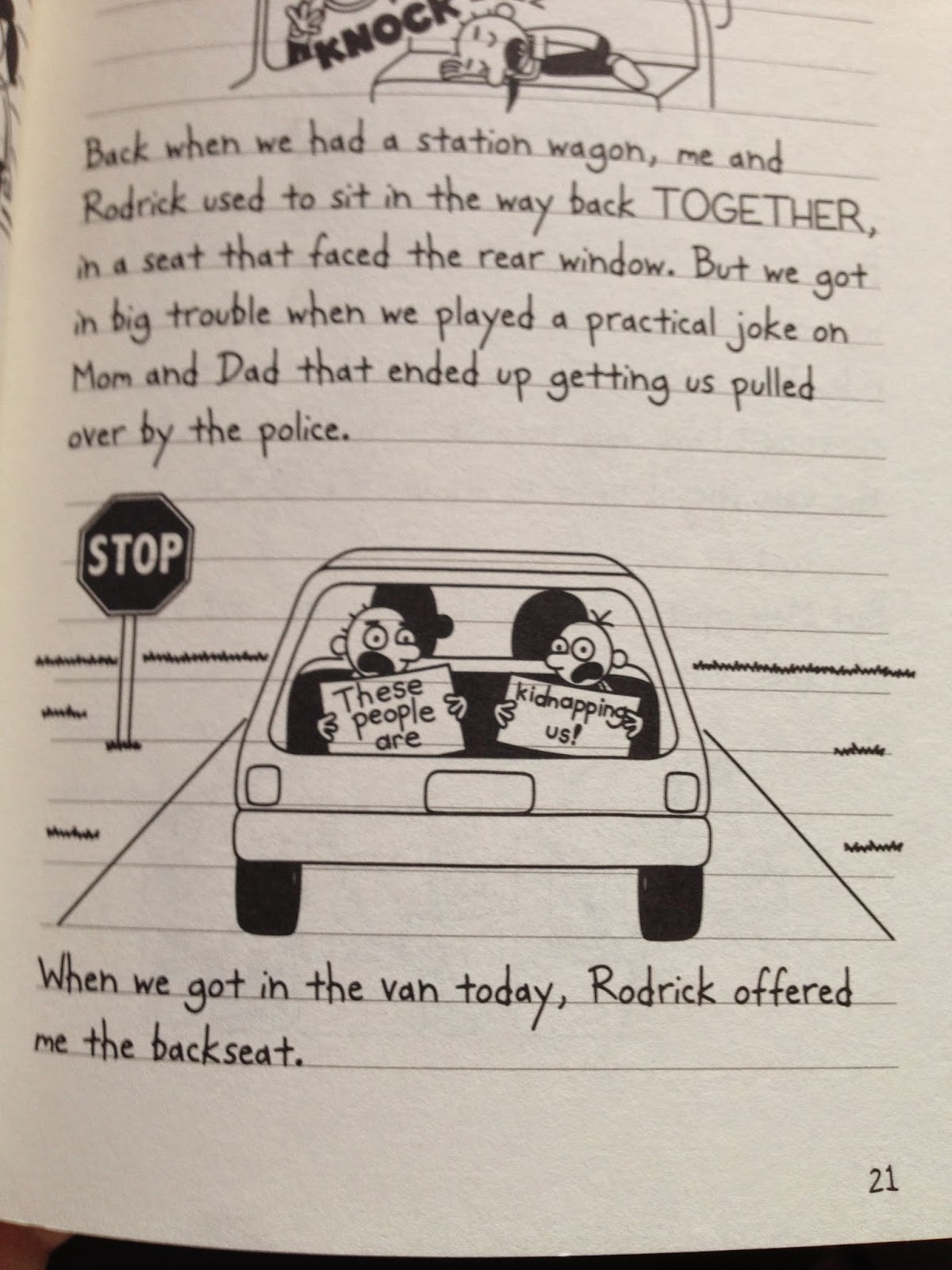
My favorite illustration was on page 186.  Greg's best friend, Rowley, may be sick and Greg fears that he may have had contact with some of Rowley's germs:


Hahaha, oh, germaphobia.

I wouldn't say that The Third Wheel is my favorite of the Diary of a Wimpy Kid series.  Alas, this book doesn't really feature any critiques of children's books that I have come to love so much.  I suppose there is a section or two that I could use as an example of human growth and development, but it's not as much fun.

I did appreciate, however, that the beginning and end of the book compliment one another, giving the book a feel of having come full-circle, a nice conclusive ending that some of the other books in this series are lacking.


Dinner Conversation:


Tasty Rating:  !!!

LinkWithin

Related Posts with Thumbnails