Thursday, May 31, 2012

REVIEW: Deadly Cool (Veronica Mars, this heroine is not...)

Halliday, G.  (2011).  Deadly Cool.  New York:  Harper Teen.

303 pages.


Appetizer:  Sixteen-year-old Hartley has been hearing rumors about her boyfriend, Josh.  Apparently he's cheating on her with Courtney, a queen bee and chastity club princess.  That's why Hartley and her best friend Sam search Josh's locker then drive to his house after school.  But instead of being able to confront Josh like they had planned, they find Courtney.  Dead.  Strangled with the iPod earbud cords. (Major tangent:  could a person properly strangle someone to death with earbuds?  I spent way too much time contemplating this.  Mostly because I have to buy earbuds in bulk.  They break easily and often.  Am I alone in this situation?)

All evidence points to Josh being the killer; especially the fact that he has gone into hiding.  Josh reaches out to Hartley, swearing he didn't kill Courtney.  So, it falls to Hartley, Sam and a broad-shouldered and handsome online high school newspaper editor named Chase to uncover the truth.

Admittedly, Hartley is no Veronica Mars (which is what I had been craving when I picked up this book).  There are a lot of fun touches of humor and some interesting word play ("She shot me a sugar-coated smile.  I matched it calorie for calorie." (p. 106)) throughout the story.  I liked Hartley's mom solely due to her reactions when she learns that her daughter had been dating a boy who turned out to be a murder suspect:
"Oh, Hartley," Mom said, hugging me again.  "To think I let you go out with a killer!"..."God, I can't believe it.  I played tennis with Josh's mom just last month," Mom said.  "And here she was, raising a murderer." (p. 81)
Oh, you amuse me, Hartley's mom.

It is worth noting, that while this series seems to be gearing up to be a bit of light fun, there may be a red flag or two for some overprotective parents of tweens.  Although the book avoids swearing for the most part (they're censoring themselves now), there was some explicit discussion of sex (no actual sex scene, but early on in the first book, Hartley describes an unsuccessful sexual encounter in more detail than some might prefer).  But as Hartley says to another character, "Teenagers have sex...get over it" (p. 108).

The mystery isn't too complex, but the touches of humor are nice.  Overall, this was a fun bit of light reading if you have a bit of free time.  I'll probably check out the second book, Social Suicide  at some point.


Dinner Conversation:

"There are three things you never want to find in your boyfriend's locker:  a sweaty jockstrap, a D minus on last week's history test, and an empty condom wrapper.
Lucky me, I'd hit the trifecta." (p. 1)

"So, I did what any good girlfriend would do.  I broke into Josh's locker.  Would the more mature thing have been to confront him directly with the rumors?  Possibly.  Would it have been as effective?
I looked at the shiny gold-foil in my hand.
Doubtful." (p. 3)

"But as Courtney's head dropped back like a rag doll's, I realized there was no way she was getting up.  Her hair fell away to reveal her porcelain pale face.  Her big, blue eyes were open, staring straight ahead.  Her mouth was fixed in a surprised little O.  And the smooth, blemish-free skin of her long, dancer's neck was bruised purple beneath the cord of her white iPod earbuds, wrapped in a deadly stranglehold around her throat." (p. 20)

"'Look, someone killed Courtney, and until the cops can nail that guy down, I'm going to be their number one suspect."  He paused.  "We need to find out who really killed Courtney."
"We?" I let out a short bark of a laugh.  "You must be joking."
"Please, Hart, you're the only one I can trust." (p. 39)

"I wasn't hot on the idea of my every move being printed for all HHH society to see.  On the other hand, I wasn't so hot on the idea of visiting Josh in a jail cell either.
And, the sad fact was, beyond canvassing the street for any nosy neighbors, I didn't have a clue where to begin a murder investigation.  Let's face it, I could use all the help I could get.
I turned to Sam.  She cocked her head to the side and shrugged.
"All right.  Fine," I said, shoving my hand toward Chase.  "Deal."
He grinned, one corner of his mouth tugging upward just a little higher than the other as he grasped my hand and shook.
"Deal." (p. 55)

"Killer beware, because Herbert Hoover High has its very one Nancy Drew on the case."  (p. 115)


Tasty Rating:  !!!

Tuesday, May 29, 2012

REVIEW: The Brimstone Journals

Koertge, R.  (2001).  The Brimstone Journals.  Somerville:  Candlewick

113 pages


Appetizer:  Branston High has the inauspicious nickname of "Brimstone" and with good reason.  One of its students is bullied.  Another is abused by her step-father.  Yet another student is trying to recruit others to an ominous "brotherhood."  One student feels like he is king of the school.  Another seeks freedom from her boyfriend.  Many students feel misunderstood.  Quite a few are religious.  A couple are racist.  Some have controlling parents or parents they disagree with.  A number resist authority.

...okay, so in truth, many of the voices in The Brimstone Journals may sound will probably feel familiar to many students.

A yearbook-style page
from the front of the book
that shows all of the characters
whose poems are featured.
The Brimstone Journals is a novel in verse that includes the 15 voices from the members of the class of 2001.  While each student shares about their personal burdons, hang-ups and interests, an underlying narrative emerges that may threaten the lives of the student body.

Broken up into six parts and with only a few over 100 poems, The Brimstone Journals is a fast read.  The language is easy to follow and it is fun to see the different ways the characters regard one another, but many of the allusions to popular culture are very dated.  (Some of the references include the movies Groundhog's Day, Ghost, and to the actors Harrison Ford and Will Smith (with the assumption that they are both much younger.)  These allusions could be turn-offs for some high school students and could make some teachers feel old to have to describe the setting and context of this book.

My character notes!
The real difficulty students will probably have with this novel in verse, however, will be the number of characters to keep track of.  Certain characters, like Lester, Boyd and Kelli are given more attention, but it could be very difficult to keep track of all the names (especially since the perspectives are interwoven in no particular order).  So, this is definitely a book to assign student to follow a particular character (I did this with another novel in verse about poetry called Bronx Masquerade...it worked very well) or to have students record character logs.

There are a lot of merits of taking on this book though:  students can research some of the social issues in the book and report statistics over long periods of time.  (Some topics would include violence in school or between family members, the effectiveness of ways to prevent bullying and violence, statistics and definitions of sexual assault, information about environmental movements, issues about body image in both men and women, tolerance in terms of race, religion and immigrant status, respect across cliques, have debates about gun control, etc.)  As you can probably see, this book considers a lot of issues and does a pretty good job with exploring them (I say pretty good, because I did feel like some of the characterizations were on the superficial side, particularly the way some of the black characters were depicted as well as Boyd and his not-so-great relationship with his father.  Plus, many of the issues or concerns that are secondary to the larger issues of school violence are left unresolved.).


Dinner Conversation:

Lester:

"My dad'd freak if he knew I played
with it, but I can't help myself.  And
I'm not hurting anybody.

The bullets are across the room" (p. 3)


Tran:

"Father does not want me to forget the country
I have never seen.  Every day an hour of
Vietnamese only.  Then another of music
with traditional instruments." (p. 4)

Damon:

"We are the champions!
Numero Uno!!
Half of us already got scholarships,
full ride.
Everybody loves us--chicks, teachers,
everybody!!
Man, standing out there in the center
of the gym in my letterman's jacket
with my buddies.  It's the best!" (p. 6)


Kelli:

"Damon is driving me crazy.  He's got like
our whole life planned:  college, jobs, kids,
even what kind of car he'll buy for me.
Already it's always the same." (p. 7)


neesha:

I don beleave in the white man sway.
I beleave thoze rools of hiz--dat
spellin, hiz gramma, doze frag mints
and common splizes--I beleave
awl them roolz r jis another way
2 keep my black brotherz and sistahs
down." (p. 9)


Allison:

"Twenty-five million teenagers go to
twenty thousand schools in the U.S.
Ten kids, TEN KIDS, in seven schools
did all the shooting, ALL OF IT,
in 1998-1999.

In the same two years, grownups
in southern California alone massacred
forty people." (p. 13)


Tran:

"What a violent country:  "He kissed
me so hard."  "I was so wasted."  "I hate
her so much."  "I love him to death."
The students even call this well-appointed
and modern high school Brimstone,
a reference to their Bible and to the end
of the world." (p. 28)


Tasty Rating:  !!!

Sunday, May 27, 2012

REVIEW: I Don't Want to Kill You

Wells, D.  (2011).  I Don't Want to Kill You.  New York:  Tor Books.

320 pages.


Appetizer:  In the final installment of the I Am Not a Serial Killer series, John, a sociopathic mortician's son, is stalking women--all who have had a major change in their lives.  He's been letting some of his well-crafted rules (all designed to prevent him from becoming a serial killer) slip recently.  He's waiting for Nobody, the big bad demon he challenged at the end of Mr. Monster, to arrive in town.

When a famed serial killer named The Handyman seems to have come from Georgia, John knows that Nobody is at work and tries to profile the Handyman in the hopes of protecting the county.  But, John must also question some of his choices he makes as girls in town commit suicide:  Are these people worth protecting?  Could he could actually be a hero?  He knew innocent people would have to die for him to find the next demon after all.

John's rules of how to avoid becoming a serial killer slip even more when, a girl named Marci asks him out.  The daughter of a police officer, they begin to profile the killer and parts of John's personality that only him mom has seen before begin to show.  But with his mask slipping and his true nature revealed, will Nobody find him before he can find the demon?

I found I Don't Want to Kill You to be a fitting conclusion to this trilogy.  With touches of humor, I thought it was a little lighter and more enjoyable than the second book, Mr. Monster, which had gotten suuuuper dark.

There are some great twists in the story and some nice foils to John's character to provide some insights into who he is.

I did feel as though the book did leave itself open to another chapter in John Cleaver's story in the future.


Dinner Conversation:

"I didn't know Jenny Zeller very well.  Nobody did, really.  I guess that's why she killed herself." (p. 13)

"Yes, finding a killer is easy.  Finding someone before they kill is almost impossible.  And the worst part about that was the way it made me so much easier to find than the demon.  I'd already killed two people."  (p. 18)

"Thus it was that five days after the killing, when I'd analyzed the news coverage a hundred times, run out of leads, and was desperate for more information, the FBI delivered the corpse right to my door.
I have the best job in the world." (p. 33).

"Now that I was a real demon hunter, everything was different.  My dark side had a safe outlet, and my dreams at night were heroic tales of John the Conqueror, slaying all the dark things of the world--and if I enjoyed the slaying a little more than necessary, well, that was my right." (p. 52)

"I laughed, smiling thinly.  "The daughter of a cop and the son of a mortician:  teen crime fighters.  We're like a bad TV show."  (p. 98)


Tasty Rating:  !!!!

Saturday, May 26, 2012

REVIEW: Insurgent Audio Book Review

Pretty cover!
Roth, V.  (2012).  Insurgent.  New York:  Harper Audio.

11 hours and 22 minutes.

So, as is obvious in my review of the first novel in this series, Divergent, I wasn't too crazy about the world of this story and was ready to set it aside and ignore it for the rest of my life.

But then, one of my Awesome YA Reading students got hooked on the series.  Now she's threatening to hold her breath until I read Insurgent so we can discuss it.

Le sigh.  I'd hate for one of my former students to pass-out on my account.


Appetizer:  Picking up soon after Divergent ends, Tris, her brother, Four and several others must seek safety from the erudite among the different factions of the city.  This proves easier said than done as many believe that Four and Tris contributed to many of the horrors that occurred at the end of Divergent.  Together, they must deal with the aftermath of all they have experienced and prevent the situation from worsening.

Wow, that was vague!  But I had to be...I didn't want to give away the events of Divergent.

To be honest, I actually liked Insurgent much more than the first book in this series.  In this book, all of the risk-taking was necessary, so I didn't have to shout "Lawsuit!" at random moments when I just couldn't believe the ridiculousness of some of Tris's reckless decisions.  (In the second book, Four actually calls her on some of these behaviors.  Good for you, boy toy!)

I also like that much of the book deals with the consequences and guilt of some of what Tris experienced.  This series went from being so-so to thoughtful.

Alas, to understand what's going on, you *still* have to read Divergent first.

Thoughts about Emma Galvin's Audio Reading:  No complaints here!  Galvin spoke clearly in a way that allowed Roth's characters to come to life without being distracting or preventing me from getting into the story.


Tasty Rating:  !!!!

Wednesday, May 23, 2012

REVIEW: Darkness Becomes Her (A kinda PG-13 fun Anita Blake or less funny more action-oriented Paranormalcy/Stephanie Plum

Keaton, K.  (2011).  Darkness Becomes Her.  New York:  Simon Pulse.

273 pages.


Appetizer:  Seventeen-year-old Ari has gone searching for information about her mother.  The woman had given her up to the state of Louisiana years ago.  Soon after learning that her mother spent time in an insane asylum where she eventually committed suicide, Ari finds a cryptic letter.  Then she is attacked by a supernatural being.  Lucky for her, she's been raised by bounty hunters for the last few years and can handle the creature attacking her...at least the first one, anyway.

Realizing that there's more going on, Ari's quest for information about her family's past leads her to the ruins of New Orleans, AKA New 2, (which had been devastated by hurricanes thirteen years previously and has since been dominated by a handful of wealthy families called The Novem who want nothing to do with the outside world).  While in New 2, Ari makes new friends, learns more about the magical curse that has haunted the women in her family and realizes she has a powerful and ancient enemy to battle.

Darkness Becomes Her proved to be a fast read (when I had the time) that was easy to get into and that I was willing to read, "just another chapter...okay one more than I'll stop...how long is the next one--okay, one more...."  I liked Ari as a character.  She was tough and could handle herself in a fight (In that way, she reminded me of Kiersten White's protagonist in Paranormalcy).  I thought it was interesting that Avi in Darkness Becomes Her had such a dark past and history of abuse (Keaton does a good job of not dwelling on this, but rather briefly showing what Ari has endured, making it impressive that the character has survived and is as strong as she is.)  Overall, the book is a light quick read.  So, since I didn't get bogged down in the darkness, it was easier to focus on the romance (with a vampire-warlock named Sebastian...oorh, in theory.  In reality, he was kind of blah.  I thought he needed to be developed more.  Aside from the requirement of being handsome, providing necessary exposition about New 2 and showing up at the right time, there wasn't much to her personality.

I could also focus on the fluff and rich descriptions of the surviving (and familiar!) parts of Southern Louisiana and New Orleans.  Keaton has created a protagonist whose world and experience are easy to escape into.  (I know I used the book to avoid grading for a little longer.)

On a tiny note, I wasn't crazy that the author included a word in Greek as a part of the name of the monster hunting group:


I have no idea how to pronounce the word!  Sigh.  I guess I can add that to my to-do list:  learn Greek, ancient and modern.  I also felt like Keaton had to work a little too hard to establish the rules of her world.  Don't get me wrong, this is important for an author to do, but I felt like she had to work a little too hard to accomplish this...like there were some weaknesses in the world building.  All this means is...so many rules.


Plus, I wasn't completely crazy about the way the Greek goddess Athena was portrayed.  But there were a still a lot of great tensions with the conflict with her.  Keaton focuses on the myth of how Medusa was created and Athena's role in that.  It has the potential to be a strong critique of the way victims have historically been treated after surviving rapes and abuse.  I wanted Keaton to push those critique and commentary more.

I liked the way voodoo, fantasy and Greek myth were all combined.  It was reminiscent of an actual New Orleans Mardi Gras experience (to which there are several scenes devoted in the book).

And since I mentioned Mardi Gras, here are some pictures I took of my own Lundi Gras parade experiences.  Think of it as setting the mood for the novel:


The sequel to this book is A Beautiful Evil.  I'll be reading it soon.  :)


Dinner Conversation:

"Under the cafeteria table, my right knee bounced like a jackhammer possessed.  Adrenaline snaked through my limbs, urging me to bolt, to hightail it out of Rocquemore House and never look back.
Deep breaths.
If I didn't get my act together and calm down, I'd start hyperventilating and embarrass the shit out of myself.  Not a good thing, especially when I was sitting in an insane asylum with rooms to spare." (p. 1).

"'After your mother gave you up to social services, she spent the remainder of her life here at Rocquemore.'  His fingers fidgeted with the file.  "Self-admitted," he went on.  "Was here six months and eighteen days.  Committed suicide on the eve of her twenty-first birthday."
An inhale lodged in my throat.
Oh hell.  I hadn't expected that."  (p. 2).


A letter from Avi's mother:  "Stay away from New Orleans, and away from those who can identify you.  How I wish I could save you.  My heart aches, knowing you will face what I have faced.  I love you so much, Avi.  And I am sorry.  For everything.
I'm not crazy.  Trust me.  Please, baby girl, just RUN." (p. 12)

"The Novem never confirmed or denied any rumors.  They never gave interviews, never stepped into the spotlight except to make the purchase.  And then they retreated into their ruined city, leaving the rest of the country to wonder.  It's wasn't long before they joined the ranks of Area 51, Roswell, the Loch Ness monster, and all the other conspiracy theories and paranormal speculations out there.  The undercover reporters and truth seekers who'd come out of the city later on with grainy photographs and accounts of monsters and murders only added to the speculation.  And now, thirteen years later, a large percentage of the country believed New 2 was a sanctuary, a hot spot, for the paranormal." (p. 29)

"'New 2 is home to a lot of what the Novem call 'gifted' people.  What do you think would happen if Violet or Dub--or I--lived beyond The Rim?'
Easy.  "If they couldn't hide their abilities, life wouldn't be so kind," I answered in a quiet voice, thinking of my own experiences.
"Exactly.  New 2 is a place where you don't have to hide, but if you want to, that's okay too.  No one is going to judge you because you're different.  That's what the Novem wanted all along." (p. 98)

"'I have asked to see you to offer my protection while you're in our city.  Together we will delve into your past and uncover this gift you have been given.  But in return, you must grant your allegiance to me, a blood oath to the Arnaud family and no other."
"Was that what you asked of my mother?  You weren't just helping out of the goodness of your heart?"
Josephine laughed.  'I don't have a heart, my dear.'"  (p. 108)


Tasty Rating:  !!!.  (AKA 3.5 explanation points of excitement)

Monday, May 21, 2012

REVIEW: Fake Mustache (Fun, but I missed Origami Yoda)

Angleberger, T.  (2012).  Fake Mustache.  New York:  Abrams.

196 pages.


Looking at this book's endpages, for the first time ever, I find myself wishing I could grow a mustache.  I suppose this is the purpose of having a fake one.  Although, I wouldn't pay 129.99 for a handlebar mustache...or any mustache.


Appetizer:  Seventh grader Leny Flem Jr. saved the world.  Fake Mustache is the story of how that happened.  It began with Casper's birthday and him receiving money from his Grandma.  He and Leny go to Sven's Fair Price Store and to Chauncey's Big & Small, Short & Tall to buy a fake handlebar mustache and a man-about-town suit where Chauncey spends, spends, spends.

Soon after, a series of bank robberies occur.  The robber is a "short, well-dressed man-about-town sporting a spectacular handlebar mustache" (p. 27).  Leny can't help but suspect his best friend.  But soon enough, the situation escalates and Leny realizes his best friend is a mad, genius, criminal mastermind who can only be stopped with the help of a child TV star named  Jodie O'Rodeo.

As with Angleberger's Origami Yoda series, Fake Mustache uses short chapters and humor to entertain readers from ages seven to 11-ish.  The humor is very fun and off the wall.  (It kind of felt like Alcatraz Versus the Evil Librarians for a slightly younger crowd).  Plus, it would be a great book to graduate fans of the Captain Underpants series to.  But even more than that, I was reminded of the Sideways Stories from Wayside School series.  While I would argue that, like Sachar, Angleberger's story felt a little too rushed or silly, it also captured Sachar's sense of the absurd.  In fact, I'd go so far as to say that Angleberger that is a new King of the Absurd.  Feel free to quote me on that.  And although the book felt a little too silly for adult-me, I imagine I would have loved it when I was in the third grade.

And there is a lot to love:  Kids saving the world, disguising themselves as adults, librarians, mimes, plumbers, accordion players, politicians and bank robberies.  AND FAKE MUSTACHES!

Although mainly told from Lenny's point of view, a portion of the story (starting around page 120) is also told from Jodie O'Rodeo's, a tough, horse-riding, former celebrity.  I liked this choice, particularly because in the case of young male readers who may be reluctant to read from a girl's perspective, that far into the story they should already be invested so they'll give Jodie more of a chance.

There's also a large portion of the story during which Lenny must disguise himself as a girl.  While this is mainly intended to be humorous there's also a possibility for this to be interpreted as empowering for the right child (and not nearly as didactic as a book like My Princess Boy) when Lenny first asks a store owner if he can change into a costume:
"Hey...uh...do you mind if I use the changing room?""For the costume?  I thought it was for your sister.""Well, no, it's for me, actually.""Follow your dreams!  Never stop dreaming!" Sven sang out. (p. 60)
Although most likely a book read solely to amuse, there are some aspects that relate to politics and voting, making this a nice read aloud for the end of October or start of November.  (Many of the events also occur on Halloween.)  There's also a short parody of the Government bailouts on p. 82.  Fake Mustache also includes a lot of great vocabular:  superlative, hirsute, deterrent, etc.  Plus, when the novel is narrated from Jodie's point of view, she describes how upsetting it is to receive mean messages in emails or on Facebook and twitter, lending the book to a brief talk about cyber bullying (pp. 119-120).


Dinner Conversation:

"You may remember seeing me on TV when Jodie O'Rodeo saved the world.  I was that nerdy guy in the background that nobody could figure out what he was doing there.  But nobody really cared because Jodie O'Rodeo had just saved the world.  Remember?
Well, that was me, Lenny Flem Jr., and believe it or not, I saved the world too.  Me and Jodie saved the world together.  And this is the story of how we did it."  (p. 2)

"My dad dropped me off at Casper's and made me promise to phone him to pick me up instead of trying to walk home.  "Remember, there's a made genius criminal mastermind on the loose, and you never know where he might be," he said.
Actually, I was fairly sure that I DID know where the mad genius criminal mastermind was, but I didn't tell Dad that." (p. 34)

"That's when our front door was knocked open by a battering ram and fast-food restaurant employees burst through, pointing at me and yelling, 'There he is!  The Evil One!  Grab him!'" (p. 45)

"That gave me two options:  I could hide in the woods, where I wouldn't have to worry about anybody, except maybe brainwashed forest rangers.
Or I could do what Casper had done and get a disguise.  A disguise would allow me to keep an eye on things and try to figure out what Casper was up to.  I mean, if I went off and hid in the woods, there would be no one to stop him from doing whatever it was he was doing." (p. 54)

"But my favorite part was when he warned us of the Evil One, a desperate bank-robbing criminal mastermind who is living in Hairsprinkle disguised as a boy named Lenny."
"It's terrifying to think the Evil One may be in Hairspinkle right now!"
"It sure is," I said.
I couldn't believe it!  Fako Mustacho--I mean, Casper--had somehow convinced everybody that I was the bank-robbing bad guy, not him, even though he was the one with the mustache!" (p. 64)

"Hey, everybody, it's me, Jodie O'Rodeo.
This whole thing is pretty crazy, huh?  I mean, if this was the plot to an episode of The Jodie O'Rodeo Showdeo, you'd be like, "Jodie's totally lost it."
Well, hold on, because it's about to get all jacked up like you wouldn't believe!" (p. 116)


Tasty Rating:  !!!


Also, OMG!  The next Origami Yoda book is coming out in August.  I want to pre-order it so badly but I don't know where I will be living!  Ugh.  WHY?

It looks glorious!

Saturday, May 19, 2012

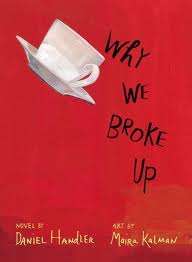
REVIEW: Why We Broke Up

Handler, D. & Kalman, M.  (2011).  Why We Broke Up.  New York:  Little, Brown and Company.

354 pages.


Why We Broke Up isn't your typical book.  Instead of the usual author blurbs describing how awesome a book is, the back cover is covered (haha) with quotations from famous YA authors (like Neil Gaiman, Holly Black, Sarah Zarr, MT Anderson, Carolyn Mackler, David Levithan etc.) describing the first time their hearts were broken.

What a wonderful touch to demonstrate that 1. a potential heartbroken reader is not alone and that 2. such pain is survivable.  Because that's what Why We Broke Up is:  an honest look at the problems and joys of a relationship between people from different cliques.


Appetizer:  Min has arranged to deliver a heavy box to Ed's front door.  The box contains everything from their less than two-month (Oct. 5-Nov. 12) relationship.  Everything.

As Min writes about the meaning of each object, the details of her and Ed's star-crossed relationship and why they broke up is revealed.

Including paintings of each object, Why We Broke Up is a loooong, slooooooow post-mordem of the relationship between 11th grade, movie-buff Min and her 12th grade, basketball co-captain, Ed.

From the beginning of their relationship, the two had almost nothing in common.  As their relationship develops--both emotionally and physically--this tension mounts and the novel serves as a very honest look at a doomed relationship.

The more I read Why We Broke Up, the more I was reminded of the Youtube video Dramatic Reading of a Break-Up Letter:


And not just because of the video's similar subject or the fact that the entire novel is told in the second person, with Ed being the intended audience.  Min's run-on sentences (which I occasionally stumbled over) started to remind me of the grammatical slip-ups in the above video.  Admittedly, Min's voice has much more poetry to it.  Plus, Min can spell.

I enjoyed Why We Broke Up a lot, but it didn't rock my world.  While there are still some darkly humorous touches one could expect from the author of A Series of Unfortunate Events (a bitter sixteenth birthday party, anyone?), the book wasn't as enjoyable as I would have expected.  I think it was the subject matter.  It's one thing to hear a brief retelling of all the hints of what contributed to the end of a relationship, it's quite another to read a 354-page play-by-play.

I was still very impressed by how honestly Handler managed to portray his female protagonist.  I liked Min's references to made-up old movies.  I found myself wishing some of those movies were real, because I would totally watch them.  I also don't think I'd mind living in the city where Handler set Why We Broke Up.  Min shopped at so many awesome and quirky stores.  If I lived in this town, I'd also be very poor.  Due to all of the shopping.  (The more I reflect on this, the more I start to realize that this novel has almost a quirky Gilmore Girls feel to it.)

The mystery of what happened between Ed and Min did carry me through.  I also liked seeing all of the paintings.  Plus, there was a lot of wonderful dialogue.  Yeah, the witty dialogue between Min and her friends definitely made the book worth-while.

Also, I want to frame some of the artwork from the novel and put it on my walls.


Dinner Conversation:

"Dear Ed,
In a sec you'll hear a thunk.  At your front door, the one nobody uses.  It'll rattle the hinges a bit when it lands, because it's so weighty and important, a little jangle along with the thunk, and Joan will look up from whatever she's cooking...You won't even know or hear what's being dumped at your door.  You won't even know why it even happened." (p. 1)

"I'm telling you why we broke up, Ed.  I'm writing it in this letter, the whole truth of why it happened.  And the truth is that I goddamn loved you so much." (p. 1)

"Every last souvenir of the love we had, the prizes and the debris of this relationship, like the glitter in the gutter when the parade has passed, all the everything and whatnot kicked to the curb.  I'm dumping the whole box back into your life, Ed, every item of you and me." (p. 3)

"'He asked you out.  Ed Slaterton.'
"He's not going to call," I said.  "It was just a party."
"Don't put yourself down," Jordan said.  "You have all the qualities Ed Slaterton looks for in his millions of girlfriends, come to think of it.  You have two legs."
"And you're a carbon-based life-form," Lauren said.
"Stop," I said.  "He's not--he's just a guy."  (p. 21)

"I gave you an adventure, Ed, right in front of you but you never saw it until I showed you, and that's why we broke up." (p. 31)


Tasty Rating:  !!!!

Tuesday, May 15, 2012

REVIEW: I Hunt Killers (A teenage Dexter Meets Dan Wells's I Am Not a Serial Killer. Enjoyable, but it doesn't really distinguish itself from similar books.)

Lyga, B.  (2012).  I Hunt Killers.  New York:  Little, Brown and Company.

361 pages.


Appetizer:  Jazz Dent is watching the police at the scene of a murder.  He knows it's a serial killer's doing.  He can feel it.

He's practically an expert.  His father is a famous, imprisoned, serial killer, after all.

With the police chief reluctant to admit that there may be another serial killer in the town of Lobo's Nod, Jazz launches his own investigation with his best friend, Howie.  But as they search, Jazz begins to realize that the killer may have a connection to his own past, some of his missing memories and to his childhood with his killer father.


As I made my way through I Hunt Killers, I found that I had to repeatedly fight the desire to have marathon viewings of the TV show Dexter.  I was also struck with the need to reread Dan Well's I Am Not a Serial Killer series.  The similar tensions and plot twists were hard to ignore.


I Hunt Killers does decidedly have a bit more of a YA feel.  Jazz struggles with his own nature, his upbringing and sexual desire.

Jazz is in an established relationship with a girl named Connie.  As I read, I found that I would have preferred to read the story of the two first getting together.  It would have helped the story to feel more YA.  (Of course, I had a similar reaction to Dexter when the first episode revealed he was already in an established relationship with Rita.  I Am Not a Serial Killer, in contrast, does explore that protagonist, John, starting a relationship with his dream girl.  So, I guess it was lose-lose whichever way Lyga wrote it.)

Throughout the story, Lyga had a tendency to avoid sharing information with the reader with sloppy narration during pivotal plot developments like "he told them his idea," as a way to try and maintain some tension and mystery for whatever Jazz, Connie and his best friend Howie were about to do.

I wrote a scene that once during the first semester of my MFA program.  My professor informed me that it was sloppy and I tend to agree.  Lyga used this "and even though Jazz knows something and the majority of the narration is from his perspective, I'm still not going to reveal it to the reader" technique many times.  It was annoying.  But hey, what do I know?  Lyga has published many books and won some awards.  I, decidedly, have not.

Having said that, some aspects of the plot felt forced; as though Jazz were forced to go through the steps on Lyga's outline because they would make for the most dramatic turns as opposed to there being honest character motivation for his choices.  *Spoiler for the final third of the novel* A moment where this impression was particularly strong was Jazz's decision to finally visit his father in prison for the first time.  It felt forced-forced-forced-forced-FORCED.  *End spoiler*

While probably not a book to be used in most classroom, I Hunt Killers does heavily reference the play The Crucible.  As with other books in its sub-genre, it could be used to describe the characteristics of a sociopath.  A fun approach to an already interesting topic in a psychology class.


Dinner Conversation:

"By the time Jazz got to the field outside town, yellow police tape was everywhere, strung from stake to stake in a sort of drunken, off-kilter hexagon." (p. 3)

"It's not that he'd never seen a dead body before.  Or a crime scene.  Jazz had been seeing those for as long as he could remember, thanks to Dear Old Dad.  For Dear Old Dad, Take Your Son to Work Day was year-round.  Jazz had witnessed crime scenes the way the cops wished they could--from the criminal's point of view.
Jazz's dad--William Cornelius "Billy" Dent--was the most notorious serial killer of the twenty-first century.  He'd made his home in sleepy little Lobo's Nod and, for the most part, kept his nose clean while in town, adhering to the old adage "Don't crap where you eat."  But eventually time had caught up with Billy Dent.  Time, and his own uncontrollable urges.  Even though he was a masterful murderer, having killed into the triple digits over the previous twenty-one years, he eventually couldn't help himself.  Two Lobo's Nod bodies later, G. William Tanner tracked Billy down and cuffed him.  It was a sad and ignominious end to Billy Dent's career, caught not by some FBI doctorate with a badge and the might of the federal government behind him, but rather by a local cop with a beer gut and a twang and one decent police car." (pp. 11-12)

"When the original devil couldn't do the crime, who did you look at next?  His son, of course.  If Jazz didn't know for certain that he wasn't involved in this murder, he would have pointed the finger (ha, ha)   at himself.  It made complete sense that the son of the local serial killer would kill someone.  but just because it made sense didn't make the thought any easier to bear." (p. 21)

"People matter.  People are real.  I will never kill, Jazz told himself over and over, his promise to himself.  He had siad it to his father once--just once--and Billy had laughed and said, You go on thinking that way, Jasper.  If that's what it takes to get you through the night, you go on thinking that way.  Billy had been so sure that Jazz would someday go into the family business." (p. 57)

"...Why are you so obsessed with this?"
"I told you yesterday:  I think this is a serial killer."
"So? If it is, the cops will eventually figure it out."
"And a lot of other people might die in the meantime."
"People are dying all over the world.  Right now.  Everywhere.  And you know they're dying; it's totally not theoretical.  So why are you so focused on this totally imaginary, maybe-not-real serial killer?"
Jazz pressed his lips together tightly, as if he could physically prevent himself from speaking.  But some part of him needed to say what came next, and that part overrode the rest of him.
"Because," he said quietly, "if I catch killers, then maybe that means I'm not a killer."  (p. 104)


Tasty Rating:  !!!

Saturday, May 12, 2012

Remembering Maurice Sendak

Over the last several months, I'd been thinking about famed picturebook author Maurice Sendak.

It bagan with the two-part Grim Colberty Tales on the Colbert Report.  I both admired Sendak for how brutally honest he was and feared ever meeting him and falling under his scrutiny.

So, after hearing of his passing, I bought two books in his honor.

The first was his recently published Bumble-Ardy.

It's the rhyming story of a pig named Buble-ardy who has never had a real birthday party.  So, when he goes to live with his Aunt Adeline and turns nine, he decides to have a costume part.

To be honest, I wasn't crazy about this picturebook.  While the rhymes were fun and the illustrations were delightfully old-school, nothing about the story really struck me.

The other book I bought, while not exactly appropriate for children *cough* a page on stripper poles *cough*, did prove to be an enjoyable tribute:

I Am a Pole (and So Can You!) is the book that Stephen Colbert published after his interviews with Sendak.

From the "Caldecott Eligible" sticker on the cover, Sendak's blurb of "The sad thing is, I like it!," an illustration of him to the illustrations that Sendak and Colbert made together prove to be fitting tributes to Sendak's personality.

Goodbye, Mr. Sendak!

You've set the bar high for all who follow!


Wednesday, May 2, 2012

Audiobook Review: Rotters

Kraus, D.  (2011).  Rotters.  New York:  Delacorte Press.

448 pages.


Rotters won the 2012 Odyssey Award.  Since I was so in love with past audiobook winners like The True Meaning of Smekday and The True Diary of a Part-Time Indian, I made it a priority to listen to this year's winner.

When I first began listening, I was haunted by the feeling that I'd heard Kirby Heyborne's voice previously and that--for some as of yet unknown reason--I didn't like him.  I went to audible and searched through the books he's read for--and my goodness, there were a lot--and I figured it out.  He read one of the characters for a book that I absolutely detested--Leverage by Joshua C. Cohen.

I tried not to let that ruin the experience of Rotters.  But it wound up not mattering, because, I hated Rotters for reasons all its own.


Appetizer:  Sixteen-year-old Joey Crouch's mom has died and he is sent to Bloughton, Iowa to live with his father, a man Joey has never met and whose only known act was to deafen his mother in one ear.

After arriving in Iowa, Joey quickly learns that his father, Ken Harnett, is ostracized from the town and Joey finds himself in a similar position at the high school.  Accustomed to getting straight-A's, Joey is bullied by a teacher and other students.

Less than excited about the turn his life has taken, Joey seeks to discover what it is his father does.  The answer will take Joey into an underworld of grave robbers and into a different and scary new life.


Sooo, I hated this book.  Seriously, hated it.  First off, I thought it took way too long to get to the grave robbing portion.  Next, I found the entire story to be frustrating.  I hated most of the characters.  Hated the dark underworld Joey was entering.

I found myself wishing for zombies.  Or unicorns.  Or to be listening to a different book.

I eventually got my final wish.


Opening Quotation:

"This is the day my mother dies.  I can taste it right off:  salt on my lips, dried air, the AC having never been switched on because she died from heart failure while reclining in front of the television, sweating in her underwear, her last thought that she needed to turn on the air because por Joey must be roasting in his bedroom.  Pulmonary embolism:  it is what killed everyone on her side of the family and now it has killed her, while I slept, and this salt is the bitter taste of her goodbye.
Turns out, her heart is not what got her."  (p. 3).


Tasty Rating:  !

Monday, April 30, 2012

#Challenge: YA Paranormal Romance Review Mad-Lib


Back by popular demand!

Here's another Mad Lib for your enjoyment.  This one is structured roughly as a review of a YA paranormal romance novel.  So, if you pull from one such book your review my eerily make too much sense.

For those of you new to my online Mad Libs, take out a book you're currently reading.  I'm going to make 10 suggestions of where to find names or words from a particular part of speech.  You record your answers and after you have them all, copy and paste the incomplete review at the bottom of the text (no peeking before!) into the comments section and insert your words.  Let me know which book you pulled your comments and names from.  Be sure to also include you email (at) address (dot) com in the post so I can contact you if you win.

To the mad libber with the craziest review, I'll offer a $10 giftcard to the online book retailer of his or her choice.

Let's say the due date to post your response in the comments will be May 15, 2012 at 7 PM Central.

Now, on the the mad libbing!

Find the following in your book of choice:

1.  List the first type of animal, supernatural being or piece of technology mentioned in your book.  Reading a work of historical fiction?  Then use "ye ol' butter churn" as your answer.
2.  An adjective used in one of the quotation blurbs by another author recommending this book on the front or back cover, in the front pages, etc.  If no authors recommended the book, then use the first adjective you encounter as you start reading the story.
3.  A protagonist's name.
4. and 5.  Two adjectives found on page 72 of your book (or on the nearest page with adjectives)
6.  Another character's name.
7.  An item of clothing that the first character described in chapter one or two is described to be wearing.
8.  An active verb used on page 37 (or the nearest page with text) of your book.
9.  The final verb used in the last sentence of chapter four.
10.  How much you paid for your book

Have all of your words?

Great!

Now copy and paste the following into your comment and fill in the appropriate blanks with the names and words you found.


Hot Hairy Lurve in the Cafeteria (a title of Shel's own invention) is about falling in lurve with a

____(1)____ and this lurve is ____(2)____!!!!!!!!

I thought ___(3)____ was a ____(4)____ and ____(5)____ character.

As for the main love-interest, ____(6)____, (s)he made my ____(7)____ ____(8)____.

Overall, I would ____(9)____ Hot Hairy Lurve in the Cafeteria to anyone who has ____(10)____ to give me.

Saturday, April 28, 2012

REVIEW: Chopsticks (OHMYGOSH, AWESOME! One story: told in music, illustration, texts, articles and videos. Read it now!)

Anthony, J. & Corral, R.  (2012).  Chopsticks.  New York:  Razorbill.

No page numbers....but, I'd guess it's more than 300 pages.  Since most of the stories is told in images or small bits of text, it's a great read.


Appetizer:  In December of 2009, 17-year-old Glory Fleming, a piano prodigy, disappears.  But, much of the story of Chopsticks focuses on 18 months earlier, when Glory was still performing and an Argentinian boy named Francisco moves in next door to her house on Usher street in the Bronx.

A romance soon begins.

But the question is, can their romance survive as Francisco struggles with racism and bullying at school and Glory with her controlling father/manager who insists on touring.  Can the two teens find a way to be together?


This novel is shared predominantly in images, with much of the plot being pieced together by found objects like newspaper clippings, programs, family albums, text messages, etc.

And it is wonderfully done.  A relatively simple story, I found that a lot of details--like Francisco's anger with his ESL homework (pictured below) to add deeper layers and criticism.

I also loved the different forms of communication.  Throughout the text messages Francisco and Glory exchange are urls to youtube videos that, while a little inconvenient to set down the book and type into my laptop, provide a lot of secondary depth.  I liked the references to Sylvia Plath and Pablo Neruda.  The book also includes playlists of songs that the two exchange, really providing a lot of focus on music.  This story does an amazing job of using a lot of different forms to tell a story.  I approve.  I approve strongly.

Plus, there's an app version of the book.  (But alas, after already spending $20 on the book, I'm too cheap to spend another $7 on the app.  Somebody else buy the app and tell me what you think!)

If a teacher wanted to find a way to include Chopsticks into a classroom, he or she could focus on looking at a section of a text as an anthropologist, studying a person or culture through the objects they have.


Dinner Conversation:


Tasty Rating:  !!!!!

Thursday, April 26, 2012

REVIEW: Slice of Cherry (Kill Bill + Dexter + a lot of magical realism)

Reeves, D.  (2011).  Slice of Cherry.  New York:  Simon Pulse.

505 pages.


Appetizer:  Sisters Kit and Fancy are close.  Very close.  In fact, with their mother working so much, they're pretty much all each other has ever since their father was convicted to death row as a serial killer and the family was ostracized from the entire town of Portero due to the fact that their father killed several of the neighbors.

After abducting a young trespasser who wanted to steal something from the house of the Bonesaw Killer and torturing him in the basement, the two sisters slowly begin to form a plan, establishing a gateway to another world where they can get away with murder.  Kit and Fancy begin to advertise their problem solving services to the residents of Portero in the hope of being able to reconnect with the community.  But as their plans unfold and the body count rises, Fancy and Kit's relationship becomes strained.


Set in the same fantastic Texas town as Reeves's other novel, Bleeding Violet, there are a few moments when the characters from that novel make their presence known.  When comparing the two, I'd have to say I preferred Bleeding Violet, as a character, I could sympathize with the character of Hanna a little more.  While still very interesting, and even when taking on a bit of the feel of Kill Bill's Bride character by exacting vengeance against characters who wrong others, I couldn't really connect with Kit or Fancy.

This novel is doing a lot of really complex stuff:  exploring the tension of coming to age, of acknowledging the violence of the world, of the sisters' relationship changing as they encounter these realities, face falling in love with two brothers for the first time as well as seeking trust, control and escapes from reality.  This book makes me wonder what it's like in the author's head.


Dinner Conversation:

"Fancy only allowed three people in the whole world to get close to her:  Daddy, who was on death row; Madda, who was working the graveyard shift; and Kit, who was dead to the world in the bed next to hers.  And so when she awoke to find a prowler hanging over her, violating her personal space, her first instinct was to jab her dream-diary pencil into his eye.
But even in the dark of night with a stranger in her room, Fancy wasn't one to behave rashly. Daddy had been rash, and now he was going to be killed.  No, Fancy would be calm and think of a nonlethal way to teach the prowler why it was important not to disturb a young girl in her bed late at night." (p. 3)

"She had far-sight.  That's what Daddy called it, an ability to see what was happening in the next room or miles away.  All she needed was something reflective to look at and she could see anything:  She could even make up things.  Like the happy place, a world she'd invented after Daddy had gone away, a world she needed.  The real world had stopped being fun a long time ago."  (pp. 14-15)

"'I know how sy you girls are,' she said gently, "but Juneteenth means something, especially in our family.  You girls are direct descendants of Cherry du Haven.  She--"
"We know, we know," said Kit.  The sisters had heard the Cherry du Haven bit of trivia a million times.  "Once upon a time there lived a famous slave who died and then came back as a ghost or whatever to grant wishes for all the good black children in town."  She tapped Fancy on the head with an imaginary wand.  "Bippety, boppety, boo!'" (p. 29)

"'Don't lose your head just because he was flirting with you.  Our dad killed his dad.  The only thing that boy could possibly want from you is revenge.'
Kit's giddiness drained away, and she was silent a long moment before she admitted,"That's what I'd want."
"Exactly!"
"But the rest of the world ain't like us, Fancy."
"You say that like it's a good thing.  At least we're honest about being the bad guys."
"Honest to who?  Nobody knows what we're really like.  Except Franken."
"Yeah, and he's tied up in our cellar, so I guess that's just as well, Kit." (p. 87)


Tasty Rating:  !!!

Tuesday, April 24, 2012

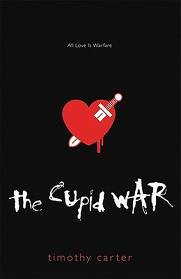
REVIEW: The Cupid War (Kinda like the TV Show Dead Like Me, but with Cupids instead of Reapers)

Carter, T.  (2011).  The Cupid War.  Woodbury, MN:  Flux


Appetizer:  Immediately after deciding *not* to commit suicide by jumping off a bridge, Ricky Fallon slips and falls to his death anyway.

Figures.

Looking down at his broken and dead body, Fallon's soul is approached by an angel.  It would seem Fallon had some unfinished business.  He's to serve as a Cupid, fanning the flames of interest among potential love birds at a local high school, feasting on love (it looks like fudge), dealing with co-workers and battling Suicides or other dead souls with unfinished business who spread depression.

While first walking the halls of his assigned high school as an invisible cupid, Fallon encounters a familiar face from his own life, that of his former "friend," a girl named Susan who had systematically clung to him, separated him from his friends and girlfriend and driven Fallon to consider suicide on the top of that bridge.

As Fallon watches as Susan targets another boy, he begins to suspect that there's something strange about this girl, that she is somehow doing the same work as the Suicides.  The only person who can help Fallon is a girl named Trina, who, somehow, despite the fact that he now exists on a different plane, can still hear Fallon's voice.


I liked the concept of The Cupid War.  It is interesting; the idea of Cupids and Suicides battling for the souls of people to spread love or dispair.  The fact that love is actually a food that the cupids feast upon also has a lot of wonderful potential.

But I wasn't crazy about this book in execution.  The writing felt rough.  A lot of the action scenes were too quick or underdeveloped.  I didn't feel a lot of the tension that the author was trying to create.  I found myself writing "ugh" in the margins of quite a few pages that didn't impress me.  A lot of the plot "twists" were pretty apparent.  The narration also included a lot of telling as opposed to showing.  A lot of tensions were also underdeveloped.  Like Fallon's relationship with his mom.  It felt like an early draft that needed to be expanded and revised extensively.

But that's just my opinion.  What did you think?


Dinner Conversation:

"Ricky Fallon sat on the bridge railing, preparing to jump.  It seemed like the least painful way to die, while ensuring the best chance for success.
He also wanted to cause the least amount of trouble for the city; his father believed a jumper was involved every time there was a delay on the subway.  Fallon didn't want his dad to think he was inconsiderate.  At least, no more than he already did." (p. 1)

"However, as he sat on the edge looking down at the barely visible Don River below, Fallon changed his mind.  It wasn't because of a ray of light from Heaven, or an angel appearing to tell him there was a better way.  Instead, Fallon changed his mind due to a very simple realization.  On Monday morning at school, there would be shock.  By afternoon, however there would be jokes.  He called himself Fallon. The word "fall" was right there in the name.  Sure, it was pronounced differently, but he knew his classmates would make the connection." (p. 5).

"'Every soul has karma,' Bud told him.  "It's the stuff your soul has to work through, the things you do to become a better person.  Some people work off their karma by the time they die, and there's a place for them that you'd think of as Heaven.  Then there's the rest, the people like you, who didn't use their lives the way they should.  If you didn't work it off in your life, you have to work it off now."
"Nobody told me that was the deal!" Fallon said.  "If I'd known that....'" (p. 13)

"...You, pretty boy, are gonna be a Cupid."
..."A Cupid?" Fallon asked.  "You mean...?"
"That's right," Bud replied.  "You're going to make people fall in love."
"Oh," Fallon said.  When it came to afterlife assignments, this wasn't what he'd been expecting." (pp. 14-15).

"Fallon looked at the brick of Love in his hands and thought about all that had been said and written about love throughout the ages.  All the sonnets, poems, and greeting cards, and all the boy-band songs.  Love, he'd heard, was the answer.  God is love, the spiritualists said.  Love made the world go' round, love is the most powerful force in the universe.
Fallon wondered if all those things would have been said if the speakers knew that love was a bunch of big chunks of red fudge." (p. 25)

"'People with severe depressive disorders are the victims of Suicides.  Strong people struggle to hang on, to fight back with drugs and therapy.  Weak ones, however..."
"Jump?" Fallon said quietly.
"Yes," Caleb replied.
Fallon stopped walking.  "Is that what happened to me?" he asked.  "Is that why I wanted to kill myself?'" (p. 42)

"Here, in the afterlife, he had a chance to start over and do something truly great.  He had it in his power to bring happiness to the world.  All he had to do was learn how.
He also had the chance to fight off the forces that had led to his death.  He could literally save lives.  If he stopped only one more Suicide, the world would be the better for it.
What in the world could be better than that?" (p. 66)


Tasty Rating:  !!

LinkWithin

Related Posts with Thumbnails