Wednesday, September 28, 2011

REVIEW: Smile (This book did make me smile--and gave me flashbacks to my braces days)

Telgemeier, R.  (2010).  Smile.  New York:  Graphix.

214 pages.


Appetizer:  Set over approximately four years (between 1988 and 1991, through the middle school years and up into the beginning of Sophomore year) in San Francisco, Smile is a memoir of Raina's tween years and her painful quest to shape her teeth into a smile that wouldn't cause her embarrassment.  It begins simply enough:  Raina is to get braces.  This plan is complicated when Raina trips while chasing a friend and lands on her face, damaging her two front teeth.  Complications ensue.

Many complications.

Aside from the issues with finally getting her smile to be the way Raina wants it to be, she's also dealing with acne, having a crush, realizing what she wants to do with her life, needing her first bra, learning that some of her friends are not so much friends as they are frienemies AND getting her ears pierced.  This book kind of reminded me of a puberty book (like Sex, Puberty and All That Stuff or What's Happening to My Body), but would be much less awkward for a young girl to receive or discuss with an adult.

At one point, Raina notes the need to talk about how tweens feel awkward about their bodies:


I feel like that is exactly what Smile does:  starts a conversation to help girls to feel a little less freakish.

This memoir felt so honest and made me reflect on my own memories of being eleven-twelve-thirteen-fourteen-ish (for better or for worse).  (For better...I focused in on the day I got my braces off in eighth grade.  My teeth felt so slimy!  Then, after I went back to school, Mike P., the boy I kinda-sorta had a crush on, was the first person to notice that my braces were gone.  Very exciting.)

I really liked the way Raina's continuing battle to get her teeth problems under control provided a unifying conflict to bring the story together.  The one aspect that weakened the text for me was the narration at the very end.  The equivalent of a voice over, on p. 206 Raina makes comments like "Instead, I threw my passion into things I enjoyed, rather than feeling sorry for myself" and "I realized that I had been letting the way I looked on the outside affect how I felt on the inside."

*Barfs a little.*

I, of course, agree that these are important messages to give to tween (and even some adult!) readers, the way the narration came in to sum-up the message felt a little too overty/teachy-preachy/didacticy for my tastes.

You had me until page 206, Raina Telgemeier.  Page 206.


Dinner Conversation:


Tasty Rating:  !!!!

Wednesday, September 21, 2011

REVIEW: The True Meaning of Smekday (I still heart it)

The last time I read The True Meaning of Smekday, I listened to the audio book...

And it was magnificent!

This time around, I decided to read the actual text, so the graphic novel portions would be a little easier to follow and so I could write a proper review of the book.

I actually only got about 40 or 50-pages in, before I found myself desperately missing the voice of Bahni Turpin and went back to the Odyssey Award-winning audio book.

(She adds so much personality to the Boov voices!)

And look, I still managed to write a review of the story.

Rex, A.  (2007)  The True Meaning of Smekday.  New York:  Hyperion Books for Children.

423 pages.

Appetizer:  As part of a school assignment and national competition, twelve-year-old Tip (AKA Gratuity Tucci) must write about "The True Meaning of Smekday" and describe her personal experience during the recent alien invasion.

Tip had quite the experience, to say the least.

In this hilarious road-trip story, Tip recounts how her mother was abducted by aliens, how she befriended a Boov alien who goes by the name J.Lo and how together the crossed much of the country in search of Tip's mom.

Although the middle part of the story does feel to drag on a little as Tip and J.Lo go from state to state encountering various characters, I absolutely love the way this novel explores and discusses issue of race, discrimination and the forced relocation of people.  (And those are topics that normally a person would be hard-pressed to say that they "love" anything about discussing them.)

There are so many wonderful humorous moments in the story that even a year after reading this book for the first time, can still make me giggle.

My biggest regret in terms of The True Meaning of Smekday is that I did not listen to or read it soon.  *Bows to Holly who had originally recommended the book to me months and months before I ever got around to reading it.*

I've used this book in my classroom twice so far.  Once, I read aloud a portion of pages 24-29 to demonstrate the misunderstanding of when people (in this case creatures) from different cultures meet and to highlight the power dynamic between different cultures meeting (and from there show how some science fiction novels include cultural critiques and can be a vehicle to discuss race relations as well has historical periods when people from a specific culture were forced to relocate...*wipes brow*  that's a lot for one little read aloud to be able to do.)

The second time I used the book, I first did a pre-reading activity in which my writing students had to invent and describe their own "Smekday" holiday.  Many of them seemed to have a lot of fun with it.  In terms of their thoughts on the book.

I also used the book to discuss audience, since during her narration, Tip mentions several times that she's writing for people in the future.

Mmm, delicious.  So much to talk about.

I have to admit though, *after* reading the book, only a handful of my students enjoyed the book as much as I did.  Many seemed to think it was too long.

My argument that the meandering middle just provided "more for them to love" only went so far.


Dinner Conversation:

"ASSIGNMENT: Write an essay titled THE TRUE MEANING OF SMEKDAY. what is the Smekday Holiday? How has it changed in the year since the aliens left? You may use your own personal experiences from the alien invasion to make your points. Feel free to draw pictures or include photographs" (p. 1)

"It was Moving Day.
Should that be capitalized? I never would have capitalized it before, but now Moving Day is a national holiday and everything, so I think it should be.
Capitalized.
Anyway.
It was Moving Day, and everybody was crazy" (p. 3).

"I remember Apocalypse Hal was on the corner by the Laundromat.  Hal was a neighborhood street preacher who worked at the fist and crab place next door.  He wore a sandwich board sign of Bible verses and shouted angry things at passerby like "The end times are near" and "Seafood samples $5.99."  Now his sign just read "TOLD YOU SO," and he looked more anxious than angry.
"I was right," he said as I passed.
"About the fish or the apocalypse?" I asked.  He followed beside me.
"Both."  (p. 4).

"I stifled a laugh.  "J.Lo?  Your Earth name is J.Lo?"
"Ah-ah," J.Lo corrected.  "Not 'Earth.'  'Smekland'."
"What do you mean, 'Smekland'?"
"That is the thing what we have named the planet.  Smekland.  As to tribute to our glorious leader, Captain Smek."
"Wait."  I shook my head.  "Whoa.  You can't just rename the planet."
"Peoples who discover places gets to name it."
"But it's called Earth.  It's always been called EArth."
J.Lo smiled condescendingly.  I wanted to hit him.
"You humans live too much in the pasttime.  We did land onto Smekland a long time ago."
"You landed last Christmas!"
"Ah-ah.  Not 'Christmas.1  'Smekday."
"Smekday?"
"Smekday"  (p. 28).

"Okay.  Starting before the Boov came.
I guess I really need to begin almost two years ago.  This was when my mom got the mole on her neck.  This was when she was abducted.
I didn't see it happen, naturally.  That's how it is with these things.  Nobody ever gets abducted at a football game, or at church, or right after Kevin Frompky knocks all your books out of your hands between classes and everybody's looking and laughing and you have no choice but to sock him in the eye.
Or whatever" (p. 33).

"My birth certificate says "Gratuity Tucci," but Mom's called me Turtlebear ever since she learned that "Gratuity" didn't mean what she thought it did.  My friends call me Tip.
I guess I'm telling you all this as a way of explaining about my mom.  When people ask me about her, I say she's very pretty.  When they ask if she's smart like me, I say she's very pretty" (p. 37).


Tasty Rating: !!!!!

Tuesday, September 20, 2011

REVIEW: Mad Love (is tons of mad fun!--but maybe a little too chaotic)

Selfors, S.  (2011).  Mad Love.  New York:  Walker & Company.

323 pages.


Appetizer:  Alice has been telling a lot of lies lately.  She's had to.  The biggest lie is that her mom, a semi-famous romance author, is "overseas," researching her next book.  The reality is far less glamorous, and despite being tired of the lies, Alice does everything she can to maintain her family's secrets.  This becomes almost impossible though, when the family savings are close to gone, her mom's publisher is demanding the next book and Alice speaks on her mother's behalf at a book event and a strange young man in the audience insists Alice tell his story.

The possibly crazy/super attractive/vaguely stalkery guy always wears a black hoodie and claims to be Cupid.  Yes, The Cupid.  But he goes by Errol now.

When Alice refuses to write "Errol's" story, he begins to make her romantic life (or lack there of) complicated.  The skateboarding boy--Tony--who Alice has been admiring from afar is suddenly in her life adding just enough stress that Alice might go crazy (one of her biggest fears).

I know it may seem like it took me over a month to read this book, but don't take that as a judgment on Mad Love.  Blame moving across the country and starting a new job.

I wanted to sit around and read this book.

What a breath of fresh air!

If you may remember, few but dear readers, I complained during my Starcrossed review that I was stuck reading a string of mediocre books that were related to Dudley the Dissertation's topic, the gods and creatures of myth.  Mad Love has cut the string!  It felt sooooo good to dip into a book by someone who can string a bunch of words together in a way that is clever, amusing and tells an engaging story.

This book is well-written and funny.  I liked the exploration of Alice struggling to write a romance novel.  I actually wound up reading a portion aloud to my writing class (When Alice looks at writing guides and lists the rules for writing a romance:  pp. 82-85.)

Although, by mid-novel, I did wish things would speed up plot-wise and that there'd be a little less random craziness and some more clear direction of where the story was going (and that Alice would make more progress on her goals).  That feeling didn't leave as I continued to read.  (Random horrible storm that Alice must go out in to rescue someone at the end?  Whattheheck?!)  In the Author's Note, Suzanne Selfors noted that she had to revise this story extensively.  Frankly, I thought it could have used another revision or two.  It felt like there were a lot of wonderful pieces that just didn't quite fit together.  My  head was left feeling a little crowded by the book's end.  Crowded, but also amused.


Dinner Conversation:

"When you're sixteen, summer is supposed to spread before you like a magic carpet, waiting to carry you to new, exciting places.  Paperback novel in hand, bare feet buried in speckled sand, long kisses with a boy in a kayak--that's what it's supposed to be about.  Summer, with its coconut and pineapple flavors, with its reggae rhythms, with its endless possibilities for adventure and romance.
But if you asked me on that Monday in July, I'd tell you that there was nothing exciting about my summer forecast.  My magic carpet looked more like a plain, beige indoor-outdoor kind of thing and it was nailed solidly to the ground" (p. 3).

"It's easier to tell lies when there are no loving eyes staring back at you.
I told lots of lies.
Deception had become my life.  It wasn't a compulsion.  I didn't do it for some sort of thrill.  I lied constantly because I'd promised my mother that I'd never tell anyone the truth about our situation.  Lie upon lie upon lie, heaped into a great big pile.  Like a dung beetle, I maneuvered that pile everywhere I went.  And I was sick of it" (p. 9).

"The guy stood.  "I have a question for Alice."
I tapped my flip-flops against the floor.  Though his eyes were somewhat shaded by the rim of his hood, his gaze was intense.  "Yes?" I asked.
"I have a love story to tell," he said.  "And I need you to write it for me.  When can you get started?"
A few women chuckled, then a long span of silence followed as the guy continued to stare at me.  Was this a joke?
Tom cleared his throat.  "You mean you want Alice's mother to write it?  Alice is the Queen of Romance's daughter.  Maybe you didn't hear my introduction."
"I know who Alice is," the guy said.  "I want her to write my story."
The word "want hung in the air, adding an eerie note to the atmosphere.  I shifted in my seat.  "Well, that's very nice and everything, but it's your story so you should write it yourself."
"I'm not a writer," he said.  "But I lived the story, so I remember every single detail.  All you have to do is read through my notes, then write it" (p. 15).

"My name is Errol, but I used to be called Eros.  Most know me as Cupid."  He continued to stare out the window.  "I wasn't named after Cupid.  I am Cupid.  The original, one and only Cupid."
Music and customer chatter competed with his statement, so no one turned to gawk or snicker.  But I'd heard him.  A pained smile spread across my face as I pretended to be interested.  My suspicions were proven.  Something was wrong with him and the last thing I needed was to be on his radar.
"There's only on thing I want," he continued.  "And that is to tell my love story to the world.  Not the version you find in mythology books, but the real story.  The true story.  I'm the only person who can tell  it and I want you to write it" (p. 55).

"Why couldn't I write Untitled Work in Progress for my mother?
Being the Queen of Romance's daughter made me the Princess of Romance.  I may not have inherited her Nordic bone structure, her sexy figure, or her naturally plump lips, but surely I'd inherited something.  And maybe that something was the knack for storytelling.  I'd gotten Bs in English.  I'd been raised on the romance genre.  It was such an obvious answer.  And what else was I doing with my summer?
Nothing!
I could devote every minute of every day to the project.  It didn't have to be a Pulitzer Prize winner, just something that Heartstrings Publishers would accept.  This could work.  It would work.  It had to work."  (pp. 81-82)

"Someone was watching me.
Errol.
He stood across the street, looking right at me.  Foreboding rolled over me, dark and sinister.  If ever there was a time to run, it was then.  But I didn't run.  I couldn't.  Like in a nightmare I stood rooted to the spot.
"Alice?" Tony touched my arm.
Errol's hood concealed most of his face, but his mouth was tight with determination.  He held his left arm  straight out.  Then he pulled his right hand to his chest.  Something was going to happen.  Something bad.  I felt as helpless as a small creature caught in headlights.
And then, BAM!
Something collided with my chest.  A jolt shot through my body, electrifying the tips of my fingers and toes" (pp. 87-88).

"In an odd way I suddenly felt better, because of the two of us standing in that bedroom, Errol was clearly the crazier.  He thought he was the Roman god Cupid.  Sure, I might have heard a voice in my head; sure, I might have gone a bit wacko for a few hours, but I had no delusions about my identity.  I wasn't Isis, or Supergirl, or Bella Swan.  I was Alice Amorous, daughter of a semifamous, mentally ill romance writer, who would soon be getting food stamps if her mother didn't turn in another book.  Which I was supposed to be writing." (p. 137)


Tasty Rating:  !!!!

Sunday, September 18, 2011

REVIEW: Wonderstruck (I wasn't struck)

Selznick, B.  (2011).  Wonderstruck.  New York:  Scholastic Press.

629 pages.

Appetizer:  Set in Gunflint Lake, Minnesoa in 1977, Ben is missing his mother who recently died in a car accident.  During a stormy night he walks to his old home from his aunt's house.  Among his mother's stuff, he finds her rainy day fund and a book called Wonderstruck with a hand-written note that mentions a man named Danny and a bookstore bookmark of a store in New York City.  With these few clues, Ben hopes that he may finally find and know his father.  Just as he picks up the phone and try to call the number for the bookstore, lightning strikes the house and Ben's life is once again changed.

This picturebook/novel is also the story of a lonely girl named Rose in Hoboken, New Jersey in 1927.  She admires an actress in a silent film named Lillian Mayhew.  After learning that Lillian will be in a play in New York City, Rose decides to run away to see her.

Both of their quests will take Rose and Ben to New York City and to the American Museum of Natural History.

Ben's story is told almost entirely in text and Rose's story is told almost entirely in illustrations.  Despite the differences in settings, there are moments when the tales connect and (eventually) unite.

When I began reading, I was frustrated because of the seemingly wide gaps between the two stories.  Initially only images like stars and lightning connect the two.  My brain was desperate for the two stories to unite.  Part of what made me fall totally and completely in love with Selznick's previous giant-picturebook/novel, The Invention of Hugo Cabret, was the way the setting, medium and content all worked together to add meaning to the story.  By the third or fourth time that I read The Invention of Hugo Cabret, I was still finding new meanings and connections among the different aspects of the story.

I can't say the same will happen with Wonderstruck.


Don't get me wrong, this novel is still impressive.  It has a E.L. Konigsburg, From the Mixed-Up Files of Mrs. Basil E. Frankweiler feel to it.  It just didn't *capture* me the way Selznick's Hugo Cabret did.

As a book, it does demonstrate a love of astronomy, dioramas, wolves, and museums, expresses a sense of loneliness and searching that I found very relatable and shows examples of the experience of being deaf in different times.

But still, Wonderstruck didn't capture my imagination or impress me the way The Invention of Hugo Cabret did.  (Not that books should always be compared.  But since these two stand alone in terms of their form, it's hard not to make comparisons.)

I'd be curious to know what some of you thought of the book, Few But Dear Readers.  Am I alone in my stance?

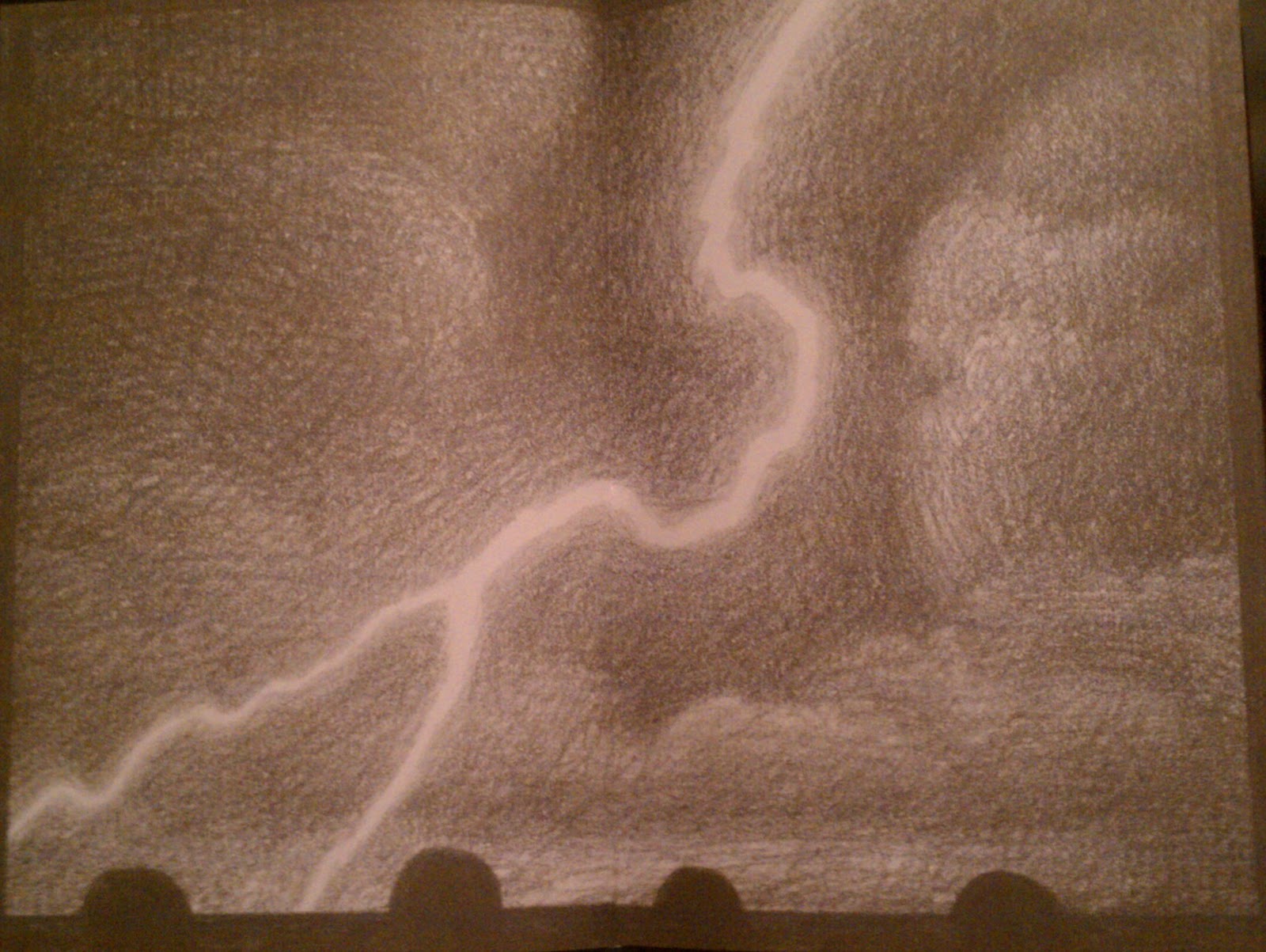
For the time being, here's one of the early moments when the stories overlap for you to enjoy.  Mary is watching a movie of a storm and Ben is in his mother's house, looking through her stuff as a storm approaches.  Enjoy.


(pp. 120-126)


Dinner Conversation:

"Something hit Ben Wilson and he hopened his eyes.  The wolves had been chasing him again and his heart was pounding.  He sat up in the dark room and rubbed his arm.  He picked up the shoe his cousin had thrown at him and dropped it on the floor.
"That hurt, Robby!" (p. 16).

"Ever since the accident, the wolves had appeared, galloping across the moonlit snow, red tongues wagging and white teeth glistening.  He couldn't figure out why they were stalking him, because he used to love wolves.  He and his mom had even seen one once from the front porch of their house.  The wolf had looked beautiful and mysterious, like it had stepped out of a storybook" (p. 17).

"He had believed his mother when she told him he'd never be lost as long as he could find the North Star.  But now that she was gone, he realized it wasn't true.
The mysterious quote from his mom's bulletin board echoed again in his mind.
We are all in the gutter, but some of us are looking at the stars" (p. 27).

"Was it days later or only a few minutes when his aunt Jenny appeared?  Her eyes were red and watery. She sat on the bed and stroked his hair.  He thought he could smell the food she'd been cooking at the lodge as she ran her fingers down his cheek just like his mom used to.  He watched her lips move.  He looked at the nurses talking to each other.  His head felt like it was full of leaves.  He opened his mouth to say he couldn't hear but nothing came out.
The nurse handed Aunt Jenny a piece of paper and a pen.  She wrote a note and handed it to Ben.
"I know you can't hear.  Don't try to talk.  Just lie still."
Ben's head throbbed.  How did she know what he'd been thinking?
"You've had an accident.  You're going to be okay, but you were hit by lightning." (p. 175)


Tasty Rating:  !!!

Tuesday, September 13, 2011

REVIEW: The Facts Speak For Themselves (but don't use quotation marks)

Cole, B. (1997). the facts speak for themselves. New York: Puffin Books.

184 pages.

Appetizer: Thirteen-year-old Linda was escorted into the police interrogation room with blood still under her nails. After being interrogated about the deaths of two men (a murder-suicide situation between the boyfriend and boss of her mother that Linda is somehow at the center of), Linda is separated from her little brothers and mother, who need her to watch over them, to stay at a center run by nuns.

She has meetings with a social worker to discuss her childhood of abuse, discrimination, abandonment and responsibility over her brothers.

Linda's story is touching, heartbreaking and the amount of responsibility she took on at such a young age is shocking.

This can be a wonderful book to give voice to the secret pains and dark scars that many children and adults have.

Although, as I was reading, I did wish that quotation marks were used to better mark dialogue.

This book may be dark, but it is also real...and difficult to put down after you start reading. (I know that if it were a movie, I'd hate it. It's kind of like Requiem for a Dream. You just know things are going to get worse and worse.)


Dinner Conversation:

"The woman policeman says why don't you come in here, and so I went. It was a little room with a table and some chairs. That was all. Instead of a window, there was a big mirror. I wouldn't look at that. I didn't want to see myself. I sad down and folded my hands. There was still blood under my nails, so after a minute I put them under the table" (p. 9).

"Listen, young lady, Sister says. You're not in charge anymore. This is a difficult situation, and it's going to take a little time to straighten out. Two men are dead, she says and bites her lip.
What two men?
Mr. Green and Mr. Perry.
That was how I found out. Jack had died in the ambulance and Frank had walked down into the basement of the parking ram and shot himself" (p. 20).

"I gave her the facts, and she wrote them up in a preliminary report. I know, because I got it out of her bag when she came back one afternoon to warn me about what was going to happen.
There's going to be a hearing, she says, and I want you to be as straight with the judge as you are with me" (p. 23).

"I want to write my own preliminary report, I said.
She looked at me a long time.
I think that's a very good idea, she says finally.
Will they read it?
Yes, she says. I'll make sure they do" (p. 25).

"Looked at in a certain way, the whole history of the world seemed arranged so we could meet that first time.
He said we were doomed by circumstance. Our fate was in the facts" (p. 141).


Tasty Rating: !!!

Saturday, September 10, 2011

Louisiana Series: An audio Book review of My Louisiana Sky (AKA the day I began to worry about Coral Snakes)

As a way to get to know my new state of residence, I've been trying to read literature about Louisiana. 

(The selection has proven to be a little...pathetic.  There's not much of a selection.  Especially since I'd like to read about more than just New Orleans.)

First off, let me tell you that my general knowledge of Louisiana was very limited before moving here:  Hurricane Katrina, other hurricanes, cajuns, Remy from the X-men, alligators, oil spill, Mardi Gras, True Blood/The Southern Vampire series (which, admittedly I've seen every episode of/read every book).

It's a pretty limited view of an entire state.

I actually had to bite my tongue during my initial Skype job interview to stop myself from asking if alligators and hurricanes were something I should worry about in the area I would be moving (Answers:  Not too concerned unless a hurricane displaces the alligators and Yes, be concerned:  power outages possibly lasting weeks, high winds and rain during the storms.)

So, I was left feeling like I wanted to see some of the other ways that my new state is presented.  I--of course--turned to children's literature.

I decided to begin my acquaintance (and this new series of reviews) with Louisiana in children's literature by listening to the audiobook of Kimberly Willis Holt's My Louisiana Sky.  She's the author of When Zachary Beaver Came to Town, which I read five or six years ago and remember enjoying.

The premise is that Tiger Anne--a girl living in Saitter, Louisiana--faces a choice.  She and her grandmother have always had to look after Tiger's mother and father who are both "retarded" (to use the dated language in this historical novel).  When tragedy strikes, Tiger must face the choice of moving to Baton Rouge to live with her stylish aunt and staying home to care for her parents.

An angsty premise that is one-part coming of age story and two-parts character figuring out her own identity through a major decision story.  I could get into it.

I especially liked that Tiger was a tomboy who played baseball better than most of the boys.

I downloaded and started listening...and absolutely *hated* the tones the narrator used to voice the various characters.  Sometimes her Southern accent didn't match the Louisiana accent I've been enjoying for the past few weeks.  Often when she gave voice to minor characters, she spoke in tones that made them sound completely and unnecessarily idiotic. 


I was not a big fan.  I probably would have enjoyed the story more if I read it.

I did eventually ease into the story.  Especially when a character died of a heart attack after seeing a coral snake.  (So...coral snakes...is this something I have to worry about now?)


Louisiana, please advise.

Then towards the end of the book, there was a hurricane.

Sigh.

At least there weren't any alligators.

How much I learned about Louisiana:  Not too much.
How much I felt comforted about some of the supposedly-scary aspects of the state usually presented by the media:  Also not too much.

I have since discovered there was a children's movie made of the My Louisiana Sky, starring Juliette Lewis and a younger Michael Cera, among others.

...

Netflix guesstimates I'd give the movie two stars.

...

I did add the movie to my queue.  It will stay at the bottom and I'll get to it when I get to it.

Monday, September 5, 2011

REVIEW: Darth Paper Strikes Back (YAY!!!!!)

Once again, I must apologize for the lack of posts.  It would seem that as stressful as preparing to move halfway across the country was, actually moving and starting the new job is even *more* stressful.

Lucky for me, there was a happy book delivery to my new home....


I have been waiting for this book to come out for YEARS several months.  I absolutely loved The Strange Case of Origami Yoda and taught it to my undergraduate children's literature classes.  It was one of the few books that the vast majority of my students seemed to enjoy.  (There were, of course, always a few Star Wars-haters or disinterested-ers who couldn't get into it.  There were also people embarrassed to be seen carrying around a book with such a nerdy cover.

Then there's me.  I want a poster of this cover to put up in my office.*  Whatever.)

But more than the fun Star Wars references, Angleberger seems to *get* it.  He seems to truly remember what it is to be a kid; the concerns and the humor.

So, I was very happy about the sequel:  Darth Paper Strikes Back....


[Cue Star Wars music!!!!!!!!!]


Appetizer:  "It is a dark time at McQuarrie Middle School."  Harvey has been causing trouble by making an origami Darth Vader and it's only the first day of seventh grade.  Worst of all, Dwight has been suspended and may have to go to a correctional and remedial education facility.  Before Dwight left the school with his Yoda finger puppet, Yoda managed to give one last bit of wisdom:  To ask Tommy, Kellen and some of the other kids at McQuarrie to build a case file to prove that Dwight isn't a danger to anyone.

What follows are the accounts of many of the seventh graders, speaking about the good deeds Dwight (and Yoda) did over the summer at the skate park and during the fall in science class and at other events.

The fact that Angleberger includes a "multicultural inclusion gone wrong" episode was of particular interest to me.  Caroline, who was a love interest to Dwight in the previous book, but who has now started going to a private school, is having trouble with an "understanding our differences" policy at her school since she is the one who is different.  Caroline has a severe hearing impairment.  She usually reads lips, but since her new classmates try to converse with her by yelling or using sign language (which Caroline does not use) she is having trouble understanding them.

Yoda's advice to Caroline *does* involve telling a lie (which I won't reveal the specifics of).  I wasn't too crazy about the lie.  But the fact that the situation was included and that Yoda/Dwight still provided a fun solution that made me think Angelberger or Yoda needs to start an advice column for middle schoolers.  He does an amazing job of encouraging empathy across different backgrounds and experiences.

As I continued to read Darth Paper Strikes Back, a few concerns did come to mind.  In this book, Harvey is presented as being a villain.  Although I will admit he was my least favorite character during the first book, he still represents a very real characterization.  So, I wanted to see a bit more understanding of his perspective sooner.  Also, this book includes pseudo-swear words (You know, %$#@, etc.).  The reason I mention this is because I know for a fact that second graders read this series.  I could see parents of children that young being upset by such typing.  (There was also use of the word "crap" on page 71, which, when I was little I used to get into debates with other kids over whether that was a swear word or not.  The character who uses the word does get in trouble for his bad attitude after using the word.  But still... *shrugs*  Parents of second-graders be warned.)

This is a series that grows with the students though.  The first book included a lot of different voices in episodic short chapters and had drawings in the margins throughout the entire story.  Darth Paper Strikes Back includes longer chapters, fewer voices, conflicts that build across chapters and, due to some of the plotting, the margin illustrations are not used in the final third of the story.  The book is slowly helping younger readers to transition to novel reading.  Good show.  Good show, I say.

Angleberger also begins to build an argument about the way creative and unusual kids are treated under the "Teach to the Test" mentality that schools have.  Here's an excerpt from Tommy's point-of-view that demonstrates this:

I was almost to my locker when I saw Principal Rabbski up ahead.  She likes to stand in the middle of the hallway so that all the kids have to detour around her. 
I put my hand up and pointed Origami Yoda right at her. 
"If you strike down Dwight, he will grow more powerful than you can possibly imagine!" said Origami Yoda. 
Rabbski sighed. 
"Tommy, I think it's time you and I had a little talk." 
..."Listen, Tommy," she started.  I've heard about your petition or whatever it is that you're going to give the school board tonight.  I can't talk to you about another student's disciplinary problems, but there are a few things you need to understand." 
She had a lot to say.  A lot of it was about the Standards of Learning tests that we have to take and how important they are to the students and to the school.  She said some students were a constant distraction from the Standards of Learning.  Not only were they hurting themselves, they were also hurting other students and the whole school, since school funding was based on test scores. 
"When I see you in the office for screaming at another student one day, and the next day you're walking down the hall with a Yoda puppet, being disrespectful to me, that just proves my point," she said.  "You're a good kid, but another kid has got you confused and distracted.  I need you to put Yoda away.  Put your petition away.  And concentrate on the real reason you're here:  To learn.  To ace the Standards test." 
Well, I was confused and distracted, but there was no way I was buying all that.  It had an Emperor Palpatine sound to it.  (pp. 129-131)
Well put, Tommy.

*Sets timer and begins waiting for the third book.  Also starts taking bets on whether there will be three or six books in this series.*


Dinner Conversation:

"It is a dark time at McQuarrie Middle School...
When did it start?  I can tell you exactly when it started.
The first day of school.  The very first day of seventh grade.  We didn't even get one good day.  We got, like, five minutes" (p. 1).

"Paperwad Yoda?  Sorry, this isn't the year of Paperwad Yoda."
And then he goes, "Bom bom bom bom-ba-bomb bom-ba-bomb."  Vader's theme.
And he sticks out his hand and there it is:  an origami Darth Vader, made out of black paper, with shiny silver eyes and a red paper lightsaber.
There are a lot of things that might have happened next.  I was about to say, "That's awesome," because I did think it was awesome.
But before any of us guys could say anything like that, Rhondella says, "Aww, it's so cute!"
And Sara says, "Yeah, it really is cute, Harvey."
And Amy says, "He's so teeeny!"
Harvey was furious, of course."  (pp. 2-3)

"This case file is to try and save Dwight and Origami Yoda from the school board.  His is it going to save them?  I have no idea.  But Origami Yoda said to do it, so we're doing it.
That was the last piece of advice Origami Yoda was able to give us.  Since then we've been on our own.  Actually, it's worse than that...
Instead of Dwight and Origami Yoda, we're stuck with Harvey and Darth Paper!" (pp. 8-9)

"Dwight looked like a zombie.  He was too freaked out to say anything.
But he held up Yoda, and Yoda said, "Out of school kicked we have been."
"Kicked out?  For what?  For having Yoda?  No way!" said Kellen.
"Way yes," croaked Yoda.  "Save Dwight you must."
"How?"
"The truth for the school board you must write.  Another case file is needed."
I was going to ask him something useful about the case file--like, why we needed to write it or what it should be about--when Kellen butted in.
"Should I doodle on it again?" asked Kellen annoyingly.
"Hurt that could not, I guess," answered Yoda.
The Dwight's mother and Principal Rabbski came out of the office, and I didn't have a chance to ask my useful question" (pp. 16-17).

"Dear School Board,
Having had some time to reflect on the incident with the pre-eaten wiener, I have come to the conclusion that Dwight/Yoda are the good guys while the rest of the kids around here are a pack of wild savages who would think it was really funny if I ended up puking from food poisoning or getting a tapeworm or worse!" (p. 92)


Tasty Rating:  !!!!


*Can somebody make this happen?  I've done multiple searches and an Origami Yoda one doesn't seem to exist.  Who wants to be a hero and find/make me a poster?!

Sunday, August 14, 2011

REVIEW: Divergent (If The Giver Bought the Hogwarts Houses a Drink, Nine Months Later This Is the Book a Stork Would Deliver to YA Readers' Doorsteps)

Roth, V.  (2011).  Divergent.  New York:  Katherine Tegen Books.

487 pages.


Appetizer:  In the future and in the remains of Chicago, people choose factions to devote their life to:  Candor for those who privilege honesty, Abnegation for those who value selflessness, Dauntless for the brave, Erudite for those who devote themselves to intelligence and Amity for those who focus on peace.  There are also an unlucky few who are faction-less, who live in poverty.

At the age of sixteen, people are tested and then choose their faction during a ceremony.  Raised by abnegation-ist parents, Beatrice--or Tris--faces a tough choice.  She has never felt like she truly belonged with her selfless parents.  The results of her test complicate matters further.  Beatrice learns she is divergent--she could potentially belong to three of the factions--a fact she is told to keep secret as she faces the choice between betraying her parents' hopes for her and pursuing her own dreams.

Divergent is an interesting concept.  It's a blending of the sorting into Hogwarts houses with the Hunger Games and The Giver.  The execution of this story, however falls short of the blogger and insta-movie deal hype that I heard about this book.  It also falls short of the stories I'm comparing it to.  Although Tris's struggle to make her own choice for herself is engaging--and is a central struggle for any young person who is contemplating making choices that his or her family disagrees with--it falls short when compared to Katniss sacrificing herself for her sister in The Hunger Games.

The deadly challenges Tris faced while being initiated into the Dauntless faction were hard to believe as permissible in the society.  While logically, I knew that Roth was constructing a world different from my own and was critiquing the hostile and horrible environments that the Dauntless characters live in, I just couldn't quite believe the world she was creating.  Wouldn't a brave person speak out against the injustice and suffering they see around them?  I found myself mumbling "lawsuit" repeatedly as the Dauntless initiates were required to jump onto or off a moving train or leap off the side of a building with no support, safety nets, training or proper instruction.  I repeat, lawsuit.

Maybe I'm just not "dauntless" enough to believe in this world or maybe I've been too sheltered all my life/too lucky to ever experience a group dynamic with such a competitive and dangerous mentality.

*Shrugs*

As a reader, I also needed to feel a clearer threat to the society or to Tris.  The Dauntless train hard to protect what remains of human society...from what?  While there are hints that Denmark Broken-Chicago is a kind of stinky place within the first 300ish pages, I needed a real threat sooner.  I also needed to understand why being divergent was dangerous sooner.  Basically, this book could have--and should have--been 150 pages shorter.

But having said that, there were some moments in this book that really captured my attention and engaged me.  Whenever Tris faced injustice at the hands of her fellow initiates or at the hands of the Dauntless leaders, I wanted her to come back and kick a-- *ahem* ...and kick bum-bum.  (And she was a tough character who wanted to do just that.)  I also found some of the subtle tensions and themes very engaging; such as the propaganda the erudite faction was creating against the abnegationists or the way Tris had to accept the idea that some of her friends were also her competition.

Overall, this is another one of those books that doesn't seem to meet the hype, but is still enjoyable.  Recommend it!  Just don't imply that it's the best thing in THE HISTORY OF THE UNIVERSE/SINCE SLICED BREAD/IN THE WORLD OF YA LITERATURE as you do.


Dinner Conversation:

"There is one mirror in my house.  It is behind a sliding panel in the hallway upstairs.  Our faction allows me to stand in front of it on the second day of every third month, the day my mother cuts my hair" (p. 1).

"Today is the day of the aptitude test that will show me which of the five factions I belong in.  And tomorrow, at the Choosing Ceremony, I will decide on a faction; I will decide the rest of my life' I will decide to stay with my family or abandon them" (p. 2).

"People who get this kind of result are..."  She looks over her shoulder like the expects someone to appear behind her.  "...are called...Divergent."  She says the last word so quietly that I almost don't hear it, and her tense, worried look returns.  She walks around the side of the chair and leans in close to me.
"Beatrice," she says, "under no circumstances should you share that information with anyone.  This is very important" (p. 22).

"I realize that the decision might be simple.  It will require a great act of selflessness to choose Abnegation, or a great act of courage to choose Dauntless, and maybe just choosing one over the other will prove that I belong.  Tomorrow, those two qualities will struggle within me, and only one can win" (p. 37).


Tasty Rating:  !!!

Wednesday, August 10, 2011

REVIEW: Starcrossed

Angelini, J.  (2011).  Starcrossed.  New York:  HarperTeen.

487 pages.  (Those be a lot of pages!  And I read every single one...like a big girl.)


BEAUTIFUL COVER:  Check.

INTERESTING PREMISE:  Helen is attracted to/repelled by a new boy on the island and learns that they are members of waring factions descended from the Greek gods.  Check.

A GOOD ENGAGING STORY:  ....

A GOOD ENGAGING STORY?

...

...

Meh.


Appetizer:  Sixteen-year-old Helen just wants to be normal.  But as a six-foot tall, beautiful, blond that all the Nantucket tourists stare at, it would seem she's doomed to stand out.  (Poor baby.  Don't you just tear-up at the thought of her burden?  It does turn out that Helen is hiding some big secrets though--including super strength and speed--but by the time I realized that she had real secrets, I was already annoyed by Helen's self consciousness.)


When the Delos family moves to town, Helen has a strange reaction to the mere sight of one of the boys in that family, Lucas:  She wants to kill him.  (WTF?  Anger, violence, hate and attempted murder are the new sexy?!  No thank you.)  She also starts to have dreams of a dry land that also hosts the three Greek fates.  To make matters worse the Delos family now know her secrets, but can she trust these potential enemies to keep them?  And what are they and Lucas hiding?  And who else might be searching for Helen?


Let's admit this straight away--I did not enjoy this book.  Normally, I probably wouldn't have finished or written a review on it.  But since Starcrossed was related to my dissertation research, I forced my way through it.

Okay, that disclaimer out of the way, on to the rest of the review...

Nothing about Helen or Lucas really grabbed me.  I found the starting point of I-Hate-and-Want-to-Kill-You to be an upsetting starting point for a romance and the continuing violence against women (with few consequences) was disturbing.

For example, one of the Delos family members, Cassandra, attacks Helen with a sword to test a theory:

"Cassandra swung the sword.  In that millisecond Helen knew she'd had a good life, because she suddenly loved it so much that she could have wept with gratitude.  She'd had amazing friends, the best dad in the world, and a strong, healthy body.  She'd even experienced the joy of flight.  And once, just once, in the middle of the night, she'd almost kissed the only boy she'd ever wanted.... (p. 254-255)
Nice defeatist attitude, Helen.  If your life is so great, why don't you try to keep it as a supposed-friend swings a sword at your neck?  You don't have to fight back, but a nice duck or sidestep would be appropriate.  Let's continue with the scene...
Helen felt a strange, vibrating tickle, like someone had pressed a gigantic kazoo against the side of her throat and blown on it.  She saw Cassandra's eyes widen as she pulled the blade back from the side of Helen's neck and looked at it."   
..."'I was right.'  She dropped the sword and grabbed Helen in a hug.  Then she started jumping up and down, making Helen jump with her.  "You're not dead!  This is...You have no idea how happy I am I didn't just kill you!" she squealed."  (p. 254-255)
What the heck?  Seriously?

Look, I am open to a book exploring violence, victimization and empowerment...but I found Starcrossed's presentation to be thoughtless with almost no consequences of actions and choices included.

Both good characters and bad characters hurt characters who pose no threat to them.  Multiple times throughout the story, Helen is abused by Hector Delos, a supposed friend, under the premise that he is training her.

Helen is also threatened many times and in many ways, but never fights back.  (This, in theory, could be a great message about remaining in control, not rising to the bate or advocating peace, but since Helen learns she's invulnerable to weapons, and so just let's herself get hit, it's not exactly a model impressionable young readers should follow.)

Plus, the way the Delos family is constructed reminded me a little too much of the Cullen family in Twilight.  Then there was the way that the entire family--whether they liked Helen or not--devoted their lives to protect her.  Like in TWILIGHT!  The fact Helen lived alone with her dad.  Also Twilight-ish.  The fact that she starts a relationship with a boy who wishes to protect her but resists her and all of his urges to be with her sexually--STINKS OF TWILIGHT!

Now would be a good time to accuse me of having Twilight on the brain...but honestly, I don't.  I haven't reread the books in year or so.

Also, I was not crazy about the way the book played with point-of-view.  The vast majority of the story is told from Helen's perspective.  That's fine.  Then suddenly, there are small segments from one of the villain's perspectives.  Okay, I guess.  The suddenly we see Lucas's perspective.  Ummm, why?  And within the last 100 pages, while being under the guise of third-person limited with Helen's perspective, the narration still briefly dips into other characters' thoughts.  Sloppy.  I just wanted the narration to be consistent.

Sigh.  I feel like I've had a string of mostly negative reviews over the last couple of months when it comes to these vaguely dissertation related myth books.  While I of course enjoy growing more and more snarky, I am starting to feel bad for the string of authors whose books I've been critical of.  Let us all keep our fingers crossed that the next book in my ol' dissertation mountain will entertain me more.


Dinner Conversation:

"Some of the Labor Day tourists were staring at her, not unusual, so Helen tried to turn her face away as subtly as she could.  When Helen looked in a mirror all she saw were the basics--two eyes, a nose, and a mouth--but strangers from off island tended to stare, which was really annoying" (p. 2).

"'But I really thought you'd be more interested in the Delos family.  You'll be graduating with a few of them.'
Helen stood there as Delos ran around her head.  The name meant nothing to her.  How could it?  But some echoey part of her brain kept repeating "Delos" over and over" (pp. 11-12).

"Secretly, Helen had always felt she was different, but she thought she had done a pretty good job of hiding it her whole life.  Apparently, without realizing it, she'd been sending out hints of that buried freak inside of her.  She had to try to keep her head down, but she wondered how she was going to do that when she kept getting taller and taller every damn day" (p. 23).

"Lucas was standing in front of his locker about twenty feet away, staring back at Helen while the world waited for gravity to switch back on.  He was tall, over six feet at least, and powerfully built, although his muscles were long and lean instead of bulky.  He had short, black hair and a dark end-of-summer tan that brought out his white smile and his swimming-pool blue eyes.
Meeting his eyes was an awakening.  For the first time in Helen's life she knew what pure, heart poisoning hatred was" (pp. 43-44).

"No one of regular human strength could have stopped Helen from strangling him if she set her mind to it.  Lucas was like her.
The thought made her stomach heave.  How could she be anything like someone she hated so desperately" (p. 70).

"Helen suddenly realize dhow many random events and raw impulses had driven her decisions these last few days.  When she thought about it, it was as if she had stopped choosing for herself days ago.
"The Furies won't allow us to avoid each other," he said in a dead voice" (p. 81).


Tasty Rating:  !!

Wednesday, July 20, 2011

REVIEW: Vordak the Incomprehensible: How to Grow Up and Rule the World

Vordak/Scott Seegert.  (2010).  How to Grow Up and Rule the World.  New York:  Egmont.

196 pages.


Appetizer:  Evil Vordak the Incomprehensible has some advise for all of us "inferior" ones:  How to grow up and rule the world (in case you didn't figure it out by the book's title).  While regularly asserting his superiority, Vordak provides essential information about any potential evil villain's behavior, costume, lair, laugh, plans, etc., as he or she seeks world domination.

This how-to guide includes contracts, quizzes, commandments, scenes that could be acted out, question and answer sections, charts and illustrations that will amuse readers.  (I could particularly see third or fourth-grade boys who have just finished Diary of a Wimpy Kid, Captain Underpants or the Alcatraz Versus the Evil Librarians series loving this book.)  I think this book's varied structure will keep kids engaged.  (Although, every now and then, I did happen upon a page that confused me a little.  Like this one from page 43...


It took me a minute to realize that the "no" and "yes" weren't a part of the dialogue on the page and were instead noting which was the appropriate response.  I would have preferred if the 'no' answer were crossed out or something.)

I did also have trouble with the way gender (and nerds!) were presented.  Scientists were picked on (I would have preferred if they were championed since mad scientists want to rule the world too!).  But much worse, there really was no possibility presented that a female villain would want to rule the world (We have ambitious goals too!)  I was willing to overlook this problem until I hit page 130.  In this section, Vordak was recommending villain-types to include on a terrifying team.  The last addition is:


Sigh.

Inappropriate.

I know there are some people out there who would say I'm reading too much into this page (I know this for a fact, I occasionally get comment/email spam from such people who not so kindly request that I relax and not take little kids' books so seriously.)  But for real, peeps.  Children's literature is how young people make meaning about the world.  The subtle messages are the ones that can be the most dangerous (as opposed to "promoting evil" which is repeated over and over again throughout the handbook and is easier to consciously critique).  Pairing a supposedly beautiful woman with the suggestion to include her on a team based solely on appearance with the stipulation that she needs no skills is not cool.

I'll stop myself there.

I'd hate to get caught ranting.

For the most part, this is a fun bit of escapist reading for any reader who loves superheroes.  One of the book's greatest strengths is Vordak's awesomely large vocabulary.  While lots of young readers will not get every word, they'll be amused enough to keep reading and (dare I hope?!) look up the meaning of a word or two to add to their vocab to intimidate and prove their superiority to the "imbeciles."

Plus, one of Vordak's commandments involves playing with language:


Having said that though, I could see some parents having a problem with the book.  Early on, Vordak asserts that all people have at least a little evil in them.  Plus, a lot of Vordak's evil advice is on a small scale, like possibly saying, "Wow!  You are one fat cow." to a lunch lady (p. 29).   While I fully believe most young readers will find this hilarious and will simultaneously realize that this is not appropriate to actually say...there is also a small minority I could picture *actually* following through with some of Vordak's suggestions.

I'd still keep How to Grow Up and Rule the World on my classroom bookshelf though.  I would probably mark the offensive "hire the woman because she looks good" page with some explanation points and even a "Not Cool" written in the margin to make my stance clear (and hope my students ask why I marked that page *fingers crossed!*).  I think the book has great potential to get a reluctant reader enjoying reading!  (I'd just also be ready to say, "This book is just for fun!  If you *do* let any of the messages in this book--subtle or obvious--influence your behavior, do the exact opposite of what Vordak suggests!  Mmm, kay?")


Dinner Conversation:

"Greetings, inferior one.  I am Vordak the Incomprehensible.  Who you are doesn't matter.  What does matter is my dastardly decision to add the world of book publishing to my growing list of conquests.  Without even trying very hard, I have created a book of such unbelievable brilliance that it dwarfs all other literature preceding it throughout the course of human history" (p. 1).

"I am tremendously proud of my heartless nature, and if you have any hopes of eventually becoming planetary dictator, you, too, will need to embrace your inner evil.  I'm not talking "break your mother's favorite ceramic egg and blame it on your little brother" evil.  I'm talking "willing to pull the moon into a collision course with the Earth by means of a powerful, nuclear-powered tractor beam in order to get your way" evil.  I'm talking incredibly evil.  Worse than your orthodontist" (p. 2).

Favorite illustration that I will try to find a way to use in one of my classes:


"We Evil Masterminds work long, grueling hours developing our organizations and concocting our brilliantly evil plans, patiently biding our time for the ideal moment in which to strike.  And then, in swoops the Superhero to thwart everything.  No preparation.  No planning.  Nothing.  He simply receives "the call" and off he goes, swooping and thwarting" (p. 73-74).


Tasty Rating:  !!

Sunday, July 17, 2011

REVIEW: Beauty Queens by @libbabray (Somehow, even more awesome than Going Bovine! It seemed impossible, right?)

Hi all!

Sorry for the lack of posting over the last few weeks.  I am teaching my first graduate class on multicultural children's literature and all the readings, the new class prep work and the super-awesome-AMAZING level of discourse among the students is keeping on my toes and striving to learn more and more so I don't drop the ball can keep challenging my students.

On top of that, I've also started training to do some part-time online tutoring.
(They actually had me teach a lesson on math!  EEEEEEEEEeeeeeeeeeEEEEEEE!)
So, I'm still working to adjust to the changes in my schedule.

ON TOP OF THAT on top of stuff, last week I also received a job offer for a year-long position that would require me to move to Louisiana within...oh, about three weeks time and begin teaching two courses (one of which the likes of which I haven't taught before).  So, yeah.  Crazy times for me.

But enough excuses, on to the review...

Bray, L.  (2011).  Beauty Queens.  New York:  Scholastic Press.

390 pages.

(An ARC was sent to my boss...AND I STOLE IT!)


   Hunger Games
   Lost
   Lord of the Flies
   Some Feminist commentary
   The worst/best of reality TV
   Libba Bray
   Satire
   Craziness
+ Fun                                         
Beauty Queens


Appetizer:  There has been a plane crash on a remote island.  The plane had been filled with 50 Miss Teen Dream Pageant contestants, their handlers, costumes and a few camera crews.  But after the crash, only a handful of the beauty queens survive.  They must determine whether they should continue to prepare for the big pageant as they await rescue or focus on survival.

As the days pass, the girls realize that there is something odd about the island and that they may have to work together and save themselves.

So, based on my love for the Printz Award winning Going Bovine and any interview that I've seen of Libba Bray, I fully expected that Beauty Queens would amuse me.

It did not disappoint.  (And actually, I think I like it even more than Going Bovine since it explores so many wonderful questions surrounding femininity and feminism. )  And by 'many,' I mean TONS OF ISSUES!  There is explorations of racial and gender stereotypes, transgendered and disability experiences, female desire for sex, many version of what femininity is.  There is also a lot of social and cultural commentary and criticisms about boy bands, beauty products, T-shirt designs, and ON AND ON.  I would love to teach this book in a feminist YA lit course!  (*Hint*  Somebody--hire me to teach a feminist YA lit course.)

In terms of classroom uses though, I would probably only do read alouds of select portions that could work as a stand-alone or short story.  (I actually used one chapter with my current students to discuss princess culture.)

Plus, both Miss Ohio and Miss Michigan survive the initial crash.  Since those are the two states I've lived in for most of my life, I was happy to follow my representatives, excited that the midwest was ON THE ISLAND!  (Of course, post-Louisiana job offer, I can't help but notice that a Miss Louisiana is missing in action.)

I did initially have some trouble with the omniscient narrator.  I wanted to stay with Adena, the first character the reader meets.  I also had trouble keeping track of who was who.  (It is worth noting that keeping track of or remembering names is a reoccurring problem in my life.  But it is also admittedly made more difficult when all thirteen-ish of a book's main characters are interchangeably referred to as Miss STATE-Name and So-and-so-first-name.)

But the more I read, the more I enjoyed the story, liking how the quirky aspects all came together.  I loved the critiques provided in the footnotes.  I also loved the way the author dove below the surface of each of the girl's characterization to break down stereotypes.  There are certain beauty queens on the island that it would have been easy for me to hate if they were presented as mere stereotypes (I'm looking  in direction of Miss Texas), but I wound up engaging with them all.  (On that note, I especially liked that the story didn't turn into a girls vs. girls massacre, which had seemed like a possibility in the early chapters.)

YAY, beauty queens!


Dinner Conversation:

"This book begins with a plane crash.  We do not want you to worry about this.  According to the U.S. Department of Unnecessary Statistics, your chances of dying in a plane crash are one in half a million.  Whereas your chances of losing your bathing suit bottoms to a strong tide are two to one.  So, all in all, it's safer to fly than to go to the beach.  As we said, this book begins with a plane crash.  But there are survivors.  You see?  Already it's a happy tale.  They are all beauty queen contestants" (p. 1).

"Okay, Miss Teen Dreamers, I know we're all real flustered and everything.  But we're alive.  And I think before anything else we need to pray to the one we love."
A girl raised her hand.  "J.T. Wooodland?"
"I'm talkin' about my personal copilot, Jesus Christ."
"Someone should tell her personal copilot that His landings suck," Miss Michigan muttered.  She was a lithe redhead with the panther-like carriage of a professional athlete.
"Dear Jesus," Taylor started.  The girls bowed their heads, except for Adina.
"Don't you want to pray?" Mary Lou whispered.
"I'm Jewish.  Not big on Jesus."
"Oh.  I didn't know they had any Jewish people in New Hampshire.  You should make that one of your Fun Facts about Me!"
Adina opened her mouth but couldn't think of anything to say."  (p. 7).

"Reality check:  We're stuck on a freaking island with only a few bags of pretzels to each and God only knows what kinds of dangerous animals or mega-zombie-insects out there, and you want us to keep working on our pageant skills?"
Taylor glossed her lips again and smacked them together.  "Correct."
"Don't be so negative," Miss Ohio said.  "I'll bet the coast guard is on its way to rescue us right now."
Adina shook her head.  "What we need is a team leader."
"I accept," Taylor said.
"Um, not to be rude or anything, but usually you put it to a vote.  It's a democracy, right?" Adina laughed uncomfortably" (p. 20).

"'I think you're missing the salient point here,' Shanti said.  "Miss Teen Dream is a girls' pageant.  You are not a girl.  Ergo, you are disqualified."
"Who says I'm not a girl?"
"You have a wang-dang-doodle!" Tiara squeaked.
"Is that all that makes a guy a guy?  What makes a girl a girl?"
And the girls found they could not answer.  For they'd never been asked that question in the pageant prep" (p. 99).

"The baton passed from girl to girl as ideas were discussed:  Huts.  Fishing lines.  Rain-catching tarp.  Zip lines.  Tanning booth.  By the time the baton came to Taylor again, the girls had a renewed sense of hope.  After all, they were the best of the best.  They had lived through the pageant circuit, which was no place for wimps.
"When they come to rescue us, they will find us with clean, jungle-forward, fashionable huts and a self-sustaining ecosystem.  We will be the Miss Teen Dreamers they write about in history books," Taylor said.
"Nobody writes about Miss Teen Dreamers in history books," Adina scoffed.
"They will now, Miss New Hampshire.  We will be the best ever.  This is my new goal.  And I am very goal-oriented" (p. 104).

"Mary Lou and Sosie gathered rocks and pebbles from the beach and spelled out the word HELP along the shore so that it might be seen from a passing plane.  At the end of the word, Sosie made an exclamation mark with a smiley face at the bottom.
"That way, they'll know we're friendly," she reasoned."  (p. 120).


Tasty Rating:  !!!!!
Friday, June 17, 2011

REVIEW: Sirenz (These girls didn't tempt me...there are more enticing sirens out there)

Bennardo, C., & Zaman, N.  (2011).  Sirenz.  Woodbury, MN:  Flux.

275 pages.


Appetizer:  Seventeen-year-old roommates Shar and Meg do not get along.  It's just not working out.  One night, after a failed attempt to try to develop a friendship, a fight over a beautiful pair of red high heels and a very attractive boy results in the guy dying in a subway accident.  To make matters worse, the nearby witnesses think Char and Meg pushed him.

In steps the god of the Underworld, Hades.  He makes Char and Meg an offer they can't refuse (at least, not without suffering through a long prison sentence).  The two girls are tasked to become sirens, like the monsters from Greek mythology.  They have a short period of time to lure a person who has made a deal with Hades to one of several underworld portals throughout New York City.

While the task seems simple enough, they realize too late that the more they use their new bewitching powers, the more bird-like their appearances become.  And if they fail, Shar and Meg will become Hades's dog walkers...for all of eternity.

The story alternates between Shar and Meg's perspectives.  At first I was amused by their differing characterizations.  But, as I kept reading, it seemed that any differences between the two were only at the surface level, and I couldn't really distinguish between their voices except for the fact that one was more fond of the color pink than the other.

I also initially liked the way aspects of mythology were alluded to early on in the text (a hot guy was referred to as a god, etc.) and the way Persephone was portrayed.

But the more I read, the more aspects of the story began to engage me less and less and leeeeeeesssssssssss.  At times, the way action was described in the story was a little too brief for my taste.  Stuff would happen, and I would be like, wait, what?    The way gender and feminine beauty are treated are also just begging to be analyzed.  (But in terms of Sirenz being a bubble gum, light, New York City is the center of the universe, fashionista, chick lit, it's nothing out of the ordinary.)  The focus on superficiality did start to grate on me as I kept reading.  It's statements like, "War it would be.  And may the better-looking, better-dressed, nicer girl--namely, me--win" (p. 65) that make me right "ugh" in the book's margins.  And what about the smarter girl?  I'm personally all for the smarter girl winning.  (Although, at no point in the story did Meg or Shar strike me as being particularly smart.  Call me a workaholic, but after making a deal with the god Hades that could cost my soul, I'd spend my next morning trying to plan how to complete my half of the bargain instead of going shopping.  But that's just me....)

Also, despite the fact that Meg and Shar are seniors in high school, they may as well be twenty-somethings.  In fact, I wish they would have been...because then I probably wouldn't have bothered to read it.

Overall, I liked the premise of this story.  But the characterizations and lack of intelligence in the plot and protagonists left me wishing the book was 100 pages shorter.


Dinner Conversation:

"God, you're wearing those clunky things again?  How stupid, wearing five-inch wedge heels on cracked and frozen New York City sidewalks.  What if you break an ankle?
"Great shoes," I said, faking a beauty queen smile at Meg" (p. 1).

"It was an accident!" whispered Shar.
"My dear Sharisse and Margaret, this poor soul is dead.  You both had a hand in killing him.  Do you think that will matter to his family and friends?  To the courts?"
"How do you know our names?" My voice, steady until now, trembled slightly.  I glanced over at Shar, who stared back, looking as pale as I felt.
"What should we do?" she whimpered." (p. 20).

"But let's get back on topic.  You killed an innocent man." He grinned sardonically.  "And if I heard you correctly, you both said that you would do anything to make this situation go away.  I'm here to oblige you.  I've never seen such natural talent!"
"Talent for what?" I asked.
"Think about what happened.  You met that young man tonight, and you made quite an impression.  He was going to take both of you to a music venue, yes?  You saw what you wanted and wasted no time in engaging him.  And then Sharisse"--he turned a lascivious grin on Shar--"not to be outdone, moved in, and all she had to do was smile.  How could he stay away from either of you?  He was completely enchanted.  You lured him to his doom, and he happily followed!"  (pp. 23-24).

"Our agreement requires you tow to lure Mr. Romanov to one of the many portals to my realm.  To help you achieve this task, your natural talents will be enhanced."  He looked from me to Meg and back again before continuing.
"As Margaret has so accurately described, the Sirens called to the sailors, who couldn't resist them.  A word or a look drew their victims to them."  He licked his full lips and gazed at me.  "One look from you, Sharisse, is already captivating.  From this moment forward, no mortal will be able to look away when you engage him.  And you," he continued, turning to Meg, "so glib, Margaret.  They'll hear you, and they'll obey."
"That's it?" I asked.
"I doubt it," Meg replied.  (pp. 30-31).


Tasty Rating:  !!

Thursday, June 9, 2011

REVIEW: Reaching for Sun

Zimmer, T.V.  (2007).  Reaching for Sun.  New York:  Bloomsbury.

181 pages.


Appetizer:  Josie Wyatt is in the seventh grade.  She lives with her mom (who is almost never around since she's trying to complete her college degree) and her grandmother.  She hates school.  She's never met her father.  Her family has had to sell most of their farm land and must watch subdivisions for the rich be built around their house.  She is bullied by most of the kids at school.  And she has cerebral palsy.

Reaching for the Sun is set over (just about) a year as Josie makes her first friend, deals with her grandmother's deteriorating health and struggles to find the words to get her mom to let her not participate in a summer clinic designed to help her with her cerebral palsy.

This novel in verse is written by Tracie Vaughn Zimmer, a local author who I have heard speak a couple of time, and who (full-disclosure!) made contact with the literary agency that would eventually represent me.  So far, this is my favorite book by her.  Josie's voice is honest and poignant.  The moment that really drew me in was when she thinks about what type of man her absentee-father must be:
"I wonder
if he ditched me and Mom
when he found out about my disability,
or if it gave him the excuse he needed--
typed letter left behind in the mailbox,
no stamp.
I wonder if I got my straight
blond hair, blue eyes,
and cowardice from him,
and whether he's real smart,
rich, and now got himself
a picture-perfect family" (p. 15)
Ouch!

Throughout the book, there are also illustrations of a flower growing in the bottom right margin of each page.  As you go through the story, Josie grows and blossoms as a character and the flower grows and blossoms too.  I thought this was a wonderful touch that complimented the content and name of the story beautifully.

Overall, I found Reaching for Sun to be a very touching and realistic story of a girl coming into her own.


Dinner Conversation:

"The last bell rings,
but
I'm hiding
in the last stall
of the girls' bathroom
until I hear
voices
disappear behind closing
classroom doors.

Only then
do I slip out
into the deserted hallway
and rush to room 204,
a door
no one
wants to be seen opening.

Not even
me."  (p. 3).

"With my odd walk
and slow speech
everyone knows
I've got special ed,
but if I wait
until the hall clears,

taunts like tomatoes
don't splatter
the back of my head" (p. 4).

"Mom wants me
to love school like she does,
follow her lead to college,
make my mark:
the first astronaut with
cerebral palsy,
or at least
a doctor or lawyer,
something with a title or abbreviations, I guess.
But Mom's dreams for me
are a heavy wool coat I
wear, even in summer."  (p.46).


Tasty Rating:  !!!!

LinkWithin

Related Posts with Thumbnails