Showing posts with label Printz Award. Show all posts

Wednesday, May 29, 2013

REVIEW: In Darkness

Lake, N.  (2012).  In Darkness.  New York:  Bloomsbury.

337 pages.

I'm not gonna lie, ya'll.  I got stuck in this book.  Like crazy cartoon nightmare stuck:  The floor and walls all turned to sticky bubblegum and every time I tried to move or read I became more tangled and it turned into a suffocating mess that gets so complicated that you wake up screaming, "I'll never leave gum on the bottom of a desk again!"

Except in this case, it was having to read and not wanting to read and thinking of all the other things I should be doing.

It was bad.

Arguably, my struggles with In Darkness are not solely the book's fault.  I was adjusting to a first year in yet another new job, living in a new town, auditioning at the community theater and trying to act for the first time since middle school, etc.  But, now that it's summer vacation and given the fact that it still took me longer than it should have to finish this book, I let that stand as evidence of how little I cared for it.

Appetizer:  Switching back and forth between narratives of "Then" and "Now," In Darkness shares the stories of Shorty, who is trapped in the rubble of a hospital that has collapsed in the 2010 Haitian earthquake and how he got to be there, long ago separated from his twin sister with whom he thinks he shares a soul.  It also takes on retelling some of the biography of Toussaint l'Ouverture as he led a rebellion to free Haitian slaves.  The two protagonists dream of one another, impacting their choices in their own times.

Here's a dramatic retelling of my thoughts as I began each new chapter of this book:

A now chapter:  "Hmmm, he's stuck in the dark, I wonder when he'll get out."
A then chapter:  "I do not connect with this character.  Hopefully this chapter will be over soon and I'll be able to read about the present."
A now chapter:  "Huh, he's still in the dark.  Surely, something will happen soon and he'll get out.  Otherwise this might become boring, despite the flashbacks to when he was younger.
A then chapter:  Ugh.  Man, Toussaint was older when this is being depicted.  I can't even connect with him as being a young adult character."
A now chapter:  "I am so sick of him being in the dark.  This chapter feels like filler so that stuff can happen in the other chapters.  How much longer until this chapter is over and I can read about someone else?
A then chapter:  "I am so bored.  I would skim, but that goes against everything I believe in, especially when reading a Printz award book.  Plus, I'd hate to miss the moment when this story becomes engaging.  Is this chapter over yet?  I'd rather read about Shorty being stuck in the collapsed hospital.
A now chapter:  Jebus, he's still trapped.  Man, there's a lot of dark and serious stuff in this book.  I feel nothing for most of these characters and wish this book would be over already.
A then chapter:  I feel nothing.
A now chapter:  Lalala.  My eyes are scanning the page, but I aaam elsewheeeeeere.
A then chapter:  LAAAAAAAAAAAAAAAA!
A now chapter:  I'm sorry, the connection has failed.  Please, try again.  Please, try again.  Please, try again.  Please, try again.  Please, try again.  Please, try again.
And so forth.

I don't want you to think that the writing was bad or the story wasn't well told.  My reasons for not liking this book are all due to me instead of the story itself.  It just didn't speak to me.  And the fact that this book was, in part, depicting a recent tragedy in Haiti and won the Printz award somehow grated on me--like the book was awarded to draw attention to the Haitian earthquake instead of saying this was the best book of 2012.  It was a well-written book on an important topic, but it didn't win me over.

From what I could tell, Lake did his research.  Admittedly, I'm no expert.  But I was left with a deeper understanding of aspects of Haitian culture than any textbook or newspaper has evern given me.  Granted, I did find myself wishing for more English translations of some of the French and Kreyol phrases and songs.  But nonetheless, a student could learn a lot about Haiti from this book, beyond what is presented in the media.


Dinner Conversation:

"I am the voice in the dark, calling out for your help.
I am the quiet voice that you hope will not turn to silence, the voice you want to keep hearing cos it means someone is still alive.  I am the voice calling for you to come and dig me out.  I am the voice in the dark, asking you to unbury me, to bring me from the grave out into the light, like a zombi.
I am a killer and I have been killed, too, over and over; I am constantly being born.  I have lost more things than I have found; I have destroyed more things than I have built.  I have seen babies abandoned in the trast and I have seen the dead come back to life." (p. 1)

"I don't know what happened.  I was in bed minding my own zafe, then everything shook and I fell and the darkness started.  Or maybe everything else fell." (p. 3)

"On the night that rebellion caught like a flame in Haiti, the slave named Toussaint swung down from his horse.  It was a good horse--it had been a gift to him from his master, Bayou de Libertas, and despite its age it still served him well.  It was, Toussaint reflected, a fitting horse for him to ride.  He, like his horse, was old and had served his master well.
Soon, though, there would be no more masters, and no more slaves.  Or so Boukman hoped." (p. 37)

"I can see the whole of Port-au-Prince--the palace, the homes of the rich, the open-air prison of Site Soley.  It's all collapsed.  The palace is just dust and rubble, the homes are destroyed.  Only Site Soley looks the same, and that's cos Site Soley was a ruin to begin with." (p. 54-55).

"Biggie, he was the general of Route 9, and before that he was the right-hand man of Dread Wilme and a big dog in the Site.  He did all the shit the government should have done in the slums.  He funded the schools, provided security.  He punished thieves and rapists.
He sold drugs and killed people.
He made me what I am today.
I have not forgiven him for that, not yet." (p. 71)


Tasty Rating:  !!

Saturday, May 19, 2012

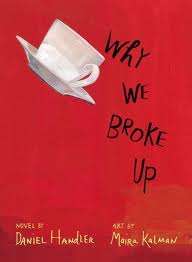
REVIEW: Why We Broke Up

Handler, D. & Kalman, M.  (2011).  Why We Broke Up.  New York:  Little, Brown and Company.

354 pages.


Why We Broke Up isn't your typical book.  Instead of the usual author blurbs describing how awesome a book is, the back cover is covered (haha) with quotations from famous YA authors (like Neil Gaiman, Holly Black, Sarah Zarr, MT Anderson, Carolyn Mackler, David Levithan etc.) describing the first time their hearts were broken.

What a wonderful touch to demonstrate that 1. a potential heartbroken reader is not alone and that 2. such pain is survivable.  Because that's what Why We Broke Up is:  an honest look at the problems and joys of a relationship between people from different cliques.


Appetizer:  Min has arranged to deliver a heavy box to Ed's front door.  The box contains everything from their less than two-month (Oct. 5-Nov. 12) relationship.  Everything.

As Min writes about the meaning of each object, the details of her and Ed's star-crossed relationship and why they broke up is revealed.

Including paintings of each object, Why We Broke Up is a loooong, slooooooow post-mordem of the relationship between 11th grade, movie-buff Min and her 12th grade, basketball co-captain, Ed.

From the beginning of their relationship, the two had almost nothing in common.  As their relationship develops--both emotionally and physically--this tension mounts and the novel serves as a very honest look at a doomed relationship.

The more I read Why We Broke Up, the more I was reminded of the Youtube video Dramatic Reading of a Break-Up Letter:


And not just because of the video's similar subject or the fact that the entire novel is told in the second person, with Ed being the intended audience.  Min's run-on sentences (which I occasionally stumbled over) started to remind me of the grammatical slip-ups in the above video.  Admittedly, Min's voice has much more poetry to it.  Plus, Min can spell.

I enjoyed Why We Broke Up a lot, but it didn't rock my world.  While there are still some darkly humorous touches one could expect from the author of A Series of Unfortunate Events (a bitter sixteenth birthday party, anyone?), the book wasn't as enjoyable as I would have expected.  I think it was the subject matter.  It's one thing to hear a brief retelling of all the hints of what contributed to the end of a relationship, it's quite another to read a 354-page play-by-play.

I was still very impressed by how honestly Handler managed to portray his female protagonist.  I liked Min's references to made-up old movies.  I found myself wishing some of those movies were real, because I would totally watch them.  I also don't think I'd mind living in the city where Handler set Why We Broke Up.  Min shopped at so many awesome and quirky stores.  If I lived in this town, I'd also be very poor.  Due to all of the shopping.  (The more I reflect on this, the more I start to realize that this novel has almost a quirky Gilmore Girls feel to it.)

The mystery of what happened between Ed and Min did carry me through.  I also liked seeing all of the paintings.  Plus, there was a lot of wonderful dialogue.  Yeah, the witty dialogue between Min and her friends definitely made the book worth-while.

Also, I want to frame some of the artwork from the novel and put it on my walls.


Dinner Conversation:

"Dear Ed,
In a sec you'll hear a thunk.  At your front door, the one nobody uses.  It'll rattle the hinges a bit when it lands, because it's so weighty and important, a little jangle along with the thunk, and Joan will look up from whatever she's cooking...You won't even know or hear what's being dumped at your door.  You won't even know why it even happened." (p. 1)

"I'm telling you why we broke up, Ed.  I'm writing it in this letter, the whole truth of why it happened.  And the truth is that I goddamn loved you so much." (p. 1)

"Every last souvenir of the love we had, the prizes and the debris of this relationship, like the glitter in the gutter when the parade has passed, all the everything and whatnot kicked to the curb.  I'm dumping the whole box back into your life, Ed, every item of you and me." (p. 3)

"'He asked you out.  Ed Slaterton.'
"He's not going to call," I said.  "It was just a party."
"Don't put yourself down," Jordan said.  "You have all the qualities Ed Slaterton looks for in his millions of girlfriends, come to think of it.  You have two legs."
"And you're a carbon-based life-form," Lauren said.
"Stop," I said.  "He's not--he's just a guy."  (p. 21)

"I gave you an adventure, Ed, right in front of you but you never saw it until I showed you, and that's why we broke up." (p. 31)


Tasty Rating:  !!!!

Tuesday, February 21, 2012

REVIEW: Where Things Come Back

Whaley, J.C.  (2011).  Where Things Come Back.  New York:  Atheneum Books for Young Readers.

228 pages.


Appetizer:  My first thought when first hearing of this book:  "Why isn't it called Where Things Return?  Why?!"  Why use two words when you could use one?

My first thought after hearing that this book won both the 2012 Morris Award for debut authors and the Printz Award for young adult literature:  "I must read this NOW.  Wordy titles work!"

My first thought after learning that the author, John Corey Whaley, is a Louisiana teacher:  "Yay!  I can't wait to show my students."

My first thought after reading the book:  "Meh.  Alas, alack, oh dear.  I wanted to enjoy it more."

Where Things Come Back is the story of seventeen-year-old Cullen Witter, whose cousin recently died and who has a crush on the tragic Ada Taylor (her previous boyfriends have a tendency to die....).  Cullen's brother has gone missing.  There's no evidence or reason for Gabriel's disappearance and the grief is hurting every member of Cullen's family.  On top of that, Cullen is stuck in Lily, Arkansas just like all of his other friends, and knows he will never leave until he knows what has happened to his brother.  As Cullen searches for a way to bring Gabriel back, the town of Lily searches for the elusive Lazarus Woodpecker which has been seen for the first time in sixty years.

Every-other-chapter is devoted to sharing the story of Benton Sage, a missionary who works in Ethiopia and then his roommate after Benton returned to the U.S. to attend college.  These seemingly unrelated stories eventually come together in striking ways.  (Although, these chapters never really won me over.  I found the narration to be too telling.)

Throughout the novel, there are paragraphs which begin "When one..." to describe the way Cullen reacts to things.  At first I found this subject change from the first person to be very off-putting, but I have to admit, it grew on me.  I also liked the way that Cullen invented book title names throughout the narrative.  It reminded me a lot of the novel King Dork and the attention its protagonist paid to creating band names and album covers.

Nonetheless, Where Things Come Back never really captured my imagination or interest.  I never desired to pick it up and read it.  However, when I did bring myself to read the book, it was the type of narrative where it was easy to just keep reading.  (To get through as opposed to enjoy)  I can appreciate and respect what Whaley has written.  He pushes away from the way many YA narratives are told.  But I never really connected with Cullen, his friends or the story.


Dinner Conversation:

"I was seventeen years old when I saw my first dead body.  It wasn't my cousin Olso's.  It was a woman who looked to have been around fifty or at least in her late forties.  She didn't have any visible bullet holes or scratches, cuts, or bruises, so I assumed that she had just died of some disease or something; her body barely hidden by the thin white sheet as it awaited its placement in the lockers.  The second dead body I ever saw was my cousin Oslo's.  I recognized his dirty brown shoes immediately as the woman wearing the bright white coat grasped the metallic handle and yanked hard to slide the body out from the silvery wall."  (p. 1)

"Being seventeen and bored in a small town, I like to pretend sometimes that I'm a pessimist.  This is the way it is and nothing can sway me from that.  Life sucks most of the time.  Everything is bullshit.  High school sucks.  You go to school, work for fifty years, then you die.  Only I can't seem to keep that up for too long before my natural urge to idealize goes into effect.  I can't seem to be a pessimist long enough to overlook the possibility of things being overwhelmingly good."  (p. 5)

"You see, Ada Taylor had a grim history.  As a sophomore in high school, when I was just a freshman, Ada was dating this ass-hat by the name of Conner Bolton.  Conner was a senior and made it his personal mission to make every freshman in the school terrified to be caught walking alone or near the bathrooms, lockers, or trash cans.  But alas, he died before Christmas break in a car accident.  Ada was the only other passenger.  She walked away without a scratch.  Then, the next year, Ada was dating this okay guy who I used to play G.I. Joes with on the floor of my mom's hair salon.  His name was Aaron Lancaster.  He didn't even make it to Thanksgiving before he up and drowned int he White River during a thunderstorm.  His dad found his empty fishing boat.  A search party found his body four days later.  I heard it looked like he had been microwaved.
After that, it almost seemed like a ridiculous thing to date Ada Taylor, or even go near her.  But that didn't matter much to the young men of Lily, even me.  The unspoken philosophy of all those in love with Ada was something like this:  If I have to die to get that, then death it is."  (pp. 6-7)

"When Benton Sage found out that he would be going on a mission for his church that year, he was overwhelmed with excitement and panic.  His stomach felt a sort of queasy rumble as he stood with his sisters and Reverend Hughes, and watched as the entire church circled around them, clasped hands, and began to pray.  Ethiopia, he thought, would be the first place he could truly exert his faith.  It was his fear of travel, of leaving his comfortable life in Atlanta, of floating mysteriously thirty thousand feet in the air, that made eighteen-year-old Benton feel as if he would collapse onto the church's soft, green carpet as he heard the choir begin to chant amens and hallelujahs behind him."  (p. 16)

"'Did you hear about that bird?' Lucas asked me, still staring toward the house.
Lucas was one of the smartest and strangest people I knew, and so I wasn't very surprised by his choice of topic.
"What bird?" I asked.
"There's this woodpecker that's been extinct for, like, sixty hears.  Only, this guy from Oregon or something was down here and he thinks he saw one."
"In Lily?"
"Right outside of town.  I think he was canoeing down the river and saw it fly by or something.
"Weird."  (pp. 29-30)

"It was one of those moments when you're waiting on someone to say something important or funny or just do anything to break you away from the sad thoughts that overwhelm your mind.  Thoughts like never having enough money to move away or not getting into college.  Thoughts like having to come back to take care of a sick parent and getting stuck here all over again.  That's what happened in Lily.  People dreamed.  People left.  And they all came back.  It was like Arkansas's version of a black hole; nothing could escape it." (p. 35)

"It was three hours later and after calling everyone we knew and driving around town twice that we decided to call the police.  It was a Thursday when my brother, the Left Hand of God, disappeared.  It was on this same Thursday that John Barling appeared on national television to talk about the Lazarus woodpecker and how it had come back from the dead." (p. 55)

"Here's the problem with a fifteen-year-old boy going missing:  No one thinks he has been taken.  Especially Gabriel, who looked to be my age.  Everyone in town, though they didn't say it, was thinking the same thing:  Gabriel Witter has finally run away from his family.  That, or he went hiking through the woods and either got lost or got eaten by a bear.  Here's what I knew:  My brother was taken from me.  He did not run away, because he wouldn't.  He couldn't.  He would never.  And he'd never gotten lost in his life."  (pp. 58-59)


Tasty Rating:  !!

Friday, November 25, 2011

REVIEW: Revolver (Built with amazing mood, tone and tension since 1910/1899)

Sedgwick, M. (2009).  Revolver. New York: Roaring Brook Press.

201 pages.

Appetizer:  Sig's father is dead. He died in an accident on the arctic ice. He died falling through thin ice that he should have--must have--known better than to cross over. 14-year-old Sig doesn't question the tragedy of his father's death too much until the very next day, when a strange and threatening man arrives at the family's cabin while Sig is there alone with his father's dead body. The man insists Sig's father took something from him and Sig must decide whether or not to use the revolver that his family has kept hidden for ten years.

Goodness gracious, ya'll! What a well-structured and tense little book.

Told in short chapters and in interweaving periods between 1899 when Sig's father first got the revolver and 1910 when Sig must decide whether he's going to use it, Revolver makes wonderful use of allusions, foreshadowing and a stark mood to create a wonderfully tense story as Sig contemplates the moral implications of using his father's gun.

Srsly, everyone, I heart it.

That doesn't mean Revolver is perfect. I wasn't too crazy about the flashbacks to 1899 and the omniscent narration that jumped among characters' perspectives all willy-nilly. But still, bravo. I approve.


Dinner Conversation:


"Even the dead tell stories.
Sig looked across the cabin to where his father lay, waiting for him to speak, but his father said nothing, because he was dead. Einar Andersson lay on the table, his arms half raised above his head, his legs slightly bent at the knee, frozen in the position in which they'd found him; out on the lake, lying on the ice, with the dogs waiting patiently in harness." (p. 1)

"If.
The smallest word, whcih raises the biggest questions." (p. 3)

"It was at these times that Einar told Sig important things. The things a son should learn from his father. It was at these times that he told him about the gold days, and the gold lust, or about the revolver, which sat in its original box, like a princess's jewels in a case. And Sig, like a good pupil, would listen, always listen, with maybe a rare question now and again.
"A gun is not a weapon," Einar once said to Sig. "It's an answer. It's an answer to the questions life throws at you when there's no one else to help" (p. 8).

"He'd come for the gold, and he hadn't meant to stay.  These things never lasted long, Einar knew.  Just like the Klondike, by the time the rest of the world got to know about the gold, it would be too late; all the best strikes found, the land claimed, the easy pickings gone.  All that would be left would be the struggle to survive in a world of danger, both natural and man-made, with the occasional speck of gold dust coming his way.  Just enough to keep that stupid dream of easy money alive, the dream of fantastic wealth, of ease and luxury and fine things for the rest of his days, but in reality not enough to live on for even a week."  (p. 45)

"Maria woke and propped herself up.  Her movement disturbed Sig, who woke too, to witness one of the few scenes from his early childhood that he would remember forever, and clearly.
He remembered the look on his mother's face as she saw what Einar had bought.  Only many years later would he finally be able to put a word to that look.  Despair.
"What is it?" Anna repeated.  "Is it food?  Is it for when the food runs out?"
"No," Einar muttered.  "It's something else.  For when the faith runs out."  (p. 50).

"He ran out of things to say, and Wolff stayed exactly where he was.
"I don't think you understand.  Since your father is no longer with us, that makes you his heir.
"That means my business is with you."  (p. 83)


Tasty Rating:  !!!!!

Monday, February 14, 2011

Literary Feast Discussion: Ship Breaker (Chapter 18-21)


Wow, so Ship Breaker is speeding up!  Let's skip the intro jibber-jabber and get straight to the comments because I need to finish this book and finish it soon....

(Keep in mind there are spoilers below!)


Shel:  So, normally I'd be all "YAY KISS!" but for some reason when Nailer and Nita kiss, I wasn't that happy for them.  The moment felt forced to me.  I think it has to do with the fact that several weeks went by and I feel like I've somehow missed some character development.  Am I alone in this?

Monica:  Nope.  They’re just not that convincing as a couple.  I think it’s more that the author didn’t have any other options.  They’re thrown together and they’re the only two people even sort of suited for each other because no one else is around and they can’t very well have Nailer making out with Tool.  But I don’t even like Nita, so I’m not about to encourage this relationship.

Shel:  See, I liked her at first.  But she's kind of losing me.  I was so excited that there was finally a potential escape.  I had visions of a fast moving ship and everything.  I can't believe Nita was captured while Nailer was out.  I guess I'll just be thankful that Tool is okay.  After all, he is winning the favorite character fight even more now.

Monica:  Nita is useless!  She’s like Princess Peach – she stands there getting into trouble and going, “Oh no!” while poor Nailer has to run around fighting all the bad guys for her.  (Poor Nita.  She really doesn’t stand a chance with me.)

Shel:  See, she seemed clever at first.  Then manipulate.  And now she's just kind of a prop.  And then Tool left.  Fail.

Monica:  EPIC FAIL.  And it doesn’t even look like he’s coming back.  Why!?  Why can’t the dramatic action shift?!  I’d happily follow Tool anywhere!  Backstory away!!

Shel:  What do you think of all this killing business and of Nailer being "blood-thirsty"?

Monica:  Eh?  I think he’s as “blood thirsty” as any other kid raised on shipwrecks, doing work from the time he was old enough to understand, with an abusive father and perhaps a somewhat underdeveloped moral compass.  I probably wouldn’t be doing much better, really, except for the way I’d be dead already due to lack of street smarts and fear of non-prepackaged food.

Shel:  Yeah, I think I would have been a goner too.  Unless I'd been born a swank.  And never left my swank neighborhood.  In other news...Yay!  Nailer is learning to read.  I approve.

Monica:  What he needs is a modified version of Dick and Jane that fits his worldview.  “See Dick strip wire.  Strip wire, Dick, strip wire!”

 Shel:  See Jane mutilate herself to keep the rapists away!  Mutilate, Jane.  Mutilate!  Quality.  


So, what do you think of Ship Breaker?  Feel free to leave your comments below.  We'll be finishing up the book for Wednesday (I promise!).  So, I'll see you back here soon.

Saturday, February 5, 2011

Literary Feast Discussion: Ship Breaker (Chapters 13 through 17)


Hello again, few but dear readers.  How goes life?  Monica and I are still making our way through Paolo Bacigalupi's Ship Breaker.  Our thoughts about chapters 13-17 are below.  We'd love to hear what you think of the book in the comments, few but dear readers.


Shel:  After taking a few days off and picking up this book once more, I can't believe some of the characters' names.  It makes me wonder what my name would be if I lived in the Ship Breaker world.  I imagine I would be something like "Whiney Girl," since I'd constantly complain about the working conditions and lack of sanitation.  How about you?

Monica:  Oh, I’d be Stumbles, for sure.  Because—and trust me on this—if I had to do be doing any of the running / wire cutting / fighting that these kids are doing on a daily basis, I’d be black and blue and blistered and crippled.  Clumsy is my middle name.

Whiney Girl:  I like that Tool turns out to be a good guy.  Yay, Tool!

Monica:  His name is strange but we love him!!!  I wonder if we’re ever going to find out his whole back story…  To be honest, he might be my favorite character of the whole book.

Shel:  See, at first, I was willing to cheer on Lucky Girl, but she is proving to be a little too manipulative for my tastes.  I do like Tool.  But just as Lucky Girl is too manipulative, he seems a little too wise.  

Shel:  I like the tension over how similar Nailer is to his father.

Monica:  And how desperate Nailer is for it to not be true.  Poor Nailer.  If my daddy was a crazy drunken killer-type person, I’d have disowned him by now.  But family loyalty wins out, I guess, at least for now.

Shel:  And I quote:  "It's human nature to tear one another apart.  Be glad you come from such a successful line of killers" (p. 175).  Yikies.

Monica:  Upside, he’s ahead in the game!  Look how much more trouble he would have had if he *didn’t* have such a fierce attitude!  (Trying desperately to look on the bright side…?)

Shel:  The bright side is fun!  While I'm enjoying this book, I did feel like the first two part were a little too heavy on the lets sit around and talk.  It's nice to have some more action now.

Monica:  Yeeees.  I liked the finger-cutting moment, but other than that, there was a LOT of exposition.  But now, there’s fighting in the streets!  Running for their lives!  Hooray!! J  (I’m a little bloodthirsty.  I can’t help it.)

Shel:  Never fear, I thirst for blood too...in the only way that a vegetarian can thirst for blood.

Monica:  Nailer is right.  Nita *is* kind of a cold one.  Way to hang Tool out to dry, girl – I like him way more than you, so I’m kind of bothered by your Cringe In The Shadows attitude.  …  On the upside, yay Nailer!  Way to be loyal!

What are your thoughts, cool cats?  Monica and I would love to read your opinions of Ship Breaker.  We'll be back with comments on chapters 18 through 21 by Saturday-ish.  The feast continues then!

Friday, January 28, 2011

Literary Feast Discussion: Ship Breaker (Chapters Seven to Twelve)

Well friends, the eagle-eyed among you will note that it is several days past when we planned on posting. Our illustrious leader, Shel, has been going quietly insane in the confines of her condo (ooh, alliteration!) whilst she struggles to complete her education by... May? Are you trying to finish by May, sweetie? I personally have no excuse whatsoever save for the fact that Library School is kicking my butt -- who on earth decided that statistics were necessary for doing research!?

But anyway. I digress.

On to Ship Breaker! Have you been enjoying it so far, few but dear readers? Is it everything you would hope for and more, in a Printz winner?

Shel: What do you think of Lucky Strike? Good guy or villain? Somewhere in between?

Monica: Somewhere in between, for sure. I don't think he's being painted as a villain, necessarily, but he's definitely scheme-y enough to not be good. Which, honestly, is probably more authentic. Just because you suddenly become wealthy doesn't mean you turn evil... but neither does it mean you are all philanthropic, either. He's obviously keeping what's his, and trying to add to it.

Shel: I love how Pima is so dismissive of the new new clothes on the wreckage of the ship. So practical.

Monica: But she does like the pretties, give the girl some credit.

Shel: I also think Pima's reaction to the realization that the supposed dead girl is not so dead: "That's some creepy shit," she said (p. 95). Yes, I agree. But imagine how creepy it is for the supposed dead girl, waking up to two people trying to cut off your fingers and discussing your state as a dead person.

Monica: Um, yes? Yes. The part where they were hauling on her hand and trying to just wiggle the rings off was gross enough. When they actually decided to just hack off her fingers, I felt vaguely like throwing up.....

Shel: I really like that Dead Girl/Lucky Girl/Whatever her real name will be... Nita has some real skills. She's not just some helpless damsel. I'm pretty serious now about wanting her perspective of this story. You hear that, Bacigalupi? Fan fiction writers?

Monica: YES! Fanfiction writers will carry her plot, even if the book fails miserably....

Shel: Although, all of this "blood with blood" stuff is just too unhygienic for my liking. There have got to be blood born diseases in this world. Nita TELL THEM!

Monica: I think they're more worried about how they don't have water. ;)

That's it for now, kids! Join us next time (I'm going to throw out Next Saturday as a date, and cross my fingers that we make the deadline) for a discussion of chapters thirteen through nineteen. As always, feel free to toss out your own thoughts in the comment section!

Monday, January 10, 2011

Literary Feast Discussion: Ship Breaker (Chapters One through Six)


Okay, so instead of getting this posted on ThursFriday, it's officially going up on Monday.  A time that is solidly and squarely three days late....

But that's okay!!!!!!  Because Ship Breaker just won the American Library Association's Printz Award, which is for young adult literature.  YAAAAAAY!  So this timing works out, right?  Right.

Comments on the first six chapters are below.  We'd love to hear your thoughts as well!


Monica: Oooh. The book may disappoint us, but I'm LOVING the opening! I feel all gritty and disgusting and cramped, just like poor Nailer. Brava for the imagery, author!

 Shel: It's official, I could never be a scavenger like Nailer. I wouldn't say I'm *actually* claustrophobic, but once as a kid I climbed under a huge, low deck in a park for some secret club meeting. I had to wiggle my way out, my back against the deck, my front scratched by wood chips. That day I learned that small spaces are not fun. I was a bit of a slow seven-year-old.

 Shel:  I like all of the religious elements.  I'm curious to see where they lead.
 
Monica: I'm wondering how far in the future this takes place. Has that been established yet? It would be interesting to see what "old" versions of religions remain in the new... and now long it apparently took to shift over. ;)

Shel:  Poor Jackson Boy...even if he was a little licebiter, that's a bad way to go.  (See above comment and the fact that this book is reminding me of my possible claustrophobia.)  
Monica: Best. Ghost story. Ever. Seriously, can you even imagine? "Hear that thumping, tiny child? That's the ghost of JACKSON BOY! He haunts these bulkheads...."

 Shel:  So far, all of the detailed descriptions and analogies are impressing me.  But I have to say what *truly* drew me in was the ending of chapter two.  Yikes!  You?
 
Monica: Like I mentioned above, I was sold from the opening. He writes like we're actually there... and since I would never, ever ever ever want to BE there, I'm finding it fascinating to read from the warm, clean safety of my living room couch, with a nice glass of clean water next to me.

Shel:  I like all this talk of luck and fate on page 41.  I'm with Pima's mom.  The fates have big plans for Nailer.  BIG PLANS, I say!  (And I don't feel that way just because I read the jacket flap.)
Monica: I hope so -- I don't know if I could take an entire book of Nailer: Copper Scavenger. Or, honestly, Nailer: Abused Child with Terrible, Terrible Father.

 Shel:  With hurricanes and oil spills, this dystopia feels much more immediate than a lot of the other ones out there.
Monica: Yes! Which is both awesome and teeeeeeeeerrible. I usually only like dystopian fiction when it seems far enough away that I don't need to worry about it.

Shel:  And now the book was just announced as winning the 2011 Printz!!!!!  Victory to Paolo Bagi...Bacigad...Bacigalupi!!!!!!!  YAY!


So, now that you know what Monica and I thought of the beginning, we'd love to hear your thoughts.  And stay tuned, will be back on Fri-Saturday with comments on chapters 7 through 12.  Of course, by Fri-Saturday, I could possibly mean next Tuesday.  We'll have to see.

Friday, May 14, 2010

REVIEW: American Born Chinese

American Born ChineseYang, G.L.  (2006).  American Born Chinese.  New York:  First Second.

1596431520

233 pages.

So, I recently had to reread American Born Chinese and I figured I may as well write a review this time around.


Appetizer: American Born Chinese shares the story of the Monkey King who has been excluded from a party by the other gods, Jin Wang who is having trouble adjusting to being one of the few Chinese-American student at his new school and his friendship with a "fresh off the boat" new student named Wei-Chen.  AND it's the story of Danny, who seems like the typical white-American teen, who must suffer through a visit from his (intentionally) stereotypical cousin, Chin-Kee.

It's a lot of stories, my friends.

Rereading the graphic novel, I was impressed by how expertly woven the themes and images of identity, inclusion exclusion and transformation are.  Lots of details all add to the overarching significance.  I can see why this pretty-baby won the Printz award (and thereby made a name for graphic novels everywhere)!.

I really like how vivid Yang's illustrations are throughout the graphic novel.  At the same time, his style is relatively simple, faces are made up of clear shapes, that seventh and eighth graders would be able to copy to create their own sketches (if they wished).  I like how essential the images are to make meaning.  It actually made it hard to pull quotes for this review, since the characters' expression really contribute to the meaning of the dialogue and narration.

For better or worse (worse!), this graphic novel did give me a flashback to grade school. At one point, Chin-Kee sings the rhyme "Me Chinese, Me play joke, Me go pee-pee in his coke" (p. 118).  I can remember hearing this in grade school.  From what I remember it was just a fun rhyme (I liked the pee-pee part), there was no consideration of the inherent racism.  I didn't think to myself, "why this runs counter to the treat everyone with respect, we're all equal" type of messages that I heard during school.  Although I probably wouldn't use this book with two many groups of middle graders, I do wish someone would have taken up this moment in the book and rhyme when I was in high school.  It presents a valuable opportunity to reflect and consider the more subtle racisms that go down on the playgrounds and in the halls.

One of the chief difficulties of this graphic novel is the fact that the chapters are seemingly unrelated to one another.  That's actually not the case.  And it turns out that some characters are the same person, but in disguise.  But there are few to no hints of this until the end of the book, when suddenly you're given this moment of "Woah, wait..." and you have to mentally go back and see if all the parts of the story still make sense together (they do!  But it's a bit of mental gymnastics to get there).  But some readers may not like going to all the trouble of integrating all the separate pieces into one whole.

American Born Chinese can also do an excellent job of beginning conversation on Chinese mythology, racial stereotypes, racism, Americanization, identity and on and on.


Dinner Conversation:

"One bright and starry night, the gods, the goddesses, the demons, and the spirits gathered in heaven for a dinner party" (p. 7).

Guard:  " Look.  You may be a king--you may even be a deity--but you are still a monkey" (p. 15).

"It's easy to become anything you wish...so long as you're willing to forfeit your soul" (p. 29).

Ma:  "I have some exciting news!  Guess who's coming to visit!"
Danny:  "Who?"
Ma:  Your cousin Chin-Kee!"


Tasty Rating:  !!!!

Sunday, December 27, 2009

REVIEW: The Disreputable History of Frankie Landau-Banks

Disreputable History of Frankie Landau-Banks, The
Okay, so, this is a good young adult novel to pair with Eleanor, Quiet No More.  Just so you know, I'm now laughing like a super villain, impressed by my own ability to pair books intended for very different ages that nonetheless explore issues of gender and power.


Lockhart, E.  (2008).  The Disreputable History of Frankie Landau-Banks.  New York:  Hyperion.

0786838183

345 pages.


Appetizer:  Frankie Landau-Banks went from a gawky freshman, to a striking sophomore dating the most popular and handsome guy at her elite boarding school to a criminal mastermind by her junior year.  Told in the aloof voice of a researcher, this book shares the dates, the pranks and insights into the secret organization as Frankie progresses from her parents' "bunny rabbit" to a mastermind of unsanctioned boarding school activity who is hungry for power.

This is one of the Printz honors for 2008 and I've been hearing good things about this YA novel and about E. Lockhart all year.

And I have to say, all the good whispers and mentions are justified.  I found The Disreputable History of Frankie Landau-Banks to be a wonderful and fun read.

I love Frankie's sense of humor and the way she banters with other characters.  Lockhart does an excellent job of portraying her intelligence as well.  I liked that Frankie, as a woman, felt that she was capable of doing all the same things that the male students felt only they were entitled to do.  I thought that by showing how gender discrimination can still exist (particularly in underground organizations like a pranking secret society--pesky clandestine societies.  Would you please start paying attention to equal rights).  As students' read on, they can contemplate whether they like Frankie's methods of trying to gain access and can consider if any other methods would be possible.

I liked that the conflicts and interactions are analyzed through the lens of power dynamics.  (It really would bring forward that interpretation for students to discuss)  But I did feel, that at least at some points, I would encourage students to think about other ways of interpreting the events and interactions.  I'm a firm believer that the best way to gain understanding is to take into account multiple perspectives or analytic lenses.

Initially, I was a little put off by the fact that this story focused upon the interactions of rich, white kids at the elitist Alabaster Boarding School.  And Frankie was one in their number.  Although, Lockhart doesn't push too hard with confronting the race or class issues, she does directly address and challenge the sense of entitlement many of the characters feel.  And she does so with a lot of humor.

If you wanted to think about the television equivalent of a lot of the content of The Disreputable History of Frankie Landau-Banks, I'd have to say it's definitely Gilmore Girls, although less family focused.


Dinner Conversation:

"I, Frankie Landau-Banks, hereby confess that I was the sole mastermind behind the mal-doings of the Loyal Order of the Basset Hounds.  I take full responsibility for the disruptions caused by the Order--including the Library Lady, the Doggies in the Window, the Night of a Thousand Dogs, the Canned Beet Rebellion, and the abduction of the Guppy" (p. 1).

"Though not, in hindsight, so startling as the misdeeds she would perpetrate when she returned to boarding school as a sophomore, what happened to Frankie Landau-Banks the summer after her freshman year was a shock.  Certainly upsetting enough to disturb Frankie's conservative mother, Ruth, and to rile several boys in Frankie's New Jersey neighborhood to thought (and even actions) they'd never before contemplated.
Frankie herself was unsettled as well.
Between May and September, she gained four inches and twenty pounds, all in the right places" (p. 4).

"Intellectually, Frankie was not at all the near-criminal mastermind who created the Fish Liberation Society, and who will, as an adult, probably go on to head the CIA, direct action movies, design rocket ships, or possibly (if she goes astray_, preside over a unit of organized criminals.  At the start of sophomore year, Frankie Landau-Banks was none of these things.  She was a girl who liked to read, had only ever had one boyfriend, enjoyed the debate team, and still kept gerbils in a Habitrail.  She was highly intelligent, but there was nothing unusually ambitious or odd about her mental functioning" (pp. 6-7).

"The problem was that to them--to Uncle Ben and her mother, and maybe even to Uncle Paul--Frankie was Bunny Rabbit.
Not a person with intelligence, a sense of direction, and the ability to use a cell phone.  Not a person would could solve a problem.
Not even a person would could walk fifteen blocks all by herself without getting run over by a car.
To them, she was Bunny Rabbit.
Innocent.
In need of protection.
Inconsequential" (pp. 12-13).


To Go with the Meal:

An excellent book recommendation, I would seriously consider using The Disreputable History of Frankie Landau-Banks in a high school classroom.  There are a lot of teaching moments that could turn into extensive classroom discussions.  For example, on pages 53-56, the narrator describes a few of the essays and arguments Frankie is learning about in one of her classes, that of the panopticon and Michel Foucault's understanding of the prison in which the inmates would always fear they were being watched.  The narrative explains the experience of being watched by comparing it to the paranoia you might feel if you think someone might have seen you pick your nose.  It is wonderful; not only because the passage is so hilarious, but also because I have a friend who has spent the entire last quarter taking a course that focused solely upon the works of Foucault.  She is working on her Ph.D.  (I of course had to call her and read the entire passage aloud to her, whether she liked it or not.  And she did like.  I mean, she laughed a few times.  But, of course, she may also have been paranoid that I was secretly watching her and would punish her for not enjoying the excerpt.  I will never know!)
But, I love it when a book helps a teacher to present complicated theoretical arguments in a practical and humorous way.  It makes me want to dance.  And harass grad students  into listening to read alouds.

The Disreputable History of Frankie Landau-Banks is also just ASKING to be the subject of high school papers that examine the power dynamics and gender expectations throughout the book.  Students could also get into a healthy debate over whether they agree with some of the choices Frankie made.

To go a creative route, students could also write a short story about what they expect Frankie to be doing ten years after the events shared in her disreputable history.

This book could also be a good choice for sisters or a mother and daughter to read together and discuss their own feelings about what a girl should expect from a romantic relationship and whether or not they would want to be the kind of person who gets lost in their significant other or whether they want a more fair balance in a relationship or whether they expect their significant other to get lost in them.  I found the fact that Lockhart included a relationship in which a guy expected the girl to accommodate his friends and interests, without him bothering to take an interest in the girl's life to be wonderful for discussion.

Speaking as a person who, during my teenage years, has lost several friends to "I didn't exist until I met him" type of obsessive romantic relationships, I feel like this needs to be addressed more.  I found myself wishing I could have had Frankie's history to read while I was in high school.  It could have provided some perspective.  (Although, admittedly, I don't think the friends I've lost touch with were masterminding a way to get their love interests to reveal their secrets or attempting to score an invite into a secret society.  But that would have been cooler.)


Tasty Rating:  !!!!!

Friday, December 18, 2009

REVIEW: The Earth, My Butt, and Other Big Round Things


Mackler, C.  (2003).  The Earth, My Butt, and Other Big Round Things.  Cambridge, MA:  Candlewick Press.

0763620912

244 pages.


Appetizer:  The aptly named 15-year-old Virginia Shreves doesn't feel like she belongs to her family.  They are all thin, successful brunettes and Gin is a "chubby" blonde who can't seem to figure out the French language.  She develops a Fat Girl Code of Conduct to guide her through getting attention from another sophomore named Froggy (and no, Froggy is not a nickname.  That's his actual name).  As Gin struggles to try to make her mother proud of her, she begins to realize that maybe she should have different goals, when her dad receives a bad news phone call about her brother.

Okay, I've been meaning to read this book for several years now.  As I mentioned at one point, I really loved Vegan Virgin Valentine when I read it, and so I've been meaning to explore more of Mackler's writing for some time.  Deciding to go through some of the ALA award winner and honor books over the next month in preparation for the announcement of the new winners, seemed like an excellent reason to pick up The Earth, My Butt and Other Big Round Things, a Printz winner.

(By the way, the award announcements will be broadcast through the internetz on January 18th from...here.  I plan to tune in--and then immediately order as many of the winners as I can afford from Amazon!  I'm just hoping this year I will have actually read some of the books! *crosses fingers and hopes all this work for the blog pays off*)

I have to say, The Earth, My Butt, and Other Big Round Things wasn't quite what I had expected.  I knew it would involve a teenage girl dealing with her body image, but I'd also expected the story to be on the light, humorous, romantic comedy side of things, mainly because that's what Vegan Virgin Valentine was like.  And don't get me wrong, there's a lot of humor, lightness and a bit of romance here, but there's a lot of serious stuff going on too.

The most humorous part for me was within the first few pages when Gin is having an awkward, unromantic and very realistic make-out session with Froggy, who's trying to inch his way to second base for the first time.

What surprised me was that The Earth, My Butt, and Other Big Round Things is essentially the quintessential young adult novel.  It includes mortification a la peers, teenage rebellion, hypocritical adults, questioning of long-held beliefs, a bit of sexual experimentation and on and on.

It also includes some of the standards for the YA problem novel--date rape, eating disorders and a reassuring teacher figure as well as multiple solutions to the issues (with sometimes vaguely teachy observations from characters).  I liked the way Mackler addressed these issues.  In terms of the characters with weight loss or eating order issues, Mackler presents solutions without body issues taking over or becoming a dramatic cautionary tale (you know the kind of tale I mean, with someone tragically hospitalized, dying because of their bad decisions).

*Spoiler for mid-way through the book* I also found the way Mackler describes date rape as a topic particularly interesting.  Virginia's older brother, who she's always admired is accused of date rape at his college.  While Byron is depressed by being suspended from Columbia  I liked that Mackler shared this issue from the point of view of a date-rapist's sister.  So, often stories about issues like this are shared solely from the victim's perspective.  It was refreshing (as much as books that explore rape can make you want to take a deep breath of cool air) to read about this type of trauma from a new perspective, to see the turmoil that a family member of the rapist can go through, and to see how it impacts her perception of and relationship with her brother.  *End book spoiler*

Also, Mackler has a new book, Tangled, coming out on December 29th.  I may have to check that out down the road....

(Although, as one of my many sidenotes, dear readers,--if you've stuck with me this long, I'm guessing you'll stay with me a little longer--I have to say I'm a little disappointed by the title of Tangled.  In the past, Mackler's given us, The Earth, My Butt and Other Big Round Things, Vegan Virgin Valentine, Guyaholic, Love and Other Four-Letter Words...Tangled seems to fall a little short, as her titles go.


Dinner Conversation:

"Froggy Welsh the Fourth is trying to get up my shirt.
This is the third Monday that he's come over to my apartment after school.  Each week we go a little further, and today, on September twenty-third at 3:17 P.M., he's begun inching his fingers across my stomach and toward my bra" (p. 1).

"It's not like Froggy Welsh the Fourth is a huge catch.  First of all, there's his name.  Not a nickname for Frank or Frederick or even Frog.  I'm still shocked that his great-great-grandparents named a son Froggy.  But what astounds me to no end is that three subsequent generations decided to follow suit" (p. 2).

"And I know that my beautiful, slim, brown-haired family wonders how they wound up with a daughter who has dishwater blond hair, pale blue eyes, a roundish face, and a larger-than-average body.
OK, fat.
Not fat fat.  More like chubby fat.
Enough so I'm picked last in gym if the activity has anything to do with running, climbing ropes, or propelling oneself over a horse.  Enough so I've heard people refer to me as plump, as if being likened to a vine-ripe tomato is some kind of compliment.  Enough so family friends, upon comparing me to my skinny siblings, raise their eyebrows as high as McDonald's golden arches.
That's the most frustrating thing.  I can't even blame it on genetics" (p. 16).

"Doesn't his sister go to Brewster?" Brinna asks.
"Yeah," says Briar.  "Virginia."
"Virginia who?" asks Brie.
Ouch.  I know Brie and I reside in different universes, but still.  We've been going to Brewster since sixth grade.  And we're in three classes together, for god's sake.
"Virginia Shreves," says Briar, cracking up.  "That chubby girl."
"No way!" Brie shrieks.  "I never knew they were related."
"Of course they are, " says Briar.  "It's not like Shreves is a common last name."
I bite down on the flesh inside my cheeks.  That chubby girl. 
After a moment Brie says, "All I can say is, if I were that fat, I'd kill myself" (pp. 25-26).


To Go with the Meal:

This is an excellent book to use to trigger discussions.  Virginia's relationship with her mother (a supposed genius when it comes to understanding the minds of adolescents) is more than a bit strained.  A mother and daughter could choose to read The Earth, My Butt and Other big Round Things to help open up honest communication in their own relationship.

It can be used in literature circles to discuss standards of beauty, body image, nutrition and exercise, date rape, teenage drinking, the way people often try to hide aspects of themselves or make things seem better than they actually are etc.

The book also makes a lot of references to many other books, so a teacher could use this as a gateway to those other authors and books, including Anais Nin, Lord Buryon, Virginia Woolf, The Scarlet Letter, One Hundred Years of Solitude, It's Perfectly Normal, among others.


Tasty Rating:  !!!!

Thursday, August 27, 2009

REVIEW: Jellicoe Road


Machetta, M.  (2008).  Jellicoe Road.  New York:  Harper Teen.

9780061431838

Finally got around to reading this year's Printz winner!

Originally published in 2006, in Machetta's homeland, Australia, this story, set in the Australian bush, crosses time to share the events on Jellicoe Road and their repercussions for students at the Jellicoe School, the cadets who camp near by for six weeks and the townies.  

The majority of the narrative follows Taylor, a seventeen-year-old girl who has just been chosen to lead her school's underground community in a battle over territory lines with the cadets and the townies.  Abandoned by her mother on Jellicoe Road when Taylor was twelve, Hannah, the woman who has been her guardian since then, has left.  Adding to her turmoil, a boy, Jonah Griggs, who Taylor ran away with in a quest to find her mother several years ago and who betrayed their location to the school and Brigadier is back as the leader of the cadets.

The narratives of the past, arguably sections of a book one of the characters is working on, provide insights into Taylor's situation and her relationship with some of the adults in the area.

A complicated text full of contrasts and parallels, Jellicoe Road seems very confusing for the first 20 or 30 pages.  After that, interest in the story and Taylor's wit, toughness and struggles as a leader captured my interest.  But then around page 80 or 90, I began to see how the different narratives from the past and present began to weave together and I began to make connections.  That's when I became totally engrossed and didn't want to put the book down.  So, readers be warned, get through the confusing beginning and it will be worth it.

Now, I don't want to rush things.  I'll have to read Saving Francesca and Looking for Alibrandi, but I think I may have to add Melina Marchetta to the list of authors I'd like to marry.


Activities:

This is a good sample text to share with students to show examples of parallels, contrasts and foils.

Doing some research on Australia would probably help to flesh out some of the details of the text:  their education system, the appearance of the bush, the uniforms cadets wear, etc.  A teacher could also use this book to trigger a refresher on metric measurements.

Jellicoe Road could also be used to encourage students to make and organize notes on the characters to help students to make connections.


Quotes of Note:

"My father took one hundred and thirty-two minutes to die.
I counted.
It happened on the Jellicoe Road.  The prettiest road I'd ever seen, where trees made breezy canopies like a tunnel to Shangri-la" (p. 1).

"Someone asked us later, "Didn't you wonder why no one came across you sooner?"
Did I wonder?
When you see your parents zipped up in black body bags on the Jellicoe Road like they're some kind of garbage, don't you know?
Wonder dies" (p. 2).

"I don't know where I fit in.  One day when I was eleven, my mother drove me out here and while I was in the toilets at the 7-Eleven on the Jellicoe Road, she drove off and left me there.  It becomes one of those defining moments in your life, when your mother does that.  It's not as if I don't forgive her, because I do.  It's like these horror films where the hero gets attacked by the zombie and he has to convince the heroine to shoot him, because in ten seconds' time he won't be who he was anymore.  He;ll have the same face but no soul" (p. 20).

"The territory wars have been part of the Jellicoe School's life ever since I can remember.  I don't know who started them.  The Townies say is was the Cadets from the city who have been coming out here for the last twenty or so years.  They set up camp right alongside the Jellicoe School for six weeks each September as part of their outdoor education program.  We say the Townies started the wars because they think Jellicoe belongs to them, and the Cadets blame us because they say we don't know how to share land" (p. 35).

"I need to act quickly before there's a coup and as I glance around the table I realise, once again, that my only potential ally is a drop-kick moron with tomato sauce all over his face" (pp. 45-46).

"Is a person worth more because they have someone to grieve for them? (p. 60).

Tuesday, August 25, 2009

REVIEW: Repossessed


Jenkins, A.M. (2007). Repossessed. New York: Harper Teen.

9780060835705

In a wickedly fun bit of perspective taking, Repossessed shares the story of Kiriel, one of the worker demons in Hell who decides to take a vacation from work and spend time in the body of a teenage boy named Shaun. While trying to remain undetected, Kiriel is out to have some fun and take in as much of the human experience as possible.

Think Meet Joe Black, but with a demon.

Kiriel had watched Shaun and the people he interacted with extensively before taking the teen's body right before Shaun would have accidentally stepped out in front of an oncoming cement mixer. Nonetheless, as Kiriel adjusts to being in Shaun's body, many of the people in Shaun's life can't help but notice small changes in Shaun, and not necessarily for the worse. As Kiriel enjoys his vacation he can't help but fear and hope for his Creator attention for having broken the rules.

This book is in part about appreciating the small things. Kiriel spends a lot of time tasting foods, touching objects, learning to walk, appreciating air and water etc. all those things most people take for granted on a daily basis. Other themes include looking beyond appearances, rejection, acceptance, love and causing change.

I have to say, I didn't really like the way this book ended. I won't say more, since I would prefer to avoid spoilers, but if anyone has read this book and would like to discuss the ending (or other aspects!) make a comment or email me with your thoughts. I hearts discussion.


Activities:

In similar fashion to the movie Dogma, Repossessed has the potential to offend, but at the same time, it manages to humorously touch on some important religious as well as universal concerns and would be an excellent discussion starter. Central questions include whether Kiriel is a redeemable character, issues of free will and determinism, issues of connecting to others and having your voice heard.

This book could be paired with Paradise Lost, The Inferno and sections from the Bible.


Quotes of Note:

"First thing I did was, I stole a body. I could have made my own, but I wasn't in an artistic frame of mind.
I was just fed up, you know; fed up with being a cog in a vast machine, with doing my pointless, demeaning job. It's not like I was the only one who could do it--anybody could do it. Tormenting the damned---it practically does itself, no lie. And it's depressing; I can't tell you how depressing it is" (p. 1).

"I wanted to keep it simple, start small. Slip into a life that was already taking place. Something with all the synapses in working condition. A body that was carefree, insulated from earthly considerations like hunger; a protected place to try out physical existence. A body without responsibilities--no job or family to care for; someone who had time to experience the things I wanted to experience. But not too protected. Someone who wasn't watched every second. Someone who had a little time on his hands, but also a safe place to go to every night.
I knew I wanted all this, so I decided to take a middle-class suburban American teenager" (p. 2).

"I don't like the term "demon." It carries quite a bit of negativity with it. It implies a pointy tail and cloven hooves. I prefer the term "fallen angel." That is, indeed, what we are. The difference between us and the angels who didn't fall from grace is that the Unfallen were, are, and always will be faithful, stalwart, and obedient. That is their nature, just as it is their nature to rejoice in worship and contemplation of the vastness of the Creator's perfection. We, the Fallen, wondered, questioned, confronted, eventually demanded, and in general pushed the edges of the envelope till the envelope burst" (p. 9).

"And I thought it would be fun to read questions and let the answers form themselves into actual words inside Shaun's head. And to write, on a piece of paper, with a pencil--to experience for myself the delicacy of finger movements required to make marks that communicated one's thoughts to anyone who saw them. Sounded like fun to me!" (p. 31).

LinkWithin

Related Posts with Thumbnails