Showing posts with label 2 Exclamation Points. Show all posts

Sunday, January 11, 2015

Quick Review: Skip Girl Online and Stay Offline

I finished listening to the audiobook of Girl Online a couple of days ago and wanted to share some thoughts on the story.

First for those of you who haven't heard of Girl Online, the story is narrated by Penny who lives in Brighton, England and loves taking photos and anonymously posting to her blog, which eventually goes viral.  When her parents have the opportunity to go to New York City over Christmas, Penny leaves behind frienemies, a crush, and many recent embarrassments and stumbles into a potential new romance.

Girl Online first blipped on my radar when the book sold so many copies.  I hadn't previously seen any of the videos by the author who is a Youtube celebrity in England, Zoella.  The fact that there was then drama about the fact that Zoe had the help of a ghostwriter moved the book up to the top of my to-be-read mountain of books.  I wanted to see what all the fuss was about.

I was not impressed with the story. It was wish fulfillment fluff.  Having said that though, even fluff has its time and place. It's a good recommendation for a young reader looking to escape reality. It kind of brings Angus, Thongs, and Full-Frontal Snogging into the present day...but with fewer laughs and even more awkwardly embarrassing moments for the protagonist.

Here's the book trailer for Girl Online.  Hope you like Taylor Swift.


I feel bad that both the author and ghostwriter have found themselves at the center of a hurricane of craziness.  I can't help but find it ironic though, given that both Zoe and her character Penny find themselves hiding from their online communities due to drama.  Best wishes to everyone involved!

I did enjoy the audio book interpretation though.  It did a good job of adding cell phone sound effects.  I felt that the reader, Hannah Tointon, did a good job of bringing Penny to life.


Tasty Rating:  !!

Wednesday, May 29, 2013

REVIEW: In Darkness

Lake, N.  (2012).  In Darkness.  New York:  Bloomsbury.

337 pages.

I'm not gonna lie, ya'll.  I got stuck in this book.  Like crazy cartoon nightmare stuck:  The floor and walls all turned to sticky bubblegum and every time I tried to move or read I became more tangled and it turned into a suffocating mess that gets so complicated that you wake up screaming, "I'll never leave gum on the bottom of a desk again!"

Except in this case, it was having to read and not wanting to read and thinking of all the other things I should be doing.

It was bad.

Arguably, my struggles with In Darkness are not solely the book's fault.  I was adjusting to a first year in yet another new job, living in a new town, auditioning at the community theater and trying to act for the first time since middle school, etc.  But, now that it's summer vacation and given the fact that it still took me longer than it should have to finish this book, I let that stand as evidence of how little I cared for it.

Appetizer:  Switching back and forth between narratives of "Then" and "Now," In Darkness shares the stories of Shorty, who is trapped in the rubble of a hospital that has collapsed in the 2010 Haitian earthquake and how he got to be there, long ago separated from his twin sister with whom he thinks he shares a soul.  It also takes on retelling some of the biography of Toussaint l'Ouverture as he led a rebellion to free Haitian slaves.  The two protagonists dream of one another, impacting their choices in their own times.

Here's a dramatic retelling of my thoughts as I began each new chapter of this book:

A now chapter:  "Hmmm, he's stuck in the dark, I wonder when he'll get out."
A then chapter:  "I do not connect with this character.  Hopefully this chapter will be over soon and I'll be able to read about the present."
A now chapter:  "Huh, he's still in the dark.  Surely, something will happen soon and he'll get out.  Otherwise this might become boring, despite the flashbacks to when he was younger.
A then chapter:  Ugh.  Man, Toussaint was older when this is being depicted.  I can't even connect with him as being a young adult character."
A now chapter:  "I am so sick of him being in the dark.  This chapter feels like filler so that stuff can happen in the other chapters.  How much longer until this chapter is over and I can read about someone else?
A then chapter:  "I am so bored.  I would skim, but that goes against everything I believe in, especially when reading a Printz award book.  Plus, I'd hate to miss the moment when this story becomes engaging.  Is this chapter over yet?  I'd rather read about Shorty being stuck in the collapsed hospital.
A now chapter:  Jebus, he's still trapped.  Man, there's a lot of dark and serious stuff in this book.  I feel nothing for most of these characters and wish this book would be over already.
A then chapter:  I feel nothing.
A now chapter:  Lalala.  My eyes are scanning the page, but I aaam elsewheeeeeere.
A then chapter:  LAAAAAAAAAAAAAAAA!
A now chapter:  I'm sorry, the connection has failed.  Please, try again.  Please, try again.  Please, try again.  Please, try again.  Please, try again.  Please, try again.
And so forth.

I don't want you to think that the writing was bad or the story wasn't well told.  My reasons for not liking this book are all due to me instead of the story itself.  It just didn't speak to me.  And the fact that this book was, in part, depicting a recent tragedy in Haiti and won the Printz award somehow grated on me--like the book was awarded to draw attention to the Haitian earthquake instead of saying this was the best book of 2012.  It was a well-written book on an important topic, but it didn't win me over.

From what I could tell, Lake did his research.  Admittedly, I'm no expert.  But I was left with a deeper understanding of aspects of Haitian culture than any textbook or newspaper has evern given me.  Granted, I did find myself wishing for more English translations of some of the French and Kreyol phrases and songs.  But nonetheless, a student could learn a lot about Haiti from this book, beyond what is presented in the media.


Dinner Conversation:

"I am the voice in the dark, calling out for your help.
I am the quiet voice that you hope will not turn to silence, the voice you want to keep hearing cos it means someone is still alive.  I am the voice calling for you to come and dig me out.  I am the voice in the dark, asking you to unbury me, to bring me from the grave out into the light, like a zombi.
I am a killer and I have been killed, too, over and over; I am constantly being born.  I have lost more things than I have found; I have destroyed more things than I have built.  I have seen babies abandoned in the trast and I have seen the dead come back to life." (p. 1)

"I don't know what happened.  I was in bed minding my own zafe, then everything shook and I fell and the darkness started.  Or maybe everything else fell." (p. 3)

"On the night that rebellion caught like a flame in Haiti, the slave named Toussaint swung down from his horse.  It was a good horse--it had been a gift to him from his master, Bayou de Libertas, and despite its age it still served him well.  It was, Toussaint reflected, a fitting horse for him to ride.  He, like his horse, was old and had served his master well.
Soon, though, there would be no more masters, and no more slaves.  Or so Boukman hoped." (p. 37)

"I can see the whole of Port-au-Prince--the palace, the homes of the rich, the open-air prison of Site Soley.  It's all collapsed.  The palace is just dust and rubble, the homes are destroyed.  Only Site Soley looks the same, and that's cos Site Soley was a ruin to begin with." (p. 54-55).

"Biggie, he was the general of Route 9, and before that he was the right-hand man of Dread Wilme and a big dog in the Site.  He did all the shit the government should have done in the slums.  He funded the schools, provided security.  He punished thieves and rapists.
He sold drugs and killed people.
He made me what I am today.
I have not forgiven him for that, not yet." (p. 71)


Tasty Rating:  !!

Wednesday, January 9, 2013

REVIEW: The Eternal Ones

Miller, K.  (2010).  The Eternal Ones.  New York:  Razorbill.

411 pages.

Appetizer:  Seventeen-year-old Haven Moore is haunted by dreams and memories of another life, of a girl named Constance who loved a boy named Ethan.  While watching TV with her uber-religious and controlling grandmother, Haven happens to see a celebrity gossip report of a rich playboy named Iain.  She faints at the sight of him, certain that she is the love she lost in the 1920s.

Haven's grandmother conspires to prevent her granddaughter from travelling to New York City, the scene of all her memories.  As her grandmother's religious overtures grow more intense and as Haven becomes more and more ostracized by the other students in her small town in Tennessee, her only means of escape to New York may include a strange society that is focused on helping people who believe they have been reincarnated.

But, even after Haven does escape to New York City, she learns that everything may not be as they appear and that the love she has trusted through multiple lives may be her greatest betrayer...time and time again.

I really liked the idea of The Eternal Ones, but the execution of the story left a lot to be desired.  Plus, despite liking this initial premise of finding a love from a previous life and trying to find him, I realized that it had already been used previously.  Dead Again is a movie from over 20 years ago and it does a much better job of establishing a mystery...if you can manage to look beyond all of the early 1990's styles:


The novel felt like a rough draft for a great mystery.  It felt like all the ingredients to a recipe had been thrown into a bowl, but very little mixing had taken place.  Plus, the story should have been tightened (say to 280 or 300 pages instead of 411 pages).  The Eternal Ones spent way too much time in Snope City with Haven being bullied by various characters.  As I read the first 120-ish pages, I thought the book would appeal much more if the novel opened with Haven arriving in New York. Let her past and purpose be a mystery to be unraveled as the reader gets further into the story, as opposed to having to witness Haven faint many times and go back and forth about deciding to leave or not leave.  Ugh.

As a character, there was nothing really striking or engaging about Haven's love interest, Iain/Ethan.  In fact, after he meets Haven, I almost immediately started to dislike him.  Gentlemen of the world pay attention:  If you want to turn-off a girl and send her running, be sure to refer to other girls as "props" (p. 163), and make her feel as though you're ordering her around (p. 179).  So unsexy.


Dinner Conversation:

"Haven was back.  She glanced across the familiar little room.  Silver clouds hovered over the skylight high above a rumpled bed.  A candle sat on the edge of the vanity, waiting for her sun's weak rays to finally fade.  Her gaze returned to the mirror in front of her.  She smoothed a strand of her blonde bob and tucked it behind one ear.  The reflection in the mirror wasn't hers, but she knew it as well as her own." (p. 3)

"Haven Moore stood on top of the footstool, gazing out the open window in front of her and willing herself not to fidget.  Over the winter, the anticipation had been building inside of her.  Once the weather turned warm, she found herself unable to sleep or stay still.  It felt as if every cell in her body were dancing.
Beyond the tall mountains that surrounded Snope City, something was waiting for her" (p. 5).

"Haven's eyes glanced up at the action.  A tan, handsome young man slid out of a black Mercedes as camera flashes sparkled in the car's windshield.  For a moment, he stared back at the paparazzi, his face dark and unreadable.  Then, unexpectedly, a corner of his mouth curled into a grin.
"Ethan," Haven whispered.  A blaze ignited at the tips of her toes.  As it began to burn its way upward, Haven felt her knees buckle beneath her." (p. 8)

"Suddenly she was no longer just Haven Jane Moore, daughter of Ernest and Mae.  If the notes were to be believed, she had once been someone else.  A girl named Constance.  And her visions weren't fantasies or hallucinations.  They were scenes from a past that was every bit as real as the present." (p. 43)

"'Well, I think I might be having the visions for a reason.  I'm pretty sure I'm supposed to find Ethan.  That's what I told my dad when I was little.'
"Ethan?  You think he's still around?  Wouldn't he be awfully old for you by now? I mean, even if he is real, at the very least he'd be pushing a hundred and ten--"
Haven cut him off.  "I had another vision last night.  There was a fire.  That's how Constance died.  I think it killed Ethan, too.  And I think he's been reborn, just like me.  I have to find him, Beau.  And you have to help me.  I can't explain how, but I know he's out there." (p. 53)


Tasty Rating:  !!

Sunday, December 30, 2012

REVIEW: The Karma Club

Brody, J.  (2010).  The Karma Club.  New York:  Farrar Straus Giroux.

258 pages.


Appetizer:  It all begins when seventeen-year-old Maddy Kasparkova receives a phone call from her best friend that a profile of her boyfriend has been published in Contempo Girl.  Maddy hopes this will increase their popularity and that she's finally obtain her goal of becoming a member of the in-crowd.

Her dreams are shattered, however, when her she discovers her boyfriend in another girl's arms, those of the popular and perfect Heather Campbell.  Seeking a way to balance the scales, not only for herself, but for her two best friends, Jade and Angie, Maddy becomes interested in Karma.  Unwilling to wait decades for the universe to sort out those who have done wrong, she and her friends form a Karma Club in an effort to find balance now.

I was really excited to read this book.  As of late, I've been interested in books that explore religious and spiritual concepts in a deep, honest, and meaningful way.  Because of that goal, I found Karma Club to be very disappointing.  Essentially, Maddy forms a revenge club.  As you might imagine, Maddy's approach is a huge misinterpretation of the nature of karma.  Although she does eventually gain some wisdom about it, I wouldn't say she ever gains a real understanding of the concept.

Although some of Maddy, Angie, and Jade's adventures are amusing to escape into, I found a couple of them were hard to believe, including the quick resolution at the end of the novel.  Nonetheless, Karma Club does end on a very hopeful note.

As a character, Maddy was believable.  Despite the fact that she was a senior approaching graduation, she felt much younger, making me think I'd most likely recommend this book for 13 to 15-year-olds interested in some light and fun reading.


Dinner Conversation:

"I can tell you right now, it's all karma's fault.
Yes, karma.  You know, that unmistakable force in the universe that makes sure good deeds are rewarded and bad deeds are punished.
Like when I stole my little sister's lunch in the seventh grade because I woke up too late to make my own.  When I got to school, I found that the meat in the sandwich was actually moldy and I had to spend the very last of my allowance money on the disgusting, unrecognizable cafeteria food.
Karma." (p. 3)

"Good deeds are rewarded while bad deeds are punished.  Good things happen to good people and bad things happen to bad people.  That's just how Karma works.
Well, at least that's how I thought it worked.
But that was before I entered the second half of my senior year.  When everything changed.  Everything I thought I knew and everything I thought I could count on suddenly went right out the window.
I think I can trace it back to one day.
That fateful day when Angie called me up with the news.
Yes, that was definitely the day it all began.  Before my simple, little world--where up was up and down was down, and right and wrong were as different as night and day--was flipped upside down.  And from that point on, there was absolutely nothing in my life that could be described as simple." (p. 4)

"I stand in complete astonishment as I try to grasp everything that has happened in the last five minutes.  My boyfriend, Mason Brooks, featured in Contempo Girl magazine!  They even called him a "hunky dough boy."  Well, yeah, it's a bit cheesy, but so what?  This is huge!  Every girl in the country is going to see this.  Every girl in the country is going to be pining for my boyfriend." (p. 10)

"Maybe my fantasy wasn't that fare off after all.  Maybe this one little article would make us the most popular couple in school.  Maybe Heather Campbell would eventually start calling me up for advice about the new spring fashions and where she should go to get her nails done and how to snag a boyfriend as wonderful as Mason.  I really wouldn't blame her.  I mean, I'm pretty much a published magazine writer now.  Who wouldn't want advice from someone whose words are in Contempo Girl magazine?" (p. 16)

"All my life I've wanted to be popular.
I don't know where the obsession came from, but from the time I was a little girl, the life of the high school "it" crowd always seemed more glamorous than anything else I could ever imagine.
Then in the sixth grade, I met Heather Campbell and from the moment I saw her, I knew I wanted to be like her." (p. 17)


Tasty Rating: !!.

Monday, July 23, 2012

REVIEW: Of Poseidon

Banks, A.  (2012).  Of Poseidon.  New York:  Feiwel and Friends.


324 pages.


Appetizer:  Emma meets Galen when she runs into him on a Florida boardwalk during her summer vacation.  Literally, runs into him.  Cheek to chest.  It's rather embarrassing for her.  Her best friend Chloe makes things worse by teasing her.

But what initially seems like a quick and innocent meeting by chance proves to be the gateway to much more.  Emma has the eyes of the Syrena; a species of sea creatures.  But, somehow, she has no knowledge of what she truly is.  Galen is a prince of the Syrena who is on land for an investigation in the hopes of finding a way to unite his people with humanity.

Galen's strange reaction to Emma is complicated by the fact that she and Chloe are attacked by a shark.  As Emma struggles against a bull shark to save her best friend, she fights harder than a human ever could.

Aware that Emma may prove to be essential to all of his goals, Galen decides to stay close to her, establishing a house in New Jersey to learn more about the unusual 18-year-old.

Before starting the book, I was a little wary of reading Of Poseidon.  I can only handle so much angsty paranormal romance and I think I've already gone well beyond that point.  As I started reading the young adult novel, I was initially pleasantly surprised.  (After I got beyond Emma being clumsy though...that reminded me a little too much of Twilight.)  Aside from the clumsiness, the first chapter included a lot of wonderful humor (this was slightly dampened after the shark attack, but the humor bounced back).  So, I was willing to let the book win me over...that is until more clumsiness and damsel in distree behavior emerged.  Emma literally runs into a door and knocks herself unconscious.  Literally.  Are you kidding me?!

Then there's the moment where she attacks someone--literally fights another character throwing someone against a wall, falling through a glass wall, etc.--over a very insensitive comment...it seemed so out of character, I couldn't believe it was actually a part of the plot.  Aaaand the book entered the realm of being too ridiculous for me to lose myself in and truly enjoy.  Banks try to sell some of this off as a quirk of the Syrena, but I just didn't buy it.

Also, since we once again have a love interest who travels across a country, enrolls in school to observe a girl, jokingly considers kidnapping her, senses that their love is biologically necessary, mentions tapping her phones, etc., I had to dust off the old stalker scale:


In the book's defense, Banks does carve out a scene between Emma and her mother in which Emma affirms that she shuns abuse in relationships:
"You two fighting already?"She's fishing, but for what I don't know.  Shrugging seems safe until I can figure out what she wants to hear."Do you fight often?"Shrugging again, I ladle enough oatmeal into my mouth to make talking impossible for at least a minute, which is more than enough time for her to drop it.  It doesn't work.  After the exaggerated minute, I reach for my glass of milk."You know, if he ever hit you--"The glass is mid-tilt, I swallow before the milk can escape through my nose.  "Mom, he would never hit me!""I didn't say he would.""Good, because he wouldn't.  Ever.  What's with you?  Do you have to interrogate me about Galen every time you see me?"This time she shrugs.  "Seems like the right thing to do.  When you have children, you'll understand.""I'm not stupid.  If Galen acts up, I'll either dump him or kill him.  You have my word."Mom laughs and butters my muffin.  "I guess I can't ask for more than that." (pp. 154-155)
I appreciate the effort, but Galen does slap Emma awake thirty pages later after she passes out due to exhaustion (p. 185).  Granted, it could be argued I'm being picky or that the slap probably isn't that hard and could be more of a tap, tap tap, against her cheek...but still, way to send a mixed message there.  Consider choosing words more carefully.


*Vague Spoiler* Then, it got worse.  During a climactic scene, Emma reflects upon her choices, narrating:
"I've turned into "that girl."  Not the one who exchanges her doctorate for some kids and a three-bedroom two-bath, but the other kind.  That girl who exchanges her dignity and chances for happiness for some possessive loser who beats her when she makes eye contact with some random guy working the hot dog stand.Not that Galen beats me, but after his little show, what will people think?  He acted like a lunatic tonight, stalking me to Atlantic City, blowing up my phone, and threatening my date with physical violence.  He made serial-killer eyes, for crying out loud.  That might be acceptable in the watery grave, but by dry-land standards, it's the ingredients for a restraining order." (pp. 291-292)
Having a character acknowledge her $hitty choice is not the same as making a good decision for her own health and future.  *End Vague Spoiler*

Plus, the book ends on a cliff-hanger.  Boo.

I'm back to taking a break from paranormal romance.


Dinner Conversation:

"I smack into him as if shoved from behind.  He doesn't budge, not an inch.  Just holds my shoulders and waits.  Maybe he's waiting for me to find my balance.  Maybe he's waiting for me to gather my pride.  I hope he's got all day.
I hear people passing on the boardwalk and imagine them staring.  Best-case scenario, they think I know this guy, that we're hugging.  Worst-case scenario, they saw me totter like an intoxicated walrus into this complete stranger because I was looking down for a place to park our beach stuff.
 (p. 1)

"The siblings lean on their elbows against the rail, watching the girls they just met peel the T-shirts off their bikinis and wade into the water with the surfboard floating between them.
"She's probably just wearing contacts," Rayna says.  "They make contacts in that color, you know."
He shakes his head.  "She's not wearing contacts.  You saw her just as plain as you're seeing me.  She's one of us."
"You're losing it.  She can't be one of us.  Look at her hair.  You can'teve call that blonde.  It's almost white."
Galen frowns.  The hair color had thrown him off too--before he had touched her.  The simple contact of grasping her arm when she fell dispensed any doubts.  The Syrena are always attracted to their own kind--which helps them find each other across miles and miles of ocean.  Usually that attraction is limited to water transmission, where they can sense the presence of one of their own. He's never heard of it occurring on land before--and never felt it so strongly, period--but he knows what he felt.  He wouldn't--couldn't react that way to a human.  Especially given how much he despises them." (pp. 8-9)

"'Stop!' she yells.
Galen stops.  But Emma's not talking to him.  She's talking to the shark.
And the shark stops.
Emma wraps both arms around Chloe and hugs her to her chest, leaning her friend away from the attack.  "You can't have her!  Leave her alone!  Leave us alone!"
The shark turns, saunters away as if sulking.
Galen gasps.  He watches until the smooth sway of its tail disappears in the distance.  He tries to comprehend it.  Because what he knows, absolutely knows, about bull sharks is that they don't back down." (p. 23)

"'So the humans followed you around, made you feel uncomfortable?'
That's what I just said, isn't it?
Toraf nods thoughtfully.  Then he says, "Imagine how Emma must feel then."
"What?"
"Think about it.  The humans followed you around a building and it made you uncomfortable.  You followed Emma across the big land.  Then Rachel makes sure you have every class with her. Then when she tries to get away, you chase her.  Seems to me you're scaring her off." (p. 56)


Tasty Rating:  !!

Saturday, July 21, 2012

REVIEW: Lies, Knives, and Girls in Red Dresses.

Koertge, R.  (2012) Lies, Knives and Girls in Red Dresses.  Somerville, MA:  Candlewick Press.


87 pages.


Appetizer:  Here's the opening for this collection of poems and fairy tale modernizations:

"Do you want to sleep?  Find another storyteller.  Do you want to think about the world in a new way?
Come closer.  Closer, please.
I want to whisper in your ear."

Aside from reminding me of the beginning of The Tale of Despereaux, these poems and vignettes
do reveal new perspectives.  Many include feminist themes, modern settings, a deeper look at a specific character or twists.  The ugly duckling becomes a bullied youth.  The beast misses having fangs.  Since the stories are based on the traditional versions (the Grimm brothers, Perrault, etc.) it is important to be familiar with the original fairy tales (which, sadly, I was not always).

The illustrations are wonderful; dark and brutal.  The woodcut style gives the book an old-school feel.  There are some notably violent images which are both shocking and also speak to the nature of the traditional fairy tales Koertge based his poems and stories upon.

Near the end, there's a character who uses the  word "gay" in a derogatory way (p. 75).  There's also another story that notes gay marriage as being a step toward the apocalypse (p. 63).  Although these phrases are in line with the characters' voices, I would have preferred they weren't included at all.  This lost the book points with me.

My one other caution about the book would be in regards to age appropriateness.  Since it's so short, illustrated and dealing with fairy tales, it's possible to assume the poems are for younger kids, but due to some swearing  and references to sex, a teacher may have to be cautious before using some of the poems in a class room.

Koertge wasn't willing to shy away from controversial topics and language with this piece.

A teacher can still select among the poems to model for students how to adapt a traditional fairy tale to modern social mores.  Some poems I would consider using include "The Stepsisters," "Memoirs of the Beast," and "Wolf."

At Cynsations you can also find an interview with Koertge and a giveaway of Lies, Knives and Girls in Red Dresses.


Dinner Conversation:

The Little Match Girl:

"She's selling CDs on the corner,
fifty cents to any stoner,
any homeboy with a boner.

Sleet and worse--the weather's awful.
Will she live?  It's very doubtful.
Life out here is never healthful." (p. 15)


Bearskin:

"The soldier had seen the devil in the desert.
And he'd seen the devil's toys--IEDs,
VBIEDs, the maniacs with dynamite
strapped to their chests.

So he was surprised when the devil came
right up to him in the VA hospital room and said,
'So here's the deal.  If you can wear a bearskin
for seven years, you'll stop having bad dreams.
And I'll make you rich.  But if you ever
take the bearskin off, I get your soul.'" (p. 19)

Twelve Dancing Princesses:

"When he tells the king, the full force
of twelve baleful glances stuns him
even as he ponders his reward:
choose any daughter.

Now they're really mad.  They're not doughnuts
in a box, oranges in a sack, pennies in a dish.
They're a force to be reckoned with." (p. 25)

Memoirs of the Beast:

"We're happy now.  We're very,
very happy.  But I have to admit
there's not much to do in Ever After.
It's always sunny and 78*.  Every
night the fireworks light themselves.

With a sigh, sometimes, I brush
my perfect teeth and remember when
they were fangs." (p. 29)


Tasty Rating:  !!.


Sunday, July 8, 2012

REVIEW: Ditched--A Love Story "Crazy Crackers"

Mellom, R.  (2012).  Ditched:  A Love Story.  New York:  Hyperion.


275 pages.


Appetizer:  The morning after prom, sixteen-year-old Justina Griffith wakes in a ditch on the side of the road.  She has no idea what happened to her last night.

With no money or phone, Justina walks to 7-Eleven, where she begs the gas station attendant for a Snickers and slowly reveals what happened to her the night before and how and why she ended up at prom with Ian Clark, dressed head-to-toe in blue.

In the past, Justina had been a bit of a, ahem, a bit of a kiss whore.  All of her kissing has caused her to develop a bit of a bad reputation (but unlike the Joan Jett song about not caring about a bad reputation, Justina cares deeply).  Eight months and twelve days ago, she'd decided to only unlock her lips for a boy that was really-truly-most-likely-boyfriend-material in the hope of improving her reputation with her classmates.


Enter Ian Clark.  They became friends the night Justina took her vow of lip-lockery, but Prom had promised to be Hallmark moment for them to become a couple.  So, when Justina wakes up in a ditch without Ian anywhere in sight, she can't help but wonder what happened to him and think that her potential prince is a frog.


Want to know what's awkward?  On page eight, Justina asserts her celebrity crush is Anderson Cooper.  That made this book a little awkward to read the week that Cooper publicly came out as gay.  Awkward reading of Ditched.  But good for you, Anderson!  And good for young kids who could be helped by knowing they're not alone.


What first seemed like a YA version of the movie The Hangover, Ditched is a little less mysterious as Justina quickly remembers everything that happened to her, but still slooooowly reveals her story to two strangers in 7-Eleven.  (Arguably, the a small mystery still remains:  Can she figure out Ian's true nature and know for sure if he's trustworthy boyfriend material.)  I liked the way that each bruise, stain and bit of damage is revealed chapter-by-chapter.  I thought the pictures pointing out the specific piece of damage to be revealed was a nice touch.  I still had been so attached to the idea that this book was a mystery, that the reality was disappointing.  (This is not the book's fault...it's totally mine.)  But I did have other issues with Ditched.

Knowing this book is a romantic comedy, it's understandable for Justina to wake up on the side of the road and not be super panicked.  Dealing with such serious emotions isn't easy to make funny (although, I imagine some authors could make it happen).  But as a person with a grasp of reality, I felt like there was much more cause for freaking-out.  Like, if I woke up in a ditch after a night of partying of which I could remember nothing, my first instinct might be to see if there was any evidence that someone had raped me or hurt me in some other way.  Awful, but true.  Just saying.  (Admittedly, the story does quell this concern on p. 19.)

I would have been willing to let Ditched slide if that were the only offense, but then Justina is essentially "rape kissed," as the kids say.  The offender is a drunk boy who is trying to make another girl jealous.  Before the kiss, Justina says, "No, Dan.  It's not right.  I won't--" (p. 91) and then ends the kiss by turning her "head away.  'Stop it.  Stay the hell away from me!'" (p. 92).  She then asks what's wrong with her.  As though she did something wrong.

Bah humbug.

My largest issue was with the way most of the female characters behaved.  I thought the author did a good job of trying to make Justina a complex character (she's an outsider who wants to blend in and erase her bad reputation, a girl with a plan of romantic perfection who has also been pressured, etc.), but the author fell into that trap of making her protagonist hate/insult any and all other female characters who could be perceived as "threats."  Two girls from another high school who attend the Huntington High School prom are "skanks" (p. 116), her best friend tries to steal guys' attention just to mess with their girlfriends.  There are a lot of insults based upon whose wearing what and how expensive it is.  The author tries to dismiss some of this behavior as low blood sugar on Justina's part.  I don't accept this.  Admittedly, as Justina starts to get to know various characters, she sees beyond their "skank" and "slutty" exteriors, but I felt it was too little too late to dig out of that deep ditch  (hahaha, see what I did there...played with the title and used cliches!  I guess that balances out).

I'll stop myself from starting to rant.

Although I do think the way gender is presented in Ditched needs to be troubled and examined (there's also a lot of assumptions that most guys are "scumbags," so the bah humbug-ness goes both ways), it is an interesting premise and there were a handful of amusing moments.  I'd say it's laugh-out-loud factor included one or two chuckles.

Also, parents of precocious tween readers be warned:  There is quite a bit of alcohol and marijuana smoking going on around Justina in various scenes.  It's still arguably responsible (no drunkards or high people drive) but, while representing the reality of prom night, the drug use also isn't at the periphery as much as it would be with other romantic comedies you might recommend to younger readers.


Dinner Conversation:

"I don't know how I ended up on the side of Hollister Road, lying in this ditch.
This moment, last night, the details--all fuzzy.  A reluctant glance down and I see I'm covered in scratches and bruises.  The bruise on my shin appears to be in the shape of a french fry.  French fries cause bruises?  And I have at least five stains on my royal blue iridescent dress--two black, one greenish-bluish, and the remaining are various shades of yellow.  What are these?  Mustard?  Curry?
Wait.  I don't even want to know.
What I do want to know is why I just fell out of a moving Toyota Prius and was left here in this ditch with a french fry shin bruise and unrecognizable stains.  Especially the yellow ones." (pp. 3-4)

"'It will be amazing,' he said.
"I can't wait to walk into that room with you," he said.
"It will be the best night of our lives," he said, as if he were reading straight from a Hallmark card.
And like a doof, I told him I would go.  I even told him if a Journey song came on, I would dance with him, and I imagined my arms draped around his neck, and his breath on my cheek, and my hip brushing against his.  I didn't explain I had been imagining a lof of things about him lately." (pp. 4-5)

"Because even though jerk is the only work I can imagine to describe him now, it's not a word that ever entered my mind as being synonymous with Ian Clark.  Ever.
I have always known of him--Huntington High isn't huge and it's the type of place where everyone's business is just known.  It's almost as if we're all distant relatives--people you've heard of and you know their basic story--or the Lifetime movie version of their story--but you don't really know them, and sometimes don't want to.
Ian became more than a person I knew basic facts about back in sophomore year, spring quarter, P.E.: softball.  I remember my first words to him.  "Have you seen that silver bat around?" (p. 19)

"...so you declare to your best friend you are never ever going to kiss another boy again until you know deep in you bones, in you marrow, in you cell structure--one hundred percent--that he is boyfriend material."
"Okay," Gilda says.  "I mean...what?"
I shrug.  "No kissing allowed until the guy proved he had the material.  Until then, lips locked."  I press my lips together, reminding myself what they feel like.  "It's been eight months and twelve days since I kissed a boy.  I was going to finally unlock my lips for Ian.  At prom." (p. 21)

"'I'm never kissing another boy again.'
"O-kay. I'm Ian."
"I know.  I remember you," I said. "I hate boys.  You included. You should probably know that up front."
He nodded. "And I hate girls."
We shook hands, and that was it. We were perfect together.
As friends." (p. 35)


Tasty Rating:  !!

Monday, June 25, 2012

REVIEW: The Serpent's Shadow (Prepare for the end of the world! Or rather, the end of another of Riordan's series.)

Riordan, R.  (2012).  The Serpent's Shadow.  New York:  Disney.

401 pages.

Bleeps (Blog-peeps, as my friend Holly asserts), I'm going to be honest here.  This book is the reason I haven't been posting much over the last two or three weeks.  I got stuck in the middle of this book and had to struggle to keep reading.


Appetizer:  Siblings Sadie and Carter Kane are back with their third and final transcript of their adventures to protect the world from some dangerous Ancient Egyptian magic that could descend the world into chaos.  This time, they're here to tell the story behind all of those earthquakes, tsunamis and the near end of the world.

Apophis, "the primordial force of Chaos" has been unleashed and Carter and Sadie must devise a way to stop it, preferably a way that won't kill them in the process.  A desperate plan will send them around the world, seeking information and preparing to achieve something no other magicians have ever managed to do.  But before they do that, the siblings will have to attend their first school dance.

I was surprised by the extent of romance in The Serpent's Shadow.  There was a downright paranormal romance vibe during the school dance mentioned above.  (Sadie finds herself with a dance partner who levitates them.  I kid you not.  I won't tell you the name of the boy causing the floating, because of course, Sadie's also the center of a love triangle, that has an arguably very strange resolution.)

OMG!
Paranormal Romance
has infected 
the Kanes!!!!!!!!

Although a satisfying end to this trilogy, Riordan leaves the door open for further adventures with the Kane siblings and all of their friends.  (I'd bet a very small amount of money that these characters are going to make an appearance in the new Norse mythology series that Riordan is working on.  This is very exciting for my research, because instead of just hinting at the gods of different cultures co-existing in the same world, Riordan will directly address the issue.  But that could just be wishful thinking on my part.  Of course, it would also mean that a lot of my dissertation will become dated.  Sigh.)

Having now completed The Serpent's Shadow, I'm officially declaring that the Kane Chronicles is my least favorite of Riordan's several myth-based series.  It's not just that I'm least familiar with Egyptian mythology, but I also had trouble keeping track of a lot of the characters.  Many of the descriptions of the actions feel rushed (I've complained about this before with his writing.  Honestly, I think it's because of the crazy writing and researching schedule Riordan must be on to complete all of the tomes for his many series.  If I were in his position, I would have burned out long ago.).  I also wouldn't have minded a little more exposition and a few more reminders of the events from the previous books.  More than that, for me, the logic of this series is the hardest to keep track of and follow.

I also got annoyed with the way the narration kept denying the reader knowledge.  At least three or four times, the Kane siblings were given vague warnings or were about to find out something important when suddenly the informant had to leave or was distracted.  I could deal with this technique once or twice, but it got a little ridiculous that Riordan relied on it so often in an effort to try and maintain the sense of mystery.

But that's just me.  What are your thoughts?


Dinner Conversation:

"Sadie Kane here.
If you're listening to this, congratulations!  You survived Doomsday.
I'd like to apologize straightaway for any inconvenience the end of the world may have caused you.  The earthquakes, rebellions, riots, tornadoes, floods, tsunamis, and of course the giant snake who swallowed the sun--I'm afraid most of that was our fault.  Carter and I decided we should at least explain how it happened." (p. 1)

"True, full-out Armageddon hadn't come yet.  It had been six months since the Chaos snake Apophis had escaped from his Underworld prison, but he still hadn't launched a large-scale invasion of the mortal world as we'd expected.  For some reason, the serpent was biding his time, settling for smaller attacks on nomes that seemed secure and happy.
Like this one, I thought." (p. 3).

"Its eyes turned the color of blood.  Its carved mouth twisted into a smile.  "Your magic is weak, Sadie Kane.  Human civilization has grown as old and rotten.  I will swallow the sun god and plunge your world into darkness.  The Sea of Chaos will consume you all." (p. 20)

"Honestly, he drones on and on about his plans for the Apocalypse, but he makes no plans at all for the school dance.  My brother's priorities are severely skewed.
I don't think I was being selfish wanting to go to the dance.  Of course we had serious business to deal with.  That's exactly why I insisted on partying first.  Our initiates needed a morale boost.  They needed a chance to be normal kids, to have friends and lives outside Brooklyn House--something worth fighting for.  Even armies in the field fight better when they take breaks for entertainment.  I'm sure some general somewhere has said that." (p. 77)


Tasty Rating:  !!

REVIEW: Squish: Super Amoeba (Number One)

Holm, J.L. & Holm, M.  (2011).  Squish:  Super Amoeba.  New York:  Random House.

94 pages.


Appetizer:  Squish is a young amoeba who loves comic books and twinkies.  His best friend, Pod, is planning to fix global warming, but only after Squish agrees to trade lunches with him.  Their friend Peggy is a paramecium who is happy all of the time.

When Lynwood, a particularly big and mean amoeba, targets consuming Peggy amoeba style (as opposed to eating with a mouth, human style) Squish tries to stand up to the bully and finds himself pressured to help Lynwood cheat in science class in his effort to do the right thing.

I liked many of the elements of Squish.  The scientific facts were subtly included, preventing the book from becoming annoying.  I liked the arrows that provided a lot of details and gave the book a pseudo-academic voice (but that were really quite funny).  I also like that Squish was a comic book fan and aspired to be like his favorite hero, Super Amoeba.

My one big complaint about the book is that--I can't believe I'm saying this, but--I wished it'd been a little more didactic about providing suggestions to deal with bullying.  The conflict with Lynwood is resolved in a quick and humorous way that wee-bullied kids can't rely upon.

I can't believe this is happening...I'm always so opposed to everything teachy and preachy.  (There is a brief suggestion about telling a teacher...and that's fine...I just wish it hadn't occurred after Squish asked for help from his dad whose response was to initially offer no help at all.)

I also could have used more character development with Pod and Peggy.  Peggy's ceaseless optimism was annoying.  Plus, when Lynwood almost eats her...she doesn't even notice.  I get that Squish has to be the one to save the day, but it'd be nice if this paramecium could be a little more self-aware.  Hopefully the rest of the series will include some more development for these supporting characters.


In contrast to the Holm siblings' other series, Babymouse, Squish is arguably a graphic novel series that will appeal more to boys while including subtle facts from a microbiology lesson.  

I'm very excited to see the other books in the Squish series mix-up the color scheme a little more.

Side note:  When you google images of 'babymouse,' you end up with some super cute results:


At the end of the book, there were a few extras for readers to try.  I appreciated that they included a short science experiment to grow mold, but I imagine there are some parents who will appreciate it far less.

I preferred the instructions on how to draw a Squish:


Here's my attempt:


Dinner Conversation:


Tasty Rating:  !!

Saturday, June 23, 2012

REVIEW: Croak (with a similar concept to the tv show Dead Like Me)

Sorry I haven't been posting much!

I am deep into revising one of my YA novels and it seems to be all I have time for.

I've gone through almost the entire book in about five days.

Hopefully, once I'm done with this revision I'll be able to give my mind a rest and focus a little more on reading.


Damico, G.  (2012).  Croak.  Boston:  Houghton Mifflin Harcourt.


311 pages.


Appetizer:  Lex is a very angry teenager.  Like way angrier than most.  She used to be an A-earning, hall monitoring, respectful girl like her twin sister, Cordy.  But for some reason, Lex just can't get along with anyone anymore.  Frustrated, her parents have decided to send her to stay with her Uncle Mort in a strange small town called Croak for the summer.

Separated from her sister for the first time, Lex quickly learns that there's something fantastic about Croak and that she won't be milking cows or feeding chickens over the summer like she'd been led to believe.  Instead, she's to be trained as a grim reaper with her new partner, the attractive and strange Driggs.  As Lex quickly settles in and excels at her new occupation, she and Driggs notice a pattern among some unusual deaths.  Will they take it upon themselves to do more than the grim reapers are ordered to do and try to find a potential serial killer?  (I bet you can guess the answer.)

There's a lot of really wonderful humor in Croak.  It was refreshing:

"'You just missed it...," Elysia told her.  "Ferbus swallowed a button.""It fell off my shirt!" he yelled, as if this explained something." (p. 235)
The above was one of my favorite moments.

Having complimented the humor, I have to admit that, along with the omniscient narration, it got in the way of me being able to connect with Lex as a character.  Worse, the humor also prevented me from feeling the seriousness of some of the situations Lex found herself in.

I also had trouble with the magical concept of loopholes (The grims can only transport to where there is a dead body intended for them to reap, but the killer somehow controls where he or she goes using loopholes).  I just didn't buy the way Damico structured them into the world.

The mystery seemed a little forced as well.  At one point, Lex learns more important information solely because her friends didn't feel like telling her details sooner.  That seemed a little sloppy to me.

Overall, I had trouble connecting with the book.  It was more than just the fact that I felt like the narration kept the characters at a distance. Some of the situations just seemed a little too awkward or unrealistic (like how Lex met Driggs for the first time:  she walks in on him using the bathroom.  Despite her supposedly feeling completely awkward about this, they talk for several minutes.  I didn't buy it.).


Dinner Conversation:

"Lex wondered, for a fleeting moment, what her principal's head might look like if it were stabbed atop a giant wooden spear.
"I can't imagine why you're smiling, young lady," Mr. Truitt said from behind his desk." (p. 1)

"Lexington Bartleby, age sixteen, had spent the last two years transforming her squeaky-clean, straight-A life into that of a hooligan.  A delinquent.  A naughty little rapscallion, as it were.
To the untrained eye, it appeared as though Lex had simply grown bored.  She had begun acting out in every way that a frustrated bundle of pubescence possibly could:  she stole things, she swore like a drunken pirate, and she punched people.  A lot of people." (p. 3)

"Mr. Bartleby looked at his wife, then at his non-tethered daughter, then up, at nothing.  Anything to avoid the squirmy, hurt visage of his troubled baby girl.  "You're going to go stay up north with Uncle Mort for the summer," he told the ceiling.
Lex, who a second ago had been fully prepared to explode into a vicious rage and had even started planning some sort of dramatic dive through the plate glass window, chair and all, was for once shocked into speechlessness.
Mrs. Bartleby put her hand on Lex's shoulder.  'I know it's a rather odd decision, but we think that a few months of fresh air could do you some good.  You can get in touch with nature, lend a hand on Uncle Mort's farm, maybe even learn something!  You could milk a cow!'" (pp. 6-7)

"Both sides of the highway came to a standstill.  Ambulance sirens screamed through the dull thudding of the rain as more emergency vehicles tore onto the scene.  Lex surveyed the wreck with nothing more than a fleeting interest and a grim expression--until something bizarre appeared.
A white, blinding flash of light.
Startled, Lex peered through the rain.  It was so brief--like the flash of a camera--that she couldn't even be sure she had seen it at all.  Or, if she had, it must have been lightning--except hadn't the light come from inside one of the cars?  But that made no sense.  The vehicle was crumpled beyond recognition, there were no signs of life." (p. 15)

"That same electric crackle shot through the air once more as Uncle Mort opened his mouth to speak.  "Lex," he said, "Croak is a portal--one that sits between our world and the next."
A strange noise escaped Lex's lips, something between a stupefied gasp and a dubious snicker.  "What?"
"That's why you're here.  I'm going to teach you how to do what I do."
"And what is that?"
He leaned in close.  She could feel his breath on her face.
"I Kill people." (p. 36)

"'But seriously.  We really have the power to whack people?'
Zara let out an exasperated huff, as if she'd been over this countless times before.  "We're not hit men, Lex.  We don't cause death.  We're just there to pick up the pieces.
"Huh?"
"Okay, a guy's head is chopped off.  He's dead, right?  But his soul isn't.  Our job is to remove that live soul from the dead body." (p. 61)

"'You're here because of a textbook spike in misanthropic tendencies and violent behavior.  The one thing we all have in common."
There it was, spelled right out for her.  An explanation.  Lex's heart leaped so high, she wouldn't have been surprised if it jumped out of her chest and started tap-dancing across the shingles.  After all this time, all the questioning, all the detentions--a concrete answer." (p. 73)


Tasty Rating:  !!
Tuesday, April 24, 2012

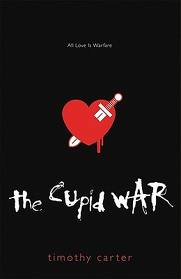
REVIEW: The Cupid War (Kinda like the TV Show Dead Like Me, but with Cupids instead of Reapers)

Carter, T.  (2011).  The Cupid War.  Woodbury, MN:  Flux


Appetizer:  Immediately after deciding *not* to commit suicide by jumping off a bridge, Ricky Fallon slips and falls to his death anyway.

Figures.

Looking down at his broken and dead body, Fallon's soul is approached by an angel.  It would seem Fallon had some unfinished business.  He's to serve as a Cupid, fanning the flames of interest among potential love birds at a local high school, feasting on love (it looks like fudge), dealing with co-workers and battling Suicides or other dead souls with unfinished business who spread depression.

While first walking the halls of his assigned high school as an invisible cupid, Fallon encounters a familiar face from his own life, that of his former "friend," a girl named Susan who had systematically clung to him, separated him from his friends and girlfriend and driven Fallon to consider suicide on the top of that bridge.

As Fallon watches as Susan targets another boy, he begins to suspect that there's something strange about this girl, that she is somehow doing the same work as the Suicides.  The only person who can help Fallon is a girl named Trina, who, somehow, despite the fact that he now exists on a different plane, can still hear Fallon's voice.


I liked the concept of The Cupid War.  It is interesting; the idea of Cupids and Suicides battling for the souls of people to spread love or dispair.  The fact that love is actually a food that the cupids feast upon also has a lot of wonderful potential.

But I wasn't crazy about this book in execution.  The writing felt rough.  A lot of the action scenes were too quick or underdeveloped.  I didn't feel a lot of the tension that the author was trying to create.  I found myself writing "ugh" in the margins of quite a few pages that didn't impress me.  A lot of the plot "twists" were pretty apparent.  The narration also included a lot of telling as opposed to showing.  A lot of tensions were also underdeveloped.  Like Fallon's relationship with his mom.  It felt like an early draft that needed to be expanded and revised extensively.

But that's just my opinion.  What did you think?


Dinner Conversation:

"Ricky Fallon sat on the bridge railing, preparing to jump.  It seemed like the least painful way to die, while ensuring the best chance for success.
He also wanted to cause the least amount of trouble for the city; his father believed a jumper was involved every time there was a delay on the subway.  Fallon didn't want his dad to think he was inconsiderate.  At least, no more than he already did." (p. 1)

"However, as he sat on the edge looking down at the barely visible Don River below, Fallon changed his mind.  It wasn't because of a ray of light from Heaven, or an angel appearing to tell him there was a better way.  Instead, Fallon changed his mind due to a very simple realization.  On Monday morning at school, there would be shock.  By afternoon, however there would be jokes.  He called himself Fallon. The word "fall" was right there in the name.  Sure, it was pronounced differently, but he knew his classmates would make the connection." (p. 5).

"'Every soul has karma,' Bud told him.  "It's the stuff your soul has to work through, the things you do to become a better person.  Some people work off their karma by the time they die, and there's a place for them that you'd think of as Heaven.  Then there's the rest, the people like you, who didn't use their lives the way they should.  If you didn't work it off in your life, you have to work it off now."
"Nobody told me that was the deal!" Fallon said.  "If I'd known that....'" (p. 13)

"...You, pretty boy, are gonna be a Cupid."
..."A Cupid?" Fallon asked.  "You mean...?"
"That's right," Bud replied.  "You're going to make people fall in love."
"Oh," Fallon said.  When it came to afterlife assignments, this wasn't what he'd been expecting." (pp. 14-15).

"Fallon looked at the brick of Love in his hands and thought about all that had been said and written about love throughout the ages.  All the sonnets, poems, and greeting cards, and all the boy-band songs.  Love, he'd heard, was the answer.  God is love, the spiritualists said.  Love made the world go' round, love is the most powerful force in the universe.
Fallon wondered if all those things would have been said if the speakers knew that love was a bunch of big chunks of red fudge." (p. 25)

"'People with severe depressive disorders are the victims of Suicides.  Strong people struggle to hang on, to fight back with drugs and therapy.  Weak ones, however..."
"Jump?" Fallon said quietly.
"Yes," Caleb replied.
Fallon stopped walking.  "Is that what happened to me?" he asked.  "Is that why I wanted to kill myself?'" (p. 42)

"Here, in the afterlife, he had a chance to start over and do something truly great.  He had it in his power to bring happiness to the world.  All he had to do was learn how.
He also had the chance to fight off the forces that had led to his death.  He could literally save lives.  If he stopped only one more Suicide, the world would be the better for it.
What in the world could be better than that?" (p. 66)


Tasty Rating:  !!

Sunday, April 8, 2012

REVIEW: Foiled

Yolen, J.  (2010).  Foiled.  New York:  First Second.

160 pages.


Appetizer:  Aliera Carstairs fences.  No that's an understatement.  She is a champion fencer, someone who has fought at Nationals, beaten fencers older and stronger than her.  She knows how to defend herself and her heart.

Yet, she's invisible at school.  Aliera watches as a new boy, Avery Castle, arrives at school, she watches as he holds the attention of every girl.  When they are paired as lab partners, Aliera must struggle to guard her heart.

Sooooo, lots of people talked-up Foiled, describing it as amazing and wonderful.  It could have been all of they hype, but I was left disappointed within the first few pages.  For a graphic novel, I thought Aliera spent waaaaaaaay too much time talking at the reader.  I wanted more focus on the visual and to get lost in the story.  That never happened with Foil.

On top of that, I strongly disliked Avery as a love interest.  Certainly, he's not supposed to be perfect.  But it was something about this panel that made him completely unredeemable in my mind:


Yep, something about object raping a dead animal for his own amusement makes a man unappealing.

*vague spoiler*, when the fantasy elements emerged, my response was essentially, "What the hell?"  I would have been content with metaphors.  There was very little foreshadowing of the magic and the way that it emerges--when Aliera puts on her fencing mask--an act she's done hundreds of times before in the storydidn't work for me as revealing the magical elements of the world.  *end vague spoiler*

This book just didn't work for me.

What are your thoughts?


Dinner Conversation:


Tasty Rating:  !!

Tuesday, February 21, 2012

REVIEW: Where Things Come Back

Whaley, J.C.  (2011).  Where Things Come Back.  New York:  Atheneum Books for Young Readers.

228 pages.


Appetizer:  My first thought when first hearing of this book:  "Why isn't it called Where Things Return?  Why?!"  Why use two words when you could use one?

My first thought after hearing that this book won both the 2012 Morris Award for debut authors and the Printz Award for young adult literature:  "I must read this NOW.  Wordy titles work!"

My first thought after learning that the author, John Corey Whaley, is a Louisiana teacher:  "Yay!  I can't wait to show my students."

My first thought after reading the book:  "Meh.  Alas, alack, oh dear.  I wanted to enjoy it more."

Where Things Come Back is the story of seventeen-year-old Cullen Witter, whose cousin recently died and who has a crush on the tragic Ada Taylor (her previous boyfriends have a tendency to die....).  Cullen's brother has gone missing.  There's no evidence or reason for Gabriel's disappearance and the grief is hurting every member of Cullen's family.  On top of that, Cullen is stuck in Lily, Arkansas just like all of his other friends, and knows he will never leave until he knows what has happened to his brother.  As Cullen searches for a way to bring Gabriel back, the town of Lily searches for the elusive Lazarus Woodpecker which has been seen for the first time in sixty years.

Every-other-chapter is devoted to sharing the story of Benton Sage, a missionary who works in Ethiopia and then his roommate after Benton returned to the U.S. to attend college.  These seemingly unrelated stories eventually come together in striking ways.  (Although, these chapters never really won me over.  I found the narration to be too telling.)

Throughout the novel, there are paragraphs which begin "When one..." to describe the way Cullen reacts to things.  At first I found this subject change from the first person to be very off-putting, but I have to admit, it grew on me.  I also liked the way that Cullen invented book title names throughout the narrative.  It reminded me a lot of the novel King Dork and the attention its protagonist paid to creating band names and album covers.

Nonetheless, Where Things Come Back never really captured my imagination or interest.  I never desired to pick it up and read it.  However, when I did bring myself to read the book, it was the type of narrative where it was easy to just keep reading.  (To get through as opposed to enjoy)  I can appreciate and respect what Whaley has written.  He pushes away from the way many YA narratives are told.  But I never really connected with Cullen, his friends or the story.


Dinner Conversation:

"I was seventeen years old when I saw my first dead body.  It wasn't my cousin Olso's.  It was a woman who looked to have been around fifty or at least in her late forties.  She didn't have any visible bullet holes or scratches, cuts, or bruises, so I assumed that she had just died of some disease or something; her body barely hidden by the thin white sheet as it awaited its placement in the lockers.  The second dead body I ever saw was my cousin Oslo's.  I recognized his dirty brown shoes immediately as the woman wearing the bright white coat grasped the metallic handle and yanked hard to slide the body out from the silvery wall."  (p. 1)

"Being seventeen and bored in a small town, I like to pretend sometimes that I'm a pessimist.  This is the way it is and nothing can sway me from that.  Life sucks most of the time.  Everything is bullshit.  High school sucks.  You go to school, work for fifty years, then you die.  Only I can't seem to keep that up for too long before my natural urge to idealize goes into effect.  I can't seem to be a pessimist long enough to overlook the possibility of things being overwhelmingly good."  (p. 5)

"You see, Ada Taylor had a grim history.  As a sophomore in high school, when I was just a freshman, Ada was dating this ass-hat by the name of Conner Bolton.  Conner was a senior and made it his personal mission to make every freshman in the school terrified to be caught walking alone or near the bathrooms, lockers, or trash cans.  But alas, he died before Christmas break in a car accident.  Ada was the only other passenger.  She walked away without a scratch.  Then, the next year, Ada was dating this okay guy who I used to play G.I. Joes with on the floor of my mom's hair salon.  His name was Aaron Lancaster.  He didn't even make it to Thanksgiving before he up and drowned int he White River during a thunderstorm.  His dad found his empty fishing boat.  A search party found his body four days later.  I heard it looked like he had been microwaved.
After that, it almost seemed like a ridiculous thing to date Ada Taylor, or even go near her.  But that didn't matter much to the young men of Lily, even me.  The unspoken philosophy of all those in love with Ada was something like this:  If I have to die to get that, then death it is."  (pp. 6-7)

"When Benton Sage found out that he would be going on a mission for his church that year, he was overwhelmed with excitement and panic.  His stomach felt a sort of queasy rumble as he stood with his sisters and Reverend Hughes, and watched as the entire church circled around them, clasped hands, and began to pray.  Ethiopia, he thought, would be the first place he could truly exert his faith.  It was his fear of travel, of leaving his comfortable life in Atlanta, of floating mysteriously thirty thousand feet in the air, that made eighteen-year-old Benton feel as if he would collapse onto the church's soft, green carpet as he heard the choir begin to chant amens and hallelujahs behind him."  (p. 16)

"'Did you hear about that bird?' Lucas asked me, still staring toward the house.
Lucas was one of the smartest and strangest people I knew, and so I wasn't very surprised by his choice of topic.
"What bird?" I asked.
"There's this woodpecker that's been extinct for, like, sixty hears.  Only, this guy from Oregon or something was down here and he thinks he saw one."
"In Lily?"
"Right outside of town.  I think he was canoeing down the river and saw it fly by or something.
"Weird."  (pp. 29-30)

"It was one of those moments when you're waiting on someone to say something important or funny or just do anything to break you away from the sad thoughts that overwhelm your mind.  Thoughts like never having enough money to move away or not getting into college.  Thoughts like having to come back to take care of a sick parent and getting stuck here all over again.  That's what happened in Lily.  People dreamed.  People left.  And they all came back.  It was like Arkansas's version of a black hole; nothing could escape it." (p. 35)

"It was three hours later and after calling everyone we knew and driving around town twice that we decided to call the police.  It was a Thursday when my brother, the Left Hand of God, disappeared.  It was on this same Thursday that John Barling appeared on national television to talk about the Lazarus woodpecker and how it had come back from the dead." (p. 55)

"Here's the problem with a fifteen-year-old boy going missing:  No one thinks he has been taken.  Especially Gabriel, who looked to be my age.  Everyone in town, though they didn't say it, was thinking the same thing:  Gabriel Witter has finally run away from his family.  That, or he went hiking through the woods and either got lost or got eaten by a bear.  Here's what I knew:  My brother was taken from me.  He did not run away, because he wouldn't.  He couldn't.  He would never.  And he'd never gotten lost in his life."  (pp. 58-59)


Tasty Rating:  !!

LinkWithin

Related Posts with Thumbnails