Showing posts with label Dystopia. Show all posts

Saturday, May 26, 2012

REVIEW: Insurgent Audio Book Review

Pretty cover!
Roth, V.  (2012).  Insurgent.  New York:  Harper Audio.

11 hours and 22 minutes.

So, as is obvious in my review of the first novel in this series, Divergent, I wasn't too crazy about the world of this story and was ready to set it aside and ignore it for the rest of my life.

But then, one of my Awesome YA Reading students got hooked on the series.  Now she's threatening to hold her breath until I read Insurgent so we can discuss it.

Le sigh.  I'd hate for one of my former students to pass-out on my account.


Appetizer:  Picking up soon after Divergent ends, Tris, her brother, Four and several others must seek safety from the erudite among the different factions of the city.  This proves easier said than done as many believe that Four and Tris contributed to many of the horrors that occurred at the end of Divergent.  Together, they must deal with the aftermath of all they have experienced and prevent the situation from worsening.

Wow, that was vague!  But I had to be...I didn't want to give away the events of Divergent.

To be honest, I actually liked Insurgent much more than the first book in this series.  In this book, all of the risk-taking was necessary, so I didn't have to shout "Lawsuit!" at random moments when I just couldn't believe the ridiculousness of some of Tris's reckless decisions.  (In the second book, Four actually calls her on some of these behaviors.  Good for you, boy toy!)

I also like that much of the book deals with the consequences and guilt of some of what Tris experienced.  This series went from being so-so to thoughtful.

Alas, to understand what's going on, you *still* have to read Divergent first.

Thoughts about Emma Galvin's Audio Reading:  No complaints here!  Galvin spoke clearly in a way that allowed Roth's characters to come to life without being distracting or preventing me from getting into the story.


Tasty Rating:  !!!!

Sunday, August 14, 2011

REVIEW: Divergent (If The Giver Bought the Hogwarts Houses a Drink, Nine Months Later This Is the Book a Stork Would Deliver to YA Readers' Doorsteps)

Roth, V.  (2011).  Divergent.  New York:  Katherine Tegen Books.

487 pages.


Appetizer:  In the future and in the remains of Chicago, people choose factions to devote their life to:  Candor for those who privilege honesty, Abnegation for those who value selflessness, Dauntless for the brave, Erudite for those who devote themselves to intelligence and Amity for those who focus on peace.  There are also an unlucky few who are faction-less, who live in poverty.

At the age of sixteen, people are tested and then choose their faction during a ceremony.  Raised by abnegation-ist parents, Beatrice--or Tris--faces a tough choice.  She has never felt like she truly belonged with her selfless parents.  The results of her test complicate matters further.  Beatrice learns she is divergent--she could potentially belong to three of the factions--a fact she is told to keep secret as she faces the choice between betraying her parents' hopes for her and pursuing her own dreams.

Divergent is an interesting concept.  It's a blending of the sorting into Hogwarts houses with the Hunger Games and The Giver.  The execution of this story, however falls short of the blogger and insta-movie deal hype that I heard about this book.  It also falls short of the stories I'm comparing it to.  Although Tris's struggle to make her own choice for herself is engaging--and is a central struggle for any young person who is contemplating making choices that his or her family disagrees with--it falls short when compared to Katniss sacrificing herself for her sister in The Hunger Games.

The deadly challenges Tris faced while being initiated into the Dauntless faction were hard to believe as permissible in the society.  While logically, I knew that Roth was constructing a world different from my own and was critiquing the hostile and horrible environments that the Dauntless characters live in, I just couldn't quite believe the world she was creating.  Wouldn't a brave person speak out against the injustice and suffering they see around them?  I found myself mumbling "lawsuit" repeatedly as the Dauntless initiates were required to jump onto or off a moving train or leap off the side of a building with no support, safety nets, training or proper instruction.  I repeat, lawsuit.

Maybe I'm just not "dauntless" enough to believe in this world or maybe I've been too sheltered all my life/too lucky to ever experience a group dynamic with such a competitive and dangerous mentality.

*Shrugs*

As a reader, I also needed to feel a clearer threat to the society or to Tris.  The Dauntless train hard to protect what remains of human society...from what?  While there are hints that Denmark Broken-Chicago is a kind of stinky place within the first 300ish pages, I needed a real threat sooner.  I also needed to understand why being divergent was dangerous sooner.  Basically, this book could have--and should have--been 150 pages shorter.

But having said that, there were some moments in this book that really captured my attention and engaged me.  Whenever Tris faced injustice at the hands of her fellow initiates or at the hands of the Dauntless leaders, I wanted her to come back and kick a-- *ahem* ...and kick bum-bum.  (And she was a tough character who wanted to do just that.)  I also found some of the subtle tensions and themes very engaging; such as the propaganda the erudite faction was creating against the abnegationists or the way Tris had to accept the idea that some of her friends were also her competition.

Overall, this is another one of those books that doesn't seem to meet the hype, but is still enjoyable.  Recommend it!  Just don't imply that it's the best thing in THE HISTORY OF THE UNIVERSE/SINCE SLICED BREAD/IN THE WORLD OF YA LITERATURE as you do.


Dinner Conversation:

"There is one mirror in my house.  It is behind a sliding panel in the hallway upstairs.  Our faction allows me to stand in front of it on the second day of every third month, the day my mother cuts my hair" (p. 1).

"Today is the day of the aptitude test that will show me which of the five factions I belong in.  And tomorrow, at the Choosing Ceremony, I will decide on a faction; I will decide the rest of my life' I will decide to stay with my family or abandon them" (p. 2).

"People who get this kind of result are..."  She looks over her shoulder like the expects someone to appear behind her.  "...are called...Divergent."  She says the last word so quietly that I almost don't hear it, and her tense, worried look returns.  She walks around the side of the chair and leans in close to me.
"Beatrice," she says, "under no circumstances should you share that information with anyone.  This is very important" (p. 22).

"I realize that the decision might be simple.  It will require a great act of selflessness to choose Abnegation, or a great act of courage to choose Dauntless, and maybe just choosing one over the other will prove that I belong.  Tomorrow, those two qualities will struggle within me, and only one can win" (p. 37).


Tasty Rating:  !!!

Saturday, June 4, 2011

REVIEW: Genesis (Moving "Forward Toward the Past")

Beckett, B.  (2006).  Genesis.  Boston:  Houghton Mifflin Harcourt.

150 pages.

A few weeks ago one of my reader friends came into my office and talked about how Genesis was the best book she'd read in a looooooooong time, how I needed to read it NOW, etc.

While this friend didn't *exactly* say we couldn't be friends anymore if I failed to read it, it was implied that to be a *good* friend I would read the short dystopian novel.  And read it soon!

And so I did.

And, let me tell you, Genesis is not a book that a doctoral student should read around the oral defense of her dissertation.  I kept getting flashbacks to my general exams.  *cringes*

Appetizer:  Anax is being tested.  Set during an examination and shared predominantly as a transcript, Genesis is told almost in in real time for a period of four-ish hours as Anax, a student of The Academy who has specialized in history and in analyzing the life of a man named Adam Forde, describes the end of the world as the reader knows it, the history of The Republic and how Forde helped change everything.

I absolutely loved the way that both the world of the story and the structure of the narrative refer back to the works of Plato and other classical thought.  Genesis is kind of like a post-apocalyptic Republic, in that it takes on issues of education, class, individuality and artificial intelligence.   It's an interesting and very intelligent narrative.

Early on, I did feel like the dialogue provided a little too much convenient backstory, but overall this is a well-plotted book...that is kind of difficult to explain beyond what I've already said.

About 3/5ths of the way through the book, Anax presents her interpretation of a series of exchanges of how the focus of her work, Adam, engaged with a being of artificial intelligence named Art.  About that point, I started to pick up a major Battlestar Galactica vibe.  For reals.  I could practically hear the stacatto music in the background as Adam and Art debated humanity vs. AI much like the conversations between Gaius Baltar and Six...except less sexual...and without the skimpy red dress.

I definitely recommend checking it out (it is, after all, a pretty quick read).  As for whether it was the best book I've read in the last couple of years...it may be my friend's, but I wouldn't say it was mine.

But then, I feel like it's been a while since a book really grabbed me.

You read that, authors and books?  That's an invitation.  Impress me!


Dinner Conversation:

"Anax moved down the long corridor.  The only sound was the gentle hiss of the air filter overhead.  The lights were down low, as demanded by the new regulations.  She remembered brighter days, but never spoke of them.  It was one of the Great Mistakes, thinking of brightness as a quality of the past.
Anax reached the end of the corridor and turned left.  She checked the time.  They would be watching her approach, or so it was rumored.  The door slid open, quiet and smooth, like everything in The Academy zone." (p. 3).

"EXAMINER:  Four hours have been allotted for your examination.  You may seek clarification, should you have trouble understanding any of our questions, but the need to do so will be taken into consideration when the final judgement is made.  Do you understand this?
ANAXIMANDER:  Yes.
EXAMINER:  Is there anything you would like to ask, before we begin?
ANAXIMANDER:  I would like to ask you what the answers are.
EXAMINER:  I'm sorry.  I don't quite understand...
ANAXIMANDER:  I was joking.
EXAMINER:  Oh.  I see. (p. 4).

"The founders of The Republic sought to deny the individual, and in doing so they ignored a simple truth.
The only thing binding individuals together is ideas.  Ideas mutate, and spread; they change their hosts as much as their hosts change them" (p. 50).


Tasty Rating:  !!!!

Sunday, March 6, 2011

Just A Snack: Wither

DeStefano, L. (2011). Wither. Simon & Schuster.

Guys, if I could star this book based on cover alone, it would be TEN WHOLE STARS. For real -- did you see this thing? Wedding ring leading to caged bird flanked by gorgeous teased-out girl in poofy ball dress, with dying lily petals drifting down the back? Love it.

As for the book itself, I had more mixed feelings. It was full of topics that I normally would be all over. Tragic dystopia? Sure! Scandal and child brides? Why not?! Twins? Yes! But when they were all combined, it seemed overdone and under-explained.

Why, for example, are only the wealthy concerned with the future of the human race? If they need babies like a fish needs water, why are they wantonly shooting girls who aren't hot enough to marry rich stupid sons? How did every other continent on Earth manage to be blown into teeny tiny pieces whilst the US apparently continued on unscathed? Are the orphanages in the pay of the Gatherers, and, if not, why the heck are they teaching impressionable kids that it's awesome to be pregnant by thirteen? And, perhaps most importantly, why must the love interest in this book be so blah?! (Sorry Gabriel. You're just not cutting it for me.)

I did enjoy reading Wither, don't get me wrong. Destefano writes like a dream--I'd be willing to be Gathered myself if it meant wearing some of the outfits she describes. The next two will be on my To Read list for sure and, presumably, all of my burning questions except the last will someday be answered. I just don't expect that the plot will stay with me for any longer than it takes me to put the book back on the shelf.

Tasty Rating: !!!

Wednesday, February 16, 2011

Literary Feast Discussion: Ship Breaker (The End!)


Welcome back, Ship Breakers!

Our thoughts on the ending of this Printz winner are below.  Beware the spoilers!  Monica and I would love to know what you thought of the ending and of Ship Breaker in general in the comments below.  So, don't be shy, let us know your thoughts.

Shel: I've decided I will have to start calling people "piratical
bastards." Although, I may go with "piratical punks" just to dull the
insult a little.


Monica: Pshaw. Use it the way it's meant to be! You can't soften up an
insult! Of course, pirates are kind of in right now. your intended target
might not even mind. ;)


Shel: So, overall, what did you think of Ship Breaker?


Monica: Three out of five stars. Middle ground. The writing was sound,
but I didn't care too much about either of the main characters. I was more
interested in the minor players, like the captain, or what's-her-face's
mom. I'm halfway through Windup Girl, also by Paolo Bacigalupi,
and honestly, I'm enjoying that one more. Maybe Ship Breaker was
just too short for him to really delve into the plot and the characters?


Shel: For me, I really like the world Bacigalupi created. The story is so
relevant. And while there are aspects of both Nailer and Lucky Girl that I
liked, neither of them really captured me in the end. I think I would have
liked to see other characters stories within this world.


Monica: I want more Tool. Is it bad, that he was the one I was most
intrigued with? I would happily read a book that explained where
he came from.


Shel: Well with Tool, Bacigalupi created this wonderful character who was
the constant outsider and we only got the surface level of why he was so
different. There was definitely more to learn about Tool.

Monica: Spin-off novel? Spin-off novel.


Monica: I'd buy that book for sure.


And that ends our feast on Ship Breaker!  What did you think of it?

We might be holding off on our next feast for a couple of weeks.  Both Monica and I seem to be a bit busy with pesky homeworks.  But never fear, we'll be back soon-ish.  Start thinking about which book you would like to read next.

Monday, February 14, 2011

Literary Feast Discussion: Ship Breaker (Chapter 18-21)


Wow, so Ship Breaker is speeding up!  Let's skip the intro jibber-jabber and get straight to the comments because I need to finish this book and finish it soon....

(Keep in mind there are spoilers below!)


Shel:  So, normally I'd be all "YAY KISS!" but for some reason when Nailer and Nita kiss, I wasn't that happy for them.  The moment felt forced to me.  I think it has to do with the fact that several weeks went by and I feel like I've somehow missed some character development.  Am I alone in this?

Monica:  Nope.  They’re just not that convincing as a couple.  I think it’s more that the author didn’t have any other options.  They’re thrown together and they’re the only two people even sort of suited for each other because no one else is around and they can’t very well have Nailer making out with Tool.  But I don’t even like Nita, so I’m not about to encourage this relationship.

Shel:  See, I liked her at first.  But she's kind of losing me.  I was so excited that there was finally a potential escape.  I had visions of a fast moving ship and everything.  I can't believe Nita was captured while Nailer was out.  I guess I'll just be thankful that Tool is okay.  After all, he is winning the favorite character fight even more now.

Monica:  Nita is useless!  She’s like Princess Peach – she stands there getting into trouble and going, “Oh no!” while poor Nailer has to run around fighting all the bad guys for her.  (Poor Nita.  She really doesn’t stand a chance with me.)

Shel:  See, she seemed clever at first.  Then manipulate.  And now she's just kind of a prop.  And then Tool left.  Fail.

Monica:  EPIC FAIL.  And it doesn’t even look like he’s coming back.  Why!?  Why can’t the dramatic action shift?!  I’d happily follow Tool anywhere!  Backstory away!!

Shel:  What do you think of all this killing business and of Nailer being "blood-thirsty"?

Monica:  Eh?  I think he’s as “blood thirsty” as any other kid raised on shipwrecks, doing work from the time he was old enough to understand, with an abusive father and perhaps a somewhat underdeveloped moral compass.  I probably wouldn’t be doing much better, really, except for the way I’d be dead already due to lack of street smarts and fear of non-prepackaged food.

Shel:  Yeah, I think I would have been a goner too.  Unless I'd been born a swank.  And never left my swank neighborhood.  In other news...Yay!  Nailer is learning to read.  I approve.

Monica:  What he needs is a modified version of Dick and Jane that fits his worldview.  “See Dick strip wire.  Strip wire, Dick, strip wire!”

 Shel:  See Jane mutilate herself to keep the rapists away!  Mutilate, Jane.  Mutilate!  Quality.  


So, what do you think of Ship Breaker?  Feel free to leave your comments below.  We'll be finishing up the book for Wednesday (I promise!).  So, I'll see you back here soon.

Saturday, February 5, 2011

Literary Feast Discussion: Ship Breaker (Chapters 13 through 17)


Hello again, few but dear readers.  How goes life?  Monica and I are still making our way through Paolo Bacigalupi's Ship Breaker.  Our thoughts about chapters 13-17 are below.  We'd love to hear what you think of the book in the comments, few but dear readers.


Shel:  After taking a few days off and picking up this book once more, I can't believe some of the characters' names.  It makes me wonder what my name would be if I lived in the Ship Breaker world.  I imagine I would be something like "Whiney Girl," since I'd constantly complain about the working conditions and lack of sanitation.  How about you?

Monica:  Oh, I’d be Stumbles, for sure.  Because—and trust me on this—if I had to do be doing any of the running / wire cutting / fighting that these kids are doing on a daily basis, I’d be black and blue and blistered and crippled.  Clumsy is my middle name.

Whiney Girl:  I like that Tool turns out to be a good guy.  Yay, Tool!

Monica:  His name is strange but we love him!!!  I wonder if we’re ever going to find out his whole back story…  To be honest, he might be my favorite character of the whole book.

Shel:  See, at first, I was willing to cheer on Lucky Girl, but she is proving to be a little too manipulative for my tastes.  I do like Tool.  But just as Lucky Girl is too manipulative, he seems a little too wise.  

Shel:  I like the tension over how similar Nailer is to his father.

Monica:  And how desperate Nailer is for it to not be true.  Poor Nailer.  If my daddy was a crazy drunken killer-type person, I’d have disowned him by now.  But family loyalty wins out, I guess, at least for now.

Shel:  And I quote:  "It's human nature to tear one another apart.  Be glad you come from such a successful line of killers" (p. 175).  Yikies.

Monica:  Upside, he’s ahead in the game!  Look how much more trouble he would have had if he *didn’t* have such a fierce attitude!  (Trying desperately to look on the bright side…?)

Shel:  The bright side is fun!  While I'm enjoying this book, I did feel like the first two part were a little too heavy on the lets sit around and talk.  It's nice to have some more action now.

Monica:  Yeeees.  I liked the finger-cutting moment, but other than that, there was a LOT of exposition.  But now, there’s fighting in the streets!  Running for their lives!  Hooray!! J  (I’m a little bloodthirsty.  I can’t help it.)

Shel:  Never fear, I thirst for blood too...in the only way that a vegetarian can thirst for blood.

Monica:  Nailer is right.  Nita *is* kind of a cold one.  Way to hang Tool out to dry, girl – I like him way more than you, so I’m kind of bothered by your Cringe In The Shadows attitude.  …  On the upside, yay Nailer!  Way to be loyal!

What are your thoughts, cool cats?  Monica and I would love to read your opinions of Ship Breaker.  We'll be back with comments on chapters 18 through 21 by Saturday-ish.  The feast continues then!

Friday, January 28, 2011

Literary Feast Discussion: Ship Breaker (Chapters Seven to Twelve)

Well friends, the eagle-eyed among you will note that it is several days past when we planned on posting. Our illustrious leader, Shel, has been going quietly insane in the confines of her condo (ooh, alliteration!) whilst she struggles to complete her education by... May? Are you trying to finish by May, sweetie? I personally have no excuse whatsoever save for the fact that Library School is kicking my butt -- who on earth decided that statistics were necessary for doing research!?

But anyway. I digress.

On to Ship Breaker! Have you been enjoying it so far, few but dear readers? Is it everything you would hope for and more, in a Printz winner?

Shel: What do you think of Lucky Strike? Good guy or villain? Somewhere in between?

Monica: Somewhere in between, for sure. I don't think he's being painted as a villain, necessarily, but he's definitely scheme-y enough to not be good. Which, honestly, is probably more authentic. Just because you suddenly become wealthy doesn't mean you turn evil... but neither does it mean you are all philanthropic, either. He's obviously keeping what's his, and trying to add to it.

Shel: I love how Pima is so dismissive of the new new clothes on the wreckage of the ship. So practical.

Monica: But she does like the pretties, give the girl some credit.

Shel: I also think Pima's reaction to the realization that the supposed dead girl is not so dead: "That's some creepy shit," she said (p. 95). Yes, I agree. But imagine how creepy it is for the supposed dead girl, waking up to two people trying to cut off your fingers and discussing your state as a dead person.

Monica: Um, yes? Yes. The part where they were hauling on her hand and trying to just wiggle the rings off was gross enough. When they actually decided to just hack off her fingers, I felt vaguely like throwing up.....

Shel: I really like that Dead Girl/Lucky Girl/Whatever her real name will be... Nita has some real skills. She's not just some helpless damsel. I'm pretty serious now about wanting her perspective of this story. You hear that, Bacigalupi? Fan fiction writers?

Monica: YES! Fanfiction writers will carry her plot, even if the book fails miserably....

Shel: Although, all of this "blood with blood" stuff is just too unhygienic for my liking. There have got to be blood born diseases in this world. Nita TELL THEM!

Monica: I think they're more worried about how they don't have water. ;)

That's it for now, kids! Join us next time (I'm going to throw out Next Saturday as a date, and cross my fingers that we make the deadline) for a discussion of chapters thirteen through nineteen. As always, feel free to toss out your own thoughts in the comment section!

Monday, January 10, 2011

Literary Feast Discussion: Ship Breaker (Chapters One through Six)


Okay, so instead of getting this posted on ThursFriday, it's officially going up on Monday.  A time that is solidly and squarely three days late....

But that's okay!!!!!!  Because Ship Breaker just won the American Library Association's Printz Award, which is for young adult literature.  YAAAAAAY!  So this timing works out, right?  Right.

Comments on the first six chapters are below.  We'd love to hear your thoughts as well!


Monica: Oooh. The book may disappoint us, but I'm LOVING the opening! I feel all gritty and disgusting and cramped, just like poor Nailer. Brava for the imagery, author!

 Shel: It's official, I could never be a scavenger like Nailer. I wouldn't say I'm *actually* claustrophobic, but once as a kid I climbed under a huge, low deck in a park for some secret club meeting. I had to wiggle my way out, my back against the deck, my front scratched by wood chips. That day I learned that small spaces are not fun. I was a bit of a slow seven-year-old.

 Shel:  I like all of the religious elements.  I'm curious to see where they lead.
 
Monica: I'm wondering how far in the future this takes place. Has that been established yet? It would be interesting to see what "old" versions of religions remain in the new... and now long it apparently took to shift over. ;)

Shel:  Poor Jackson Boy...even if he was a little licebiter, that's a bad way to go.  (See above comment and the fact that this book is reminding me of my possible claustrophobia.)  
Monica: Best. Ghost story. Ever. Seriously, can you even imagine? "Hear that thumping, tiny child? That's the ghost of JACKSON BOY! He haunts these bulkheads...."

 Shel:  So far, all of the detailed descriptions and analogies are impressing me.  But I have to say what *truly* drew me in was the ending of chapter two.  Yikes!  You?
 
Monica: Like I mentioned above, I was sold from the opening. He writes like we're actually there... and since I would never, ever ever ever want to BE there, I'm finding it fascinating to read from the warm, clean safety of my living room couch, with a nice glass of clean water next to me.

Shel:  I like all this talk of luck and fate on page 41.  I'm with Pima's mom.  The fates have big plans for Nailer.  BIG PLANS, I say!  (And I don't feel that way just because I read the jacket flap.)
Monica: I hope so -- I don't know if I could take an entire book of Nailer: Copper Scavenger. Or, honestly, Nailer: Abused Child with Terrible, Terrible Father.

 Shel:  With hurricanes and oil spills, this dystopia feels much more immediate than a lot of the other ones out there.
Monica: Yes! Which is both awesome and teeeeeeeeerrible. I usually only like dystopian fiction when it seems far enough away that I don't need to worry about it.

Shel:  And now the book was just announced as winning the 2011 Printz!!!!!  Victory to Paolo Bagi...Bacigad...Bacigalupi!!!!!!!  YAY!


So, now that you know what Monica and I thought of the beginning, we'd love to hear your thoughts.  And stay tuned, will be back on Fri-Saturday with comments on chapters 7 through 12.  Of course, by Fri-Saturday, I could possibly mean next Tuesday.  We'll have to see.

Saturday, January 1, 2011

Literary Feast Invite: Ship Breaker by Paolo Baca...Bacigad...Bacigalupi (One thing is certain: If I had to memorize the spelling of his last name to pass Kindergarten, I'd still be *in* Kindergarten.)

Having felt like we've encountered a few books that we were less than enthused about during our literary feasts in the past, Monica and I have decided to try and play it a little safe for our first literature circle book of 2011.

We've decided to read and discuss the National Book Award Finalist, Ship Breaker.  Our reasons for choosing the book are varied:

1.  We've heard good things about it.
2.  I saw Paolo speak about the book a few months ago and made immediate plans to sit down and read the book.
3.  I read Paolo's portion of The Dark Side of Young Adult Fiction Debate for The New York Times (but let's be honest NYT, a "debate" usually involves more...back and forth...arguments, you know, a debate.) and remembered my no-longer-not-quite-exactly "immediate" plans to read Ship Breaker.
3.  Sometimes being terrified that the world is going to end in a dystopian oily mess may give us the motivation to be planet savers instead of planet haters or planet lazy-ers.
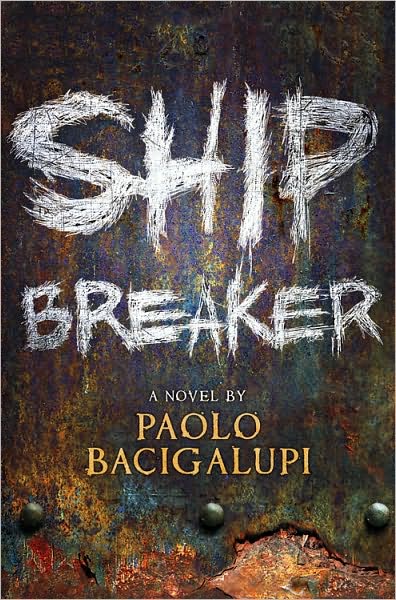
4.  The cover is pretty.  (Sure it's supposed to be the graffitied hull of a rusted, oil tanker-detritus, but the designer managed to add a bit of sparkle to it:


Shiny.

This cautionary dystopia is set in the Gulf Coast, where Nailer scavenges among the oil tankers for copper wiring.  When he "discovers an exquisite clipper ship beached during a recent hurricane, Nailer faces the most important decision of his life:  Strip the ship for all it's worth or rescue its lone survivor, a beautiful and wealthy girl who could lead him to a better life...."

Our first literary feast/literature circle discussion will occur on...*draws a random date out of the air like a fake-psychic* on Thurs...day...Friday-ish?  So, check back at some point around ThursFriday, and I'm sure Monica and my thoughts about the first six chapters of Ship Breaker will be posted.  Be ready to share your own thoughts in the comments section.  Cool beans?

Thursday, December 23, 2010

REVIEW: Matched by @allycondie: Your match banquet has been scheduled!

Condie, A.  (2010).  Matched.  New York:  Dutton Books.

366 pages.


Appetizer:  Set in the future after the world as we know it has ended, seventeen-year-old Cassia is celebrating her birthday AND her Match Banquet, when she'll learn the name of the boy she is to be matched with for the rest of her life.

Her Match is unusual because she is paired with one of her close friends, Xander, a rarity throughout the Society.  But then things get even stranger when she reviews the chip on her match at home and she sees another boy's face appear on the screen, another boy she knows.  But the other boy, Ky, is an Aberration, someone not allowed to be matched.  Has someone played a horrible trick on Cassia or could it be possible that the Society has made a mistake?

Cassia's world is highly regulated.  Their daily intake of nutrients are monitored, her and her family's dreams tracked.  Seventeen-year-olds are matched to produce the strongest children, the most likely to survive.  They are told when their lives must end (at 80, a reality Cassia's grandfather now faces).  Cancer has been wiped out.  There are almost no areas of wilderness left.  Everyone carries around three drug capsules:  The green to calm you, the blue to keep you healthy and the red...well, nobody knows what the red one does.  All for the Society's survival.  But what does it mean if the society has made a mistake in Cassia's Match?  What other mistakes could exist in their Society?

I first head talk of this book aaaaaaaall the way back in the summer.  And from the first mention of it, I've wanted to read this book (the beginning of a trilogy...that already has a movie deal.  Of course!).  And since then, I've had to read rave review after rave review.  Few but dear readers, it was soooo hard to be a good little patient reader.

As I started reading, Matched reminded me strongly of Lois Lowry's The Giver in terms of how regulated the dystopian world is and in terms of how the teens are given specific responsibilities as they age.  Except I feel like Ally Condie must have constantly been consuming sugar to express how cheerful and protected the society is.  Seriously, the cheerful exchanges early on in the book, when the world seemed to be a utopia, practically gave me a cavity.  I had to call The Dentist-Father to make an appointment.

Then, as I kept reading Matched I was reminded of 1984 (one of my all-time, forever and EVER favorite books).  I think it was the way that Ky and Cassia felt most comfortable talking in nature.  But I wasn't the only one to make the connection.  Someone on Twitter (I didn't pay attention to who, oopsie) tweeted something to the effect that Matched was the 1984 for people born after 1984.  Well said.

As I read, I couldn't help but think that the story really showed that Condie used to be a high school English teacher.  She incorporates a lot of excellent poetry into the story and who else but an English teacher would create characters who treasure being able to write in cursive?

The Society Condie has created is great and could start a lot of wonderful conversations in a classroom.  For example, nobody in the Society creates, they're forever restricted to the 100 poems, 100 songs 100 sculptures that were allowed to continue to exist.  I can just picture groups of students trying to pick the 100 poems to represent the human experience (And let's hope that many of those groups would come to the conclusion that more works of art are needed to share all of the human experience, emotions and world).

I have to say, despite all of the hype, I didn't find Matched to be the page-turner that I was expecting.  I found it to be more of a slow build of tensions as Cassia begins to doubt the perfection of her family, her match, the officials and the Society.  As she begins to question some of the rules and the realize that the people in the Society never fight for anything, I found myself wishing to know more of the consequences for misbehaving, to see the dark underbelly of the world, to have more of a sense of the danger.  But then, I do like my dystopians to be dark.

So, I tried looking at Matched as a romance first and a dystopian novel second.  It was interesting, because the tension for Cassia comes down to wanting to choose who to love and choosing between, Xander, the boy next door that she has always known and Ky, the more mysterious boy (who also happens to live just down the street) who has a dark and mysterious past.  (Does poor Xander even stand a chance?!)

I would  definitely recommend this book.  I think it's particularly fitting for middle grade readers who don't know what to pick after loving The Giver or for readers who are a bit weary of dark dystopian novels.


Dinner Conversation:

"I've waited so long for this:  for my Match Banquet.  Where I'll see, for the first time, the face of the boy who will be my Match.  It will be the first time I hear his name" (pp. 3-4).

"I watch and wait, determined that he girl my Match will see on the screen in his City Hall somewhere out there in Society will be poised and calm and lvoely, the very best image of Cassia Maria Reyes that I can present.
But nothing happens.
I stand and look at the screen, and, as the seconds go by, it is all I can do to stay still, all I can do to keep smiling.  Whispers start around me.  Out of the corner of my eye, I see my mother move her hand as if to take mine again, but then she pulls it back.
A girl in a green dress stands waiting, her heart pounding.  Me.
The screen is dark, and it stays dark.
That can only mean one thing" (pp. 13-14).

"I reach up to touch the words Courtship Guidelines on the screen but before I do Xander's face darkens and then disappears.  The postscreen beeps and the voice says again, "Cassia Reyes, the Society is pleased to present you with your Match."
My heart stops, and I can't believe what I see.  A face comes back into view on the port in front of me.
It is not Xander" (pp. 34-35).

"I try to pull my thoughts from the boy who is an Aberration.  I should be thinking about how wonderful it is that everything is back in order.  But instead I think about Ky--how sorry I feel for him, how I wish I didn't have to know this about him and could have gone on thinking he had chosen to be a Single.
"I don't need to remind you to keep the information about Ky Markham confidential, do I?" she asks mildly, but I hear the iron in her voice.  "The only reason I shared it with you was so that you could know without a doubt that he was never intended to be your Match."
"Of course.  I won't say anything to anyone" (p. 47).

"I wanted to know more about this boy who lives among us, but who never truly speaks.  More about what happened before.  I wanted to know more about my mistaken Match.  But now I feel like finding out about him is one of the ways I find out about myself.  I did not expect to love his words.  I did not expect to find myself in them.
Is falling in love with someone's story the same thing as falling in love with the person himself?" (p. 196).


Tasty Rating:  !!!!  (4.5 explanation points, if I could make a .5 explanation point.  A .?  !!!!.)

Saturday, August 28, 2010

(Kinda) Review: Mockingjay

So, I'm having trouble putting my thoughts about Mockingjay into words.

But since I did review both The Hunger Games and Catching Fire, I couldn't just ignore Mockingjay.

So, my thoughts are below.  Be warned on two counts, few but dear readers:  I ramble and there are spoilers.

Collins, S.  (2010).  Mockingjay.  New York:  Scholastic.

390 pages.

Mockingjay (The Final Book of The Hunger Games)Appetizer:  For those of you not in the know, Mockingjay is the final installment in The Hunger Games trilogy.  The books follow a teenage girl named Katniss who takes the place of her younger sister in a televised fight to the death among children and teens from poor districts for the amusement of the rich Capitol.

Mockinjay is set during the districts' rebellion against the capitol.  Katniss is now seventeen and must decide whether she wants to accept the role of becoming the "mockingjay" or the face of the rebellion and encourage the people to rebel.

As you can imagine, it's very dramatic.  Dark.  Beautifully written.  Tense.  Dark.  Captivating.  And dark.

As a whole, the Hunger Games books have done an AMAZING job of capturing the interest of students who generally don't like to read ever.  I've had undergraduates admit that they started reading for fun again because of The Hunger Games.  It is so exciting to see.

Having said all of this, I had some trouble with Mockingjay.

I was fine for the first two-thirds of the book.  As with the other books, I enjoyed Katniss's emotional struggle with what she has done and what has been done to her.  I loved the realization that it is through Katniss's authentic-ness that she won over people to her cause.  I thought it was tragic what Peeta had to endure while held prisoner by the Capitol.  I liked that Gale finally had more of a role.  I also liked that the hunger games became a metaphor for the larger battles in Katniss's life.  I liked some of the new characters introduced (Boggs!).  Although, I was very disappointed that some other characters disappeared from the story entirely after a quick sentence that they'd died tragically.

My big problem was....

WE INTERRUPT THIS POST TO REMIND YOU THAT THERE ARE SOME BIG SPOILERS AHEAD!!!!!!!!

My big problem was with when Katniss became a soldier.  As she and others traveled through the capitol to reach President's Snow's mansion I was more reminded of the movie Black Hawk Down than a YA novel.  I was fine with the messages about war and peace that were included, but I felt like those messages were shared at the expense of a story I had been captivated by up until that point.

The Ask and the Answer: Chaos Walking: Book TwoAnd with the Katniss's uncertainty over who to trust--Snow or Coin--I couldn't help but be reminded of the Chaos Walking series.  And to be honest, I thought that book did a better job of constructing foils between leadership styles and the conclusion that pretty much all war leaders aren't exactly super-awesome-straight-forward peeps who will be content with only a tiny taste of power.

I also had a lot of trouble with the bombs that were sent down in little parachutes in front of the president's mansion and who those explosions killed.  After the ending of that chapter, I honestly thought the following seven or eight pages were a dream sequence.  Honestly.  It wasn't just that I didn't want to believe what had happened had...happened.  But the language about it as Katniss recovers was just so vague and metaphorical that it made the events hard to believe.

Now, having said all of this.  I did still find the ending of the book to be satisfying.  All my questions were answered and I did feel like (those left alive) could find peace (kinda).

So, yeah, rambling done.

What did all-ya-few-alls think?


Dinner Conversation:

"I stare down at my shoes, watching as a fine layer of dust settles on the worn leather. This is where the bed I shared with my sister, Prim, stood.  Over there was the kitchen table.  The bricks of the chimney, which collapsed in a charred heap, provide a point of reference for the rest of the house.  How else could I orient myself in this sea of gray?" (p. 3).

"I'm going to be the Mockingjay" (p. 31).

"And now Coin, with her fistful of precious nukes and her well-oiled machine of a district, finding it's even harder to groom a Mockingjay than to catch one.  But she has been the quickest to determine that I have an agenda of my own and am therefore not to be trusted.  She has been the first to publicly brand me as a threat" (p. 59).


Tasty Rating:  ????????  Two stars, four stars...I can't decide.  Internets, help me make sense of how I feel about this book!

Thursday, December 10, 2009

REVIEW: The Forest of Hands and Teeth


Ryan, C.  (2009).  The Forest of Hands and Teeth.  New York:  Delacorte Press.

9780385736817

310 pages.

30-Second Summary:  Set in a post-apocalyptic world, Mary lives in a village, fortified by walls and fences.  Beyond the village is the Forest of Hands and Teeth, where the unconsecrated live, ready to bite and attack anyone who leaves the safety of the village.   After dawdling by a stream with a boy named Harry, Mary's mother, who is still mourning the loss of her husband, is infected by the unconsecrated by the fence.  Losing what sense of family Mary has left, she has little choice but to join the sisterhood, the religious organization that helped protect the city.  As Mary begins her training she bonds with Travis, the boy she has always loved and she catches sight of a stranger, leading her to believe their might be a safe way to pass through the forest.

Wow.  That summary took more than 30 seconds to type.  It probably took more than thirty seconds to read.  The moral of this?  The Forest of Hands and Teeth is a complicated text that works on a number of levels.  Be aware!

I have to admit, I had trouble getting into the book.  Serious trouble.  I think my issue with the text is a little different than many other readers out there (who may have trouble with the book because of the fantasy element or the darker aspects of its content).  I was fine with it being set in a post-apocalyptic world.  I was also cool with the darkness.  I didn't like the protagonist, Mary.  I found that she was all over the place emotionally.  Up and down.  Up and down.  And I didn't really want to follow her.  Up and down.  Up and down.  For example, on page 112, she starts out with her "whole body flooding with fear and hope and joy."  A few paragraphs later she wants "to crumble right there, to fall into [her]self until [she is] nothing more than a heap of emptiness on the floor."  And by the end of the page a thought has fallen like a "stone" inside her stomach.  I guess that means she's not a heap of emptiness anymore.

I just wasn't there with her, being *ahem* empty one moment and filled the next.

From what I can tell, a lot of readers are right-there-with-Mary throughout the story. My problem with Mary may actually be a personality thing.  I like my people to be steady, consistent.  People who are all over the place emotionally kinda drive me crazy.  I guess I just like people to resemble inanimate objects.   So, Mary drove me crazy.  So, much so I kept hoping for more of her loved-ones to die (since I doubted that, as the narrator, Mary would be leaving the story).  I also started to contemplate how, were I Mary's mother, I too might consider allowing myself to be bitten by a zombie unconsecrated person in the hope of becoming consumed by an undying hunger because it's gotta be better than listening to Mary's never-ending whining.

Wow, it felt good to type all that.

Take the above as a grain of salt, my few but dear readers.  I clearly was driven a bit insane by all of Mary's emotional chaos.  There is a lot of beauty to this text.  Ryan's language is often very poetic.  Her word choices encourage readers to think of the text as allegory or as an exploration of issues of belief and choices.  Carrie Ryan demonstrates that she is truly evil-minded capable at keeping her characters in a state of suffering and tension.

Initially some of the religious wording was a little off-putting for me too.  But once I eased into that, I found a more compelling thing to nit-pick.  I had trouble with Travis as Mary's love interest.  At the start of the novel, all we know about him is that Mary is already interested in him and Travis has chosen to court Mary's best friend, Cass.  The first we actually see of Travis is as an injured, fevered ball in the care of the Sisterhood, during which time, Mary falls completely in love with him.  Now, we do see a cute moment or two during this time--for example, Mary whispering description of what a fabled ocean looks like.  Nice, but it still doesn't show me what's so endearing and wonderful about Travis.

The sequel, The Dead-Tossed Waves, will be out in March.

That's not too long of a wait.  And I'll probably make a point of reading it.  At some point....


After Dinner Exercises:

While this might be best as an individual recommendation, the novel can provoke discussions about power and the way authority figures control information, questions of trust and when to challenge the status-quo.

This could also be used in young adult religious reading circles since the book takes on issues of faith, blind trust in religious organizations, choice and determinism.  Groups could also discuss the way that the unconsecrated hunger for flesh and the sexual significance that could have.  This could channel into discussions of marriage and whether the institution should be about love alone or about commitment and support.

On a lighter note, the book could feed into a lesson on roman numerals, since they enter into the content of the text with the assumption that the reader will not immediately know their significance.


Quotes of Note:

"My mother used to tell me about the ocean.  She said there was a place where there was nothing but water as far as you could see and that it was always moving, rushing toward you and then away.  She once showed me a picture that she said was my great-great-great-grandmother standing in the ocean as a child.  It has been years since, and the picture was lost to fire long ago, but I remember it, faded and worn.  A little girl surrounded by nothingness" (p. 1).

"All my life I have trained by that siren.  Before I could walk I knew the siren meant death.  It meant somehow the fences had been breached and the Unconsecrated were shuffling among us" (p. 6).

"In my village an unmarried woman has three choices.  She may live with her family; a man may speak for her, court her through the winter and marry her in the spring ceremonies; or she may join the Sisterhood.  Our village has been isolated since soon after the Return and while we have grown strong and populous over the years, it is still imperative that every healthy young man and woman wed and breed if possible" (pp. 24-25).

"The path is forbidden to everyone:  villagers, Sisters, Guardians.  Never have I seen this gate opened, never have I seen someone use this path.
Someone from Outside has come to our village.
Which means that there is an Outside--something beyond the Forest" (p. 59).


Tasty Rating:  !!!

Friday, November 27, 2009

REVIEW: Among the Impostors

Haddix, M.P.  (2002).  Among the Impostors.  New York:  Simon & Schuster Books for Young Readers.

0689839081

172 Pages.

30-Second Plot Summary:  Luke has left his family's farm for the first time in his life to attend school under the identity of another boy.  As Luke deals with the shock of being around many new people, bullying and not getting lost as he travels the school's halls, he begins to realize that something may be off about the Hendricks school.

I like to think of Haddix as being the JJ Abrams of children's literature.  For the longest time, both of these creative types are excellent at writing surprising, twisty narratives.  But the more time you spend reading/watching their work, the more you learn to expect the completely unexpected and can figure out where they're going.  Plus, in both cases, when the two work on series, they eventually get distracted and mentally move on to other things leaving you mid-series with a project is slowly going downhill.

When I read the first book in the Shadow Children series, Among the Hidden, I was impressed that Haddix managed to keep me interested in a book that featured a protagonist who spent much of the book in one room.  With the second book, reading about Luke being stuck in one building got a little old much more quickly.  Luke's big adventure is to escape to the woods outside the school and plant a garden.  And I was left going, "A garden?  Really?  Ugh.  Do we REALLY have to watch the plants grow.  Really?!  I like potatoes.  I'm in no way opposed to planting them.  But do I have to read about it here?  Really?!"  So imagine my joy when his garden was trampled and Luke had a new mission:  Discover who else is leaving the school and meeting in the woods and why.

I also started to wonder how long it would take for Luke to finally age.  I'm only on book two and it already feels like enough time has passed in these two books that he should have had a birthday by now.  Is it part of the shadow children's distopian world that they're to be powerless hidden children forever?  Never to age or grow?  Yes, I'm starting to think so.

I also struggled with the way the Hendricks Academy was run.  This could be a teacher thing, but Luke is introduced to the school.  And isn't given a class schedule.  He wonders from random class to random class.  Later the reader learns that a lot of the students at the school have special needs.  This made the teachers' disinterest in their classes that much less believable.  Now, several characters explain the reasons why the school is the way it is.  I still struggled.

Of course, the last forty books or so of the book were still pretty tense (and involved a touch of violence) that kept me up a little late to finish the book and ready to read book three, Among the Betrayed.  It is important to note, this really is a series that needs to be read in it's proper order.  No picking which book has the coolest title or cover (if I still made book decisions that way, there's no way Among the Impostors would have been the second book I read).


ACTIVITIES:

Since Luke/Lee has little understanding of how school works, what with never leaving his parents' house EVER before, the boy struggles to fit in and is bullied upon his arrival.  This could be a nice reminder for middle grade readers about how people have different experiences from one another and how we (teachers included!) need to make certain to welcome new students and make sure they are comfortable and understand the school rules.

One of the tensions throughout Among the Impostors is the way that children from the country are perceived.  A teacher could lead discussion on stereotypes, in this case the way farmers are perceived both in the book and in American culture.  (This can turn into a history lesson since Jefferson had a lot to say about citizens who farm compared to those who don't.)  Also since, Luke starts growing a garden, a class can do the same.

As with the rest of the series, the distopian world Haddix has created lends itself to discussion social revolutions, the passage of laws, the population laws of China or historical events like the Holocaust and other situations where groups of people were persecuted.


QUOTES OF NOTE:

"Sometimes he whispered his real name in the dark, in the middle of the night.
"Luke.  My name is Luke" (p. 1).

"It was awful.  All those eyes, all looking at him.  It was straight out of Luke's worst nightmares.  Panic rooted him to the spot, but every muscle in his body was screaming for him to run, to hide anywhere he could.  For twelve years--his entire life--he'd had to hide.  To be seen was death.  "Don't!" he wanted to scream.  "Don't look at me!  Don't report me!  Please!" (p. 15).

"But Luke wished for so much, he couldn't go on.
He was so busy longing for big, impossible changes, he never gave a thought to wanting anything smaller or more practical.  Like an open door.
But that was what he got" (p. 37).

"He'd thought that coming out of hiding would expose him to the world, teach him everything.  But being at Hendricks seemed like just another way to hide" (p. 79).


TASTY RATING:  !!!

Wednesday, November 25, 2009

REVIEW: Little Brother


Doctorow, Cory. Little Brother
382 pages -- 0765319853

Thirty second summary: After San Francisco is attacked by terrorists, made into a police state, and written off by the rest of the country, seventeen-year-old Marcus and his friends find themselves in a fight for their lives against the Department of Homeland Security.

So there I was, friends, at the library, when I stumbled upon a book that looked fairly awesome. Teenagers in sneakers? Check. Binary code everywhere? Check. A ringing author endorsement… from Neil Gaiman? Check and check.

Perfect! Better take it home!

I’m not going to lie to you – I finished Little Brother, read the last of the author’s notes, looked at the book for a minute or two, and then flipped to the front and started it over again. Partly, it was just that good. Partly, I wanted to give it a second read-through with Google on standby, helping me with any technobabble I didn’t quite get the first time around. Equal parts futuristic what-if and present day warning (with, you know, some fun and dancing and swearing and sex thrown in), you’re going to end the book convinced that your laptop is being monitored for anti-government sentiment, that your bus card is being tracked for suspicious activity, that pinhole cameras are eeeverywhere, and that at any moment your basic civil rights are going to be swept away from you in a flurry of “for the greater good”ness. Some of you may *already* feel this way, but that’s… a discussion for another post.

This isn’t going to come as a shock to anyone who takes more than a cursory glance at the book, but the adults in Little Brother are the Bad Guys. The sixties’ shout of “Don’t trust anyone over 30” has been pared down to “Don’t trust anyone over 25.” Good to know I still sneak in under the wire, I suppose! Marcus’ parents are useless at best (and dangerous at worst), blindly accepting martial law and the restrictions that come with it, and the only helpful teachers and reporters are helpless against the onslaught of the US Government. The teens take the ineffectiveness of their authority figures in stride, though, and go on to try and save their city without any help or supervision.

This isn’t a happy-go-lucky, Let’s Change The World kind of book. Marcus and his friends may eventually come out on top, but there are serious costs. His life is thrown upside down and turned inside out. His kidnapped-and-rescued friends are PTSDing. His trust in his parents, his government, and the world at large is shattered. People are betrayed and captured and tortured, and in the end, no one is actually punished. Grr.

The big issue in Little Brother boils down to this: Is it worth trading your privacy for the illusion of security? Marcus spends the entirety of the book fighting to prove that it’s not – facing both the anger of Homeland Security (whose creepiness factor is cranked up to eleven) and the “awesomely serene” blindness of his parents and other adults. Regardless of your opinion on the issue, you’ll be rooting for him by the end too.

(As an aside, Little Brother has the added bonus of being one of the geekiest books I’ve read in a long time. Half of it went right past me – I’m techy, but not *that* techy, and I’d never even heard of things like Bayesian math. I was so relieved, though, when Marcus went about explaining public and private keys to me in a way that I could actually understand – Now, at last, I can read xkcd without feeling like I’m completely in over my head! Thanks Mr. Doctorow!)

So go out and read Little Brother, friends. Or, better yet, download a copy for free. Do it now… and prepare to get paranoid.

Quotes of Note:

Why did we have cameras in our classroom now? Terrorists. Of course. Because by blowing up a bridge, terrorists had indicated that schools were next. Somehow that was the conclusion that the Board had reached anyway. (p. 92)

“My name is Trudy Doo and you’re an idiot if you trust me. I’m thirty-two and it’s too late for me. I’m lost. I’m stuck in the old way of thinking. I still take my freedom for granted and let other people take it away from me. You’re the first generation to grow up in Gulag America, and you know what your freedom is worth to the last goddamned cent!” (p. 191)

“Do you know what waterboarding is, M1k3y?” Her voice reeled me in. “You get strapped down like this, and we pour water over your nose and down your mouth. You can’t suppress the gag reflex. They call it a simulated execution, and from what I can tell from this side of the room, that’s a fair assessment. You won’t be able to fight the feeling that you’re dying.” (p. 344)

Tasty Rating: !!!!!

If you thought this was delicious, try:

Hunger Games by Suzanne Collins

Forget privacy versus protection – what if we chose comfort and television entertainment over human lives?

Tuesday, September 1, 2009

REVIEW: Catching Fire

Collins, S. (2009). Catching Fire. New York: Scholastic Press.

0439023491
Enjoyment Rating:  !!!!

So, I got ahold of an advanced reader's copy of this book MONTHS ago. And let me tell you, I've had trouble keeping quiet about it.

But now, I can shout about it. Yay! On to the review....

(Warning! This review does include spoilers for the first book in this series The Hunger Games)

Several months have passed since Katniss won the hunger games. And while her family now has a new house, warm water and more money than they know what to do with. Life is far from perfect though. Katniss is directionless, still treated distantly by her supposed boyfriend Peeta, kissed once by her best friend, Gale, who said he "had to do that. At least once" (p. 27). (That's right, readers, a potential love triangle!)

Add to that a threat from the President of Panem that she needs to make her romance with Peeta convincing because some people in the other districts have interpreted some of her acts during the hunger games as civil disobedience instead of as the desperate choices of a love-sick girl.

All these tensions build as Katniss embarks on a celebratory tour of all the districts with Peeta and after that to learn about the plans for the 75th Hunger Games. Can she quell the calls for a rebellion against a government that she herself hates? To find out you'll have to read this second installment of The Hunger Games Trilogy.

Collins's writing is consistent from the last book. I eased right into the narrative. There were a few moments of explanation of what occurred in the first novel, but not so many that it got annoying. There are also some plot points that are very similar to the last book, which do have the potential to become tedious, but Collins clearly tried to avoid that.

Overall, Catching Fire should keep readers engaged, managing to raise the stakes of The Hunger Games to new highs.

P.S. Dear Suzanne Collins,

Don't keep me waiting for the final book.

Heartsies!


Activities to Do with the Book:
A teacher could guide students to compare real historical uprisings and why they happen with the events of Catching Fire. Students who have been studying various political theories could examine Catching Fire to see which philosophies are at work. Then students could even discuss how they would structure their own imaginary country.

In terms of the culture in the Capitol in both of these books, a teacher could recommend students to do a little research into the history of ancient Rome and pull out parallels in papers.

This series is a wonderful recommendation for students who like strong female protagonists, social commentary, distopia literature or an engaging story.

Also, since birds factor largely into the imagery of this series, a teacher could encourage students to include projects based on this book that involve the social networking site, Twitter.

Favorite Quotes:
"I clasp the flask between my hands even though the warmth from the tea has long since leached into the frozen air. My muscles are clenched tight against the cold. If a pack of wild dogs were to appear at this moment, the odds of scaling a tree before they attacked are not in my favor" (p. 3).

"You have no access to information about the mood in other districts. In several of them, however, people viewed your little trick with the berries as an act of defiance, not an act of love. And if a girl from District Twelve of all places can defy the Capitol and walk away unharmed, what is to stop them from doing the same?" he says. "What is to prevent, say, an uprising?" (p. 21).

"Katniss Everdeen, the girl who was on fire, you have provided a spark that, left unattended, may grow to an inferno that destroys, Panem," (p. 23).

"If I feel ragged, my [beauty] prep team seems in worse condition, knocking back coffee and sharing brightly colored little pills. As far as I can tell, they never get up before noon unless there's some sort of national emergency, like my leg hair" (p. 48).

"I don't try to move away. Why should I anyway? His voice drops to a whisper. "I love you."
That's why.
I never see these things coming. They happen too fast. One second you're proposing an escape plan and the next...you're expected to deal with something like this" (pp. 96-97).

LinkWithin

Related Posts with Thumbnails